Friday, May 26

Multiple choice or Multiple strategies

This week in a delightful discussion group called Business Creativity (an international but essentially Indian Yahoo group focused on Human Resources), the moderator challenged the list with a multiple choice question in the form of a human resource case study problem (essentially, whether or not to grant paid leave to Don, an employee seeking to further his education on company time). This provoked some interesting feedback, but most of the contributors stayed strictly within the implicit reasoning of the initial choices.

I saw this discussion as an opportunity to review some of our classic pedagogic strategies and made the following reply, highlighting some points about formal and informal learning as well as CoPs:

I see this exercise as a first phase of creative thinking, and this for three reasons.

  1. As in most multiple choice questions (and many case studies) there is no developed context, which means the intangible, invisible aspects of social reality are absent and we are condemned to work at the level of abstract principles, which never apply “cleanly” to reality, but do provide some “reasoned guidelines” (unfortunately in our pedagogical tradition nobody ever makes this capital point about the relativity of the principles we are meant to learn).
  2. In people management, there are plenty of wrong answers but never a totally right one (precisely because of context), yet multiple choice in the teaching-learning tradition leads learners to believe, first, that there is one right answer; second, that the trainer knows that answer; and third, that we will "know" that answer for eternity at the end of the exercise.
  3. Multiple choice questions limit the horizon if we use them as a strict frame for reflection, but their value can be to open the horizon by showing that there are indeed multiple possible answers. They can start the brainstorming process going by challenging people to imagine the variables of context that will influence the best selection of strategy. Doing it in multiple phases, as is the case here, is one way of opening the horizon.

In other words, questions like this can be a springboard for creativity so long as we accept to think outside of the box and even aim precisely for that by pushing the cases further and, if need be, to their breaking point. Two of the techniques we use in training where an activity starts with a multiple choice are:

1. to use it to brainstorm on ANY and ALL kinds of similar cases within the experience of the group of learners, who then must account for as many elements of context as possible (including, for example, personality issues, social networks, etc.), all of which allows us to discover the importance of these “social reality” issues. In other words, the learners fill in the missing context from the initial case by relating it to real, known contexts. This actually helps, on another level, to build group and individual confidence and to create the reflex of relating what would otherwise be considered as "canned wisdom" to their own very real human context.

2. to go back through a deconstruction phase and find out why each of the initial choices was proposed (i.e. what kind of reasoning lies behind them -- including the good reasons that lie behind faulty choices -- but also, what was the didactic strategy of the author of the question! – a process which often makes people think on a different and highly stimulating level).

These are processes that work well within a group of learners in a seminar but aren’t easy to apply in an online discussion group, where the level of mutual knowledge and personal trust is impossible to assess. They also work well in CoPs (Communities of Practice), which is the major theme I'm now working on, in conjunction with informal learning. As a case in point of the deep compatibility between formal and informal learning, multiple choice questions -- the simplest of teaching tools -- are highly formal but can provide occasions for lively informal learning. We maintain, of course, that in all configurations people learn mostly from informal exchange, but -- as Jay Cross, the leading light on the subject, insists -- that formal learning can be structured in such a way as to encourage it. Unfortunately, that still rarely happens.

At the end of the day, my answer to Don (in my own context, not the abstract one proposed in the question) would be to throw two questions back to him: what do you need to learn and what are you expecting to learn from the course you want to enrol in? I wouldn’t try to dissuade him from taking the course (and discussing how that fits in to his work schedule), but I would try to better understand what his goals are and how they correlate with mine (i.e. the organization's). I would use the knowledge gained from this exchange to understand in what form what he needs to know professionally exists (or fails to exist) in our real work context. I would then look at ways in which three separate things can happen:

  1. How to make more explicit within the workplace the “knowledge” or skills he's hoping to acquire.
  2. How to foresee support within the workflow for what should have been learned in the formal phase (to avoid the highly predictable loss of formally acquired knowledge).
  3. How existing social networks (determined through ONA, Organizational Network Analysis) can be used to support, develop and share this kind of kind of knowledge in informal settings.

This would probably lead to the definition of one or more CoPs, as well as the integration of Don into one of them.

Of course, everything I’ve said above focuses only on the learning side of the problem, which certainly wasn’t the initial intent of the question. But I hope this serves as a demonstration of how something as formal as a Multiple Choice Question built around a specific learning point (in this case, how to manage work time in relation to personal and organizational goals) can stimulate creative contributions. That works, of course, only if the trainer’s attitude is also creative. Unfortunately, many trainers are still thinking in terms of pre-established “teaching points” and fail to recognize what I would call “lateral wisdom”.

There's increasing reason, however, to believe the old school is losing ground and new approaches to learning -- first as a complex personal, social and professional goal, then as a process -- are truly emerging. The process has always been put first, but the priority of goals is finally being recognized, at least in some quarters. And that should lead to some unexpected new conclusions.

Wednesday, May 24

SimWord of the Day: Building Skills


If there is one thing that computer game designers and sports coaches, have in common, is that they realize the importance of practice.

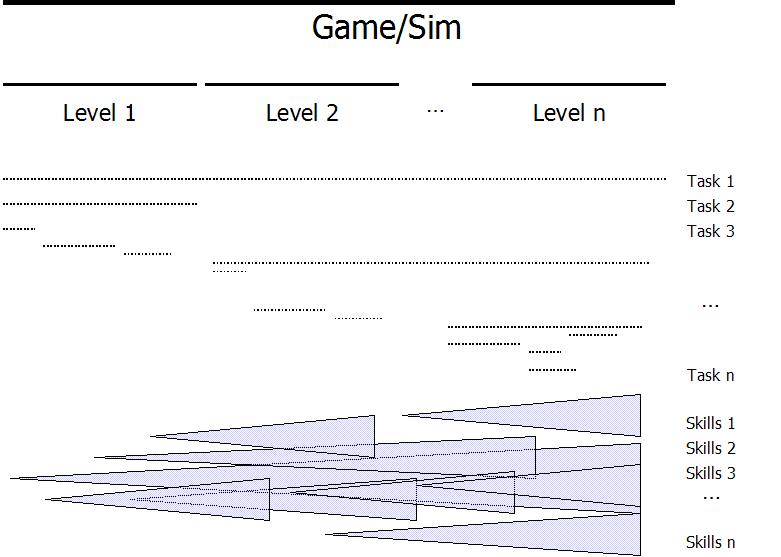
When one first looks at any good game/sim, one first looks at the flavor, the theme. One might look at what the levels are, or what the tasks/quests are that challenge people to accomplish something.

But what is really being developed are underlying skills.

The skills should be developed carefully, one or a few at a time. Then increasingly mixed and matched, allowing effortless use and improvisation.

Sims, unlike their cousins role-plays for example, are interesting because they can uniquely fill this need to allow for systematic skill building through repeated practice in a controlled environment. This subliminity of practice is a sine que non of developing skills, both big and small.

You don't have to use simulations, of course. But if you don't have practice built in, nine times out of ten, your program will be wasting everyone's time.

SimWord of the Day: Failure

Nothing is more boring than playing a computer game "perfectly," i.e. never failing.

There are big failures, that can only be recovered using a "start-over" or "load game" option, and little failure, that require small a series of small corrections.

Game designers need to spend a whole lot of time thinking about failure. What are different types of failures? What do they look like? How can one learn from them?

Most training people, meanwhile, focus on one brittle path to success. Focusing just on success is faster, after all. One can cover more ground. It is easier and more "positive" as well. Failures are harder to research as well, as most SME's from sales people to engineers, hate thinking about and dwelling on failure.

Ironically, of course, is that by sticking to the brittle path of success, so many training programs fail to achieve real behavioral transformation.

Monday, May 22

Pushing PowerPoint

(once again, this is a response to DC's post below, but I still don't know how to put pictures in a response)

I used to joke that PowerPoint was great if you only had ten minutes to put together a two hour presentation.

However just because you can be simple in PPT, doesn't mean you have to.

Moreover, homework and reports should be visual as often (if not more) than a stream of text. Visual work is often more rigorous, more succint, more complete, more challenging to authors, and better able to present interesting systems/relationships. I even hope visual content creators will think in terms of situational awareness and available options, whether for a historical figure or a potential customer.

Here are some more dense charts I have created (and I apologize for the repeats for long terms readers of the blog).

And techincally, I have found that PowerPoint is a very good authoring environment for producing charts that, as long as there are no pictures, are small (in size) when embedded in Word, and looks great when converted to a pdf.

Sunday, May 21

Clicking early with PowerPoint


While some in business see Powerpoint as a powerful presentation tool, and others see it as a crutch that reduces the analytical quality of presentations, schools see it as a learning tool when the students create them:

Teachers say the PowerPoint presentations are superior to the old-fashioned report in many ways. The assignments help students learn to synthesize large amounts of information into a clear, concise format; bring people, places, and ideas to life with pictures and sounds; and spark students’ interest and creativity. - full Boston Globe article here.

What do you think?

Monday, May 15

Building an Internal Simulation Capacity

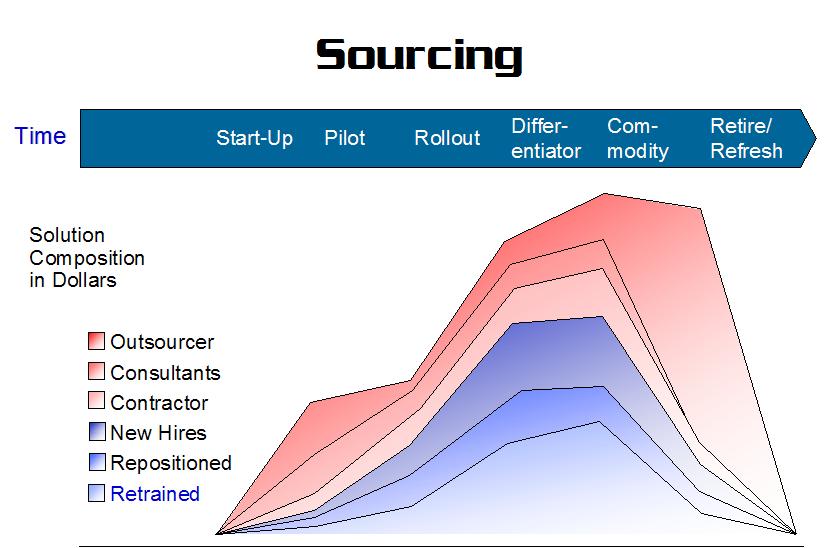
Organization that want to build an internal simulation deployment capability should first learn from the best practices of other departments developing new competencies:

Developing New Organizational Competencies, 101

New projects often require skills that do not exist within a business unit, creating a gap that needs to be filled across the project’s life. To produce the right portfolio of skills over the life of the project, managers have to juggle between:

  • outsourcers,
  • consultants,
  • contractors,
  • new hires,
  • repositioned employees, and
  • retrained employees.

Some organizations have outsourced everything, a strategy that gave them the immediate ability to compete, but ultimately was too expensive and rigid. Other companies have tried to develop the capacity from within, only to find that it took too long and the window off opportunity passed.

Many leading organizations have taken a hybrid path. They have begun with bringing in outside experts in different capacities and jumped start the process. While the project was being designed, they also began a parallel track of building an internal capacity, through training and hiring and shadowing. At some inflection point, the responsibility is shifted from external to internal.

Now, Simulations

With that as a bit of background, here are the skills an organization will need to develop, in order.

acquisition

- The best simulations will be bought "off-the-shelf" and mildly, if at all, customized.
In some academic environments, commercial off the shelf (COTS) computer games will better meet a need than any educational simulation. Evaluation criteria include: learning objectives, cost, ease of deployment.

measuring/evaluating situations

- Measuring the effectivness of sims is critical to growing and perpetuating any program.

project management

- Deploying and scheduling sims is a bit of work, although should be less impactful than scheduling a physical class.

coach/facilitator

- Coaches add pedagogy and motivation.

planning, strategic

- Where to use sims is a critical , but it is an issue that can only be fully understood after a few real simulation deployments.

- Build versus buy is a critical long term issue, although most organizations will want to leverage vendor experience initially.

web, creating

- An organiation should have people with a basic knowledge of HTML/CSS

Director and Flash, using

- Flash remains the first programming skill to need.

dedicated tool, branching story

- Scenariation

- Moodle

dedicated tool, game based model

- authoring environments

dedicated tool, interactive spreadsheet

dedicated tool, virtual lab

- But most people use the more general Director and Flash.

database, programming

- Data management/manipulation, from database (e.g. mySQL) to even manipulation of batches of number in Excel

languages programming

- Organizations need people with some sort of programming and scripting to generate interactivity. anywhere from JavaScript to ActionScript/Lingo to PHP/ASP

images, manipulating

- PhotoShop/PaintShopPro

sound, editing

- Audacity

developer, simulation/game

- game engines

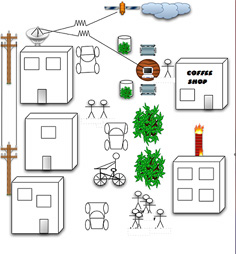
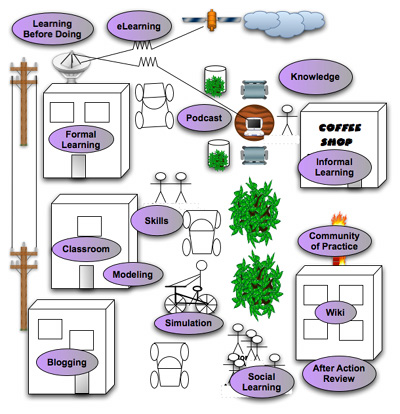
Pensare's Vision of Knowledge Communities


This is a contribution to Donald Clark's post; I just am not sure how to upload pictures in a response.

Readers of Simulations and the Future of Learning will recognize this picture, from a now-defunct e-learning company called Pensare. (I think this picture was done in 1998).

I always loved how sweeping and ambitious it was. I would strongly encourage any reader to click on it and really look around. In fact, make a poster of it and hang it on your wall!

Sunday, May 14

From Training Departments to Learning Woonerfs


Woonerf is the Dutch name for a "living street" in which the needs of car drivers are secondary to the needs of users of the street as a whole. It is a "shared space" designed to be used by pedestrians, playing children, bicyclists, and low-speed motor vehicles, becoming a public place for people instead of single-purpose conduits for automobiles. In a woonerf, vehicles may not impede pedestrians, who in turn may not unreasonably hinder the progress of drivers.

This "self-reading street" has its roots in design principles that emerged in the 1970s. By dynamically blurring the boundary between the street and sidewalks, woonerfs combine innovative paving, landscaping and other urban designs to allow for the integration of multiple functions in a single street -- the neighborhood shares the road with slow-moving cars. This two-way interaction of people and cars becomes a virtuous circle as the busier the streets are, the safer they become; it seems that when you drive people off the street, that they become less safe.


Good design gives spaces multiple functions, thus training departments that serve a single or limited set of functions, hinder the organization through their wasted spaces. By linking the full gamut of learning processes into a "Learning Woonerf," the organization evolves from a linear learning function into a dynamic uninterrupted slew of learning connections. Thus, unlike a training department, which normally consists of a single space for training, a learning woonerf accounts for all the learning processes, from informal to formal -- the organization truly becomes a "learning organization" rather than just an organization that simply does training.

Saturday, May 13

The act of interacting: is it interactivity and/or interaction?

Historians of technology assisted learning -- if such people exist -- should by now have noticed that there have always been two alternating and possibly opposed trends. (I say possibly because I believe they can be reconciled, but I can see that the tendency to align with one side or the other in the aim of promoting a simple, saleable solution is as strong in the "learning industry" as it is in politics).

I call these two contrasting (and potentially converging) trends interactivity and interaction. Apparently the general idea of interacting has convinced everyone that that's what technology is all about. That's where we expect our payback for supporting and investing in technology. But what does interacting mean? To answer that question we have to ask another question: "who is interacting with whom or with what"?. Beyond that (i.e. at the heart of everything) are the whys and wherefores, long before the how. The fact that no one seems willing or able to formulate clearly why we learn or why we should learn may explain some of the confusion.

Depending on how you answer the question "interacting with whom or with what?", you are likely to align yourself either with the humanists (salvation will come from dialogue, social learning, facilitated by flexible user-friendly networks) or the technologists (salvation can be found in computing power: expert systems, realistic graphics, animation and simulations). It's possible to embrace both, of course, but the trend is to opt for one or the other. Personally I give priority to the humanist side, considering everything else to be a flipchart, an immensely valuable instrument that can provide specific services in the interest of improving and refining interaction. Giving priority is not choosing one against the other: it is simply taking a first step towards recognizing the importance of why rather than deciding in favor of one with whom or another. And priority should be determined by finality not by personal preference.

Technological innovation in interactivity has driven the marketplace over the past 30 years, laregely on the basis of
1) fascination with technology in the press and general public
2) the visibility and marketability of finished products as compared to the unmarketable nature of processes to be learned, acquired, spread and applied by groups of people.

Can the two worlds converge? The promise of the Web 2.0 seems to indicate yes, as we move away from a product and broadcast based model to one of dynamic networks that includes all forms of innovation. It's similar to moving from a Ptolomaic (mechanically organized) to a Newtonian universe (organized around gravitional cores, to borrow Tim O'Reilly's notion), while waiting for some future Einsteinian revolution (where gravity is still the fundamental force but where we all become relatives in the same family!). Ptolomy's planets and stars are still there to be observed as units, but they are no longer confined to their set spheres. Morevover, in a gravitational universe, we finally recognize their own principle of power and influence (gravitational force) rather than seeing them as simple objects placed in a set position in a stable and totally repetitive machine.

The real hope of interacting -- at least for those who see the finality as dynamic and evolutionary -- is to escape the logic of pure repetition that is so pleasing to both the representatives of the establishment, where the function of instructing is more important than the reality of learning, and to the marketing people who want you to believe that using their product will solve all your problems.

I believe the next couple of years will bring about some serious changes. A lot has already been accomplished, but below the level of most people's radar. Some things are now coming to light that will change our vision of the relationship between interaction and interactivity.

More news on this in July!

SimWord of the Day: Boss

In some games, at the end of a level, in order to progress to the next level, the player has to accomplish a significantly more difficult challenge. This might include solving a complex puzzle, defeating a large number of "normal" opposing units, and/or one or more very powerful opposing units. These more powerful end-of-level units, sometimes actually physically larger, are called bosses. The most powerful boss is at the end of the last level of the game.

These bosses may also have significance in the story, such as being a recurring antagonist; thus their defeat moves the story along as well.

Bosses can cause significant frustration if they are too difficult, and almost a letdown if they are too easy. These bosses are primarily a game element, but they also require a player to demonstrate a certain level of competency that will be necessary for subsequent levels.

So to sum it up, final exams are horrible and tension inducing, and bosses are exciting and satisfying. Go figure.

Thursday, May 11

Aldrich Loops?

I would like to thank Thiagi for allowing me to steal credit from such unknowns as Escher, Godel, and Bach, by dubbing a version of the infinite loop as an Aldrich loop.

And to think, it all started at the Learning Circuits Blog.

Monday, May 8

SimWord of the Day: Full Motion Video

Full Motion Video (FMV) is a series of pictures shown in rapid succession to simulate coherent movement. It can also include an audio track. FMV can be live video, animated, or a combination. They can also have text superimposed.

Full Motion Video can stand-alone, such as in a movie or television, or can be included as a cut scene in a computer game or educational simulation.

FMVs, when used in a computer game or educational simulation, are pre-scripted and often pre-rendered, represent a situation where the player looses all control except to possibly skip the scene, and are usually triggered to:

  • introduce the entire program,
  • introduce a scene or mission,
  • give the player key information regarding the story or their mission,
  • introduce a sub mission in the middle of a larger mission,
  • show the resolution of a sub mission in a larger mission, or
  • show the end of a mission (where there may be multiple cut scenes, with the one chosen depending on the success or failure of the player).
Full Motion Videos are judged by their production and artistic quality, sim, game, or pedagogical success, their frames per second, and their resolution. Usually, the FMV is of higher quality than the fully interactive portions. If the same game engine is used to render the cut-scene as the full game, and the cut-scene happens in the middle of a mission, black bars conventionally appear at the top and bottom of the screen to give a letterbox, wide-screen appearence, to differentiate it.

Where there is interactivity in full motion video, it is primarily limited around multiple choice decisions, although sometimes in finding a hot spot on the screen, such as which of multiple people to choose or buttons to push. This interactivity can either launch more FMV, or change a condition in the mission.

Some genres, such as interactive stories, are almost completely FMV.

Saturday, May 6

SimWord of the Day: Avatar, Player's

In many games including massively multiplayer, the player is represented with a "physical" presence in the game world or play space. The presence is called an avatar, and it can be the form of an abstracted person, vehicle, animal, or even a completely abstract token.


The avatar is often the hero of a story that provides context and motivation for specific tasks/quests.

The location of the avatar on a map or the relationship to another unit can activate a context specific trigger, such as the sound of traffic if the avatar is near a road, or a context specific menu, such as the opportunity to talk if the avatar is near another character, or even use a copier if the avatar is near a copier. Often the object of a game is to get the avatar to certain key locations.

The perspective of the camera in a virtual world often is governed by the position of the player's avatar, either looking through the eyes of the avatar (first person), or "over-the shoulder" (third person). Being able to see your avatar during the course of the simulation enables more complex actions, and also creates a stronger sense of character.

The avatar can be customized in many ways. The look of the avatar can be customized as game element to add levels of "buy-in." This includes changing wardrobe, face, even importing a photograph.

The avatar has certain abilities, such as speed, health, and persuasiveness. The abilities of the avatar can often be increased or decreased, either permanently or temporarily, through various activities including found power-ups and the accomplishment of certain quests. In role-playing frameworks, the player might have choices in terms of development opportunities, such as between increasing sales skills or technical skills.

The avatar might also have a limited or unlimited inventory, granting further capabilities.

Avatars can also represent a person in a chat room or other communities model.

In many tycoon games, god games, and strategy games, the player is not represented by an avatar.

SimWord of the Day: Asynchronous Learning

Asynchronous is a form of communication that is turn-based, not real-time. Letters and emails are asynchronous while phone calls and instant messenger chats are synchronous.

Originally, asynchronous learning referred to a style of formal learning where the student and instructor has regular interactions, but the interactions were separated by delays of hours, days, weeks, or months. Most early post-office based distance correspondence courses followed this model.

This "instructor supported" asynchronous learning is still used today, although technology has reduced the "turn-around" time for an instructor response more towards minutes, hours and days, rather than weeks or months.

Increasingly, asynchronous also means a type of learning that is self-paced. The subject matter expert, instructional designer, and technical designer create the content, such as a paper or web based workbooks or videos; the end-learner consumes the content, even completes quizzes, without tailored feedback from another human.

Friday, May 5

Simword of the Day: Directing 'Bots

In educational simulations in the future, end-learners will be working with other, computer-controlled people ('bots). And part of the success will be in doing that well.

But how to work with 'bots is non obvious. When real humans are involved, you can just talk to them, either via typing or voice. This is OK, but has some of the problems of a role play, the biggest being that you can't practice over and over again. After one or two plays, the group gets into ruts. Completely open-ended interfaces also spiral out of control, most likely abdicating the intructional opportunity and responsibility of a sim to another layer of pedagogy.

Branching stories, an educational simulation genre, has their place, which enables exploration but prohibit practicing by being fixed, rather than dynamic.

So it is useful to look at some of the ways that computer games deal with the issue of directing bots in a dynamic environment. In those First Person Shooters, a player literally just points to a place and click on the "go there" button. The bot will defend or attack from that spot until dead. The only other option a player might have is "follow me," to alter either the previous "stay in that spot" command or the AI default behavior of shooting bad guys. (Here is an example from Half-Life 2).


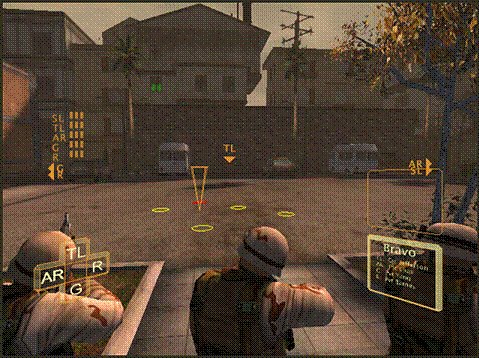
Some squab-based shooters, like this example from Star Wars: Republic Commando, are similar, but you can ask your squad to do more complex moves. Same with Full Spectrum Warrior.

The Star Trek game Bridge Commander presents the player with dozens of possible commands to give his or her crew at any time, organized by the different crew members. The commands can be highly specific, or they can be high level enough to let the AI do at least some planning on their own.

In Sid Meier's turn-based strategy game Alpha Centauri, the player can ask the AI to take control over many different functions, including base management. But the player can also tell the AI of any given unit or base on what to prioritize: exploring, discovering, building, or conquering. A player might prioritize "building" on bases near the center of their empire, and "conquering" on the bases near hostile empires.

In all of these models, however, the player has absolute control over their 'bots. Because that is seldom the case, even with direct reports (except in parts of the military), I find the interfaces that deal with more realistic and complex inter-personals to be more useful and even predictive.

Sid Meier's turn based Civilization IV requires that you negotiate with other leaders. You might make a transaction trade, where you have to figure out what is a good trade, but you also have to manage a long term relationship based on past favors and even aligned goals, such as religion and domestic agenda.

Virtual Leader, in dynamic real-time, focuses on both interpersonal and idea based "moves" to shape a conceptual map of possibilities and commitments.

Finally, in "The Sims," in both building relationships and now sales, players indirectly control bots by buying and placing objects to meet their needs, and creating opportunities to build common bonds.
Ultimately, the opportunity of the interface is to shape how an end-learner looks at his or her strategic options in a situation. This is more true, and in some cases, more controversial, when dealing with characters rather than learning how to drive a car.

As with the previously mentioned ownership and rules, directing bots will become increasingly explored and then standardized as educational simulation genres are developed and refined.

Wednesday, May 3

Firing Students

When should instructors fire students (ask students to no longer participate)?

This is a more challenging issue in the corporate and government world, where training is more thought as a service, or a requirement, than the academic.

This gets more interesting when simulations are introduced, and there is real work required from a student, not just showing up. Courses can also be several sessions, not just one.

Some people view percentage who finish the course as a critical metric. And any pure e-learning course never automatically jettisons a student.

But if students weakly approach a course, they go through the motions but don't push, then that messes up any ROI and evaluations. The passive students also can become the biggest critics, resolving their own dissonance by lowering the view of the course instead of raising their own expectation for growth.

Tuesday, May 2

Doing and/or non-doing, formal and/or informal

First, thanks to all for the various takes on my very pragmatic but apparently provocative question. The simple answer appears to be that there's no available or known research on this topic! I hope there's more to come on the general question raised by Clark and would love to see Jay taken up on the offer of a public debate (more on that below).

When Jay mentioned that informal learning is, in some sense, going back to basics ("the natural way"), I couldn't help thinking of Aristotle (even more than Socrates) who conducted learning “peripatetically”, i.e. by walking around and letting both his thoughts and the discussion grow and flow. Apparently, he also did a few "wandering" lectures (most of his extant writings appear to be the result of students’ notes on his lectures) but his school was known for moving and grooving. This is certainly a way of building doing into formal learning while at the same time specifically recognizing the value of informality. I would suggest that we would be wise not to be satisfied by simple opposites, such as studying or listening vs. doing, or formal vs. informal, but reflect on how these opposites are complementary and may, with a bit of judicious encouragement and clever organization, in some way blend (could this be the key to a new definition of blended learning?).

On the question of learning by doing, it might be useful to expand our cultural horizon by introducing a nuance in the form of an apparent opposite: the Taoist concept wu wei or “non-doing”. Ted Kardash elucidates it as follows:
Wu-wei refers to behavior that arises from a sense of oneself as connected to others and to one's environment. It is not motivated by a sense of separateness. It is action that is spontaneous and effortless. At the same time it is not to be considered inertia, laziness, or mere passivity. Rather, it is the experience of going with the grain or swimming with the current. Our contemporary expression, "going with the flow," is a direct expression of this fundamental Taoist principle, which in its most basic form refers to behavior occurring in response to the flow of the Tao.
Even if we all agree that learning by doing is better than learning by listening to an authority, I would suggest that we need to think about how to integrate non-doing (an active, not a passive concept) into our learning strategies. That may even be one of the keys to understanding the meaning and processes of informal learning.

In a recent book by Andrea Nightengale, Spectacles of Truth in Classical Greek Philosophy we learn that the origin of our all too familiar word theory, which our civilization has turned into a synonym for abstraction (and more recently, a highly pretentious form of abstract criticism) comes from Greek “theoroi” which originally meant “spectators” and implied active involvement (eye-witnessing) in games, including the notion of actually going to the games and interpreting them within a social context. A far cry from the way we use the term today. It’s true that Plato and Aristotle used the idea of participating in events, observing action and reporting on it as a model for contemplative study, which they subsequently called theoria. But the theoria they proposed implied a kind of communion with real physical events (Nightingale calls it “sacralized spectating”). Possibly a Greek version of wu wei.

So what’s the point of all this? I’m suggesting that we may have a tendency to paint ourselves into linguistically and culturally determined corners that restrict our reflection on the very problems we all recognize. Perhaps we need a bit of lateral thinking rather than head-on debate, or rather, we need both, as they are the yin and yang of inquiry. Instead of looking for a winner between polar opposites let’s try to see what both doing and non-doing accomplish and how formal and informal complement each other. Is that beyond our powers?

My final point: we still seem to assume that learning means assimilating or appropriating and its end product is possession, which reflects a highly individualistic view of learning and neglects both its social dimension and that part of knowledge that exists below the threshold of immediate and measurable awareness. While these metaphorical notions have value in describing aspects of the process, I'd suggest that we make a special effort to bear in mind that they are only metaphors and can only do part of the job. Wu wei and theoria are two examples of culturally unfamiliar notions that may help us to achieve a deeper level of nuance.

What is informal learning, anyway?

First, more importantly, if anyone has a comment on research regarding the effectiveness of informal learning, please attach it to Peter Isackson's comment below.

For me, the question is still, what is informal learning? For the sake of effectiveness and clarity, let's have those two conversations in parallel.

For a bit of context, and also to keep this from getting personal, I would also like to quote what I wrote in "Learning By Doing," about early, pre-hype stages of any new technology, or re-launches of "re-discovered" approaches (just to make sure we steer clear of these traps):

Theory:Wouldn’t It Be Great?
New ideas first tend to bubble up in academic papers, magazine columns, blogs, or conference panels. Those who introduce the emergent idea are very detailed in critique of the last generation, very vague in their descriptions of what the actual solution would look like, and very enthusiastic about the promises of what the technology will accomplish.
A lot of history analogies are brought in (we all get to learn about Dutch shipping patterns or the advent of the abacus), as well as out-of context quotes. There is often some graph of how large something is (dot-com companies loved showing how fast Internet access was growing as a justification for their own business model), no matter how indirectly related. The technology, if there is any, tends to be described in a pure environment, one without legacy systems.
As far as the theory goes, it sounds good. And almost all who hear this new theory nod and think, “This makes a lot of sense. This could be big.” But there are no examples of it working the way it is described. At best there are precursors that are “sort of” similar. Or a wild success in a different industry is held up as a model.


So, with that "dead elephant" out of the way, what is informal learning, anyway? I grant you that 95% (or some other, huge, made-up number) of learning happens outside of formal learning. The "largeness" of that number (like the dot-coms referring to the largeness of the Internet) does not a case make, as plenty of knowledge management vendors can attest.

And much more specifically, unless you work at Google or an IM vendor, what is your "value add" to it?

The evolving culture of informal learning

I'm currently preparing a project for European funding aiming at the development of communities of practice as a structured way of fostering and deepening transfer and sharing of skills, knowledge and competency. Thanks to Jay Cross and others, we know that informal learning is ultimately much more productive of lasting effects than traditional formal learning, whether it be face to face, distance tutoring or the self-access variety of e-learning. (Should simulation be dealt with as a separate category? Clark and others will no doubt have an opinion, but that isn't really what concerns me today).

Communities of practice are part of the response to the need to encourage informal learning and perpetuate its results. But even before any formal organization of this type is undertaken, it occurs to me that the actual amount of informal learning has increased significantly over the past few years, though in a completely unstructured and anarchic way, thanks to the culture of the Web: discussion groups, blogs, etc. as well as the recently acquired habit for many people of googling.

Which leads me to pose a question to everyone involved in these things: are there any studies or reports indicating a recent increase in informal learning attributable to the culture of the Web? It's clear to me that the kinds of newly acquired habits we can see all around us in the use of the Internet must necessarily increase the opportunities for informal learning, but has their been any kind of identifiable trend or measurable effect that can be accounted for?

All contributions to this debate are welcome (and will help me build my arguments for our project, for which I thank you in advance).

SimWord of the Day: Rules

We talked about ownership as being a concept that will eventually be as ubiquitously interpreted and applied in future educational simulations as guns and vehicles are in today's computer games.

Another building concept that educational simulations will necessarily have to deal with are rules.

Games are based on rules. Rules in games can be learned and even exploited, but not really broken.

In real life, and in educational simulations, rules will take on a different role. There will still be hard rules, rules that cannot be broken. Gravity comes to mind.

But there will also be soft rules, like around speeding, or copyright protection, or ethics, or sexual harassment. The challenges can be two fold.
  • If you are a grunt, you will have to decide when to break these rules, and what to do to prevent getting caught. This might be loosely akin to so-called "First Person Sneakers" like Thief, when players work hard to not get caught breaking in or out of a guarded building.
  • If you are a manager or a team mate, however, than perhaps the challenge will be when to interrupt a well-running process in order to enforce rules. This is never easy.

There are also meta-rules. Part of the sim experience will be when to actually change the rules.

  • This might be challenging the primary variables against which you are evaluated.
  • This might be destabilizing an entire industry, rendering old metrics obsolete (or at least trying to).
  • This might be realizing there are better predictors of success than what is tracked currently by the on-screen display.

Like so many of these simwords, I hope what makes them so interesting is that the concepts seem critical when looking at any real knowledge, but falls through the cracks when looking at lecture/paper models of capturing and nurturing.

Sunday, April 30

SimWord of the Day: Coach

Unlike, say, in branching stories, more dynamic simulations, from interactive spreadsheets to practiceware, need live coaches. Coaches are critical members of any simulation community, and of any sim deployment, and both technology and process must be built to support them.

Coaches can be co-located or remote, synchronous or asynchronous.

At least three factors drive the need for coaches
  • The divergence of the learning (increase need for coaching)
  • The importance that the learning actually occurs (increase need)
  • How well designed the sim is (decrease need)

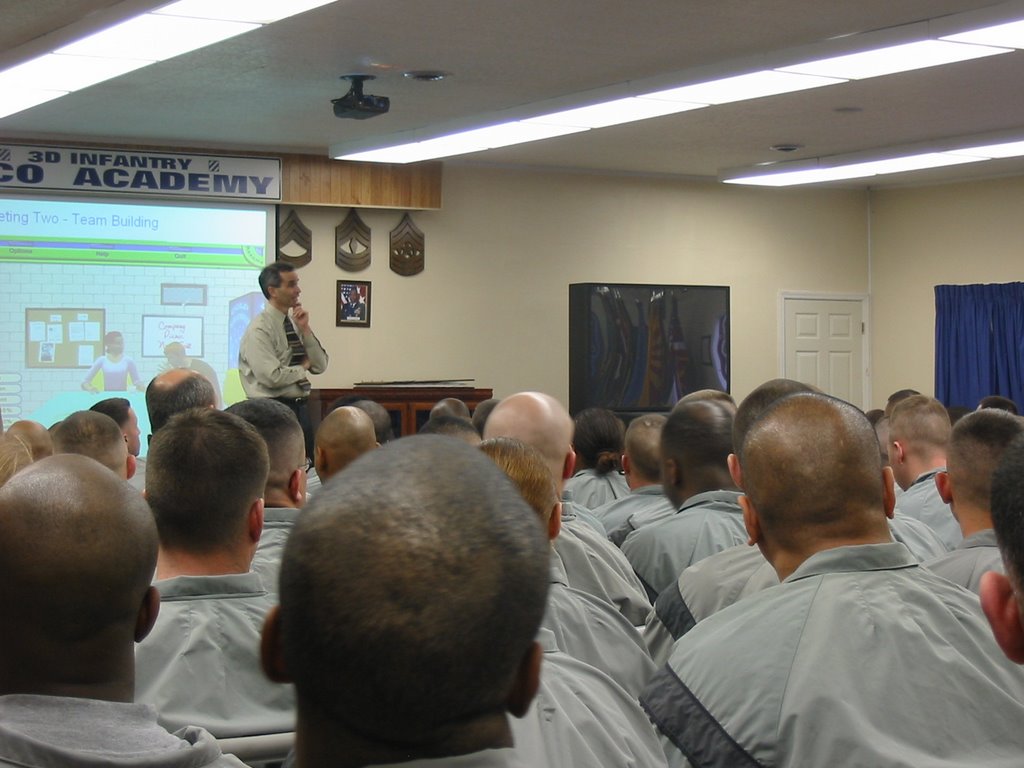
SimuLearn has two master-level coaches, Graham Courtney and Tom Parkinson (Tom seen here with an US Army group). Their mantra is: "Our role is 99% to motivate. Let the simulation do the teaching." This is really hard for so many people with training backgrounds, who are, by necessity, control freaks.

Coaches can give specific assignments, break students into teams, ask students to redo, or skip ahead. They can run facilitated group sessions. They can sometimes explain parts of the simulation. They can make issues more specific (many of our coaches review 360 data before students begin taking the simulations). They can do live After Action Reviews or review uploaded or submitted AAR data hours or days later. And they can still grade.

Preparing coaches requires a facilitator's guide and even a train the trainer program, all typically part of the simulation deliverable.

This role, from being a traditional instructor to be a coach, has often been talked about. But simulations provide a transition strategy for instructors to leverage many of their traditional skills to increase their own value considerably to end-learners.

Friday, April 28

First Batch of SimWords in ASTD Article

ASTD's Ryann Ellis has organized the first batch of SimWords in this here Glossary. Enjoy!

Thursday, April 27

SimWord of the Day: The Sim Experience

"Mother Nature/Experience is the worst teacher because it gives you the test before the lesson." - attributed to multiple sources

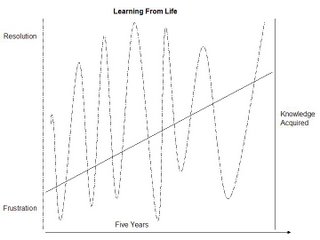
Learning anything in real life, especially big skills like ethics and relationship management, but also learning how to speak a foreign language, is filled with frustration (and resolution). It is uneven, with moments where you want to give up and moments of exaltation.


Simulations do not smooth out the peaks and valleys (or perhaps, but only minimally), as much as compress them and make them more predictable.

The valleys present a bit of problem, however, not in the learning (where they are critical), but in the expectation of the sim experience.
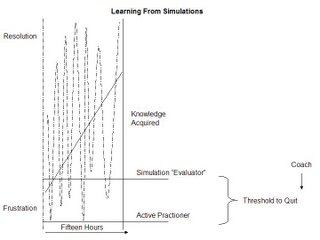
There is a "threshold to quit" for different end-learners, that if the experience dips below the threshold, the learner will opt out of the course with a negative bias.

Factors that raise the threshold, making it more likely a student quits include:

  • The student is "evaluating" or "surveying" the material.
  • The program has little support.
  • Poorly set expectations for the sim experience.

Factors that lower the threshold, making it less likely a student quits include:

  • A live coach
  • The students understand that they really need the content
  • The program has a lot of credibility.
  • The students are being graded in an academic setting or ordered to take it in a military setting.

SimWord of the Day: Shopping

Shopping can be used in many ways as game elements, something to motivate the user beyond the intrinsic learning.

A shopping environment can be a fun and familiar environment in which any activity can be placed, from learning math skills (the lower tension of the environment softens the higher tension of having to learn an unfamiliar skill) to an ironic zombie frag fest (a la George Romero’s satire Dawn of the Dead.)

Earning virtual money is a great motivation in and of itself. It becomes slightly more powerful when there is a high score list, either private or public.

But shopping can also have a more direct game-play element.

Shopping can lead to buying better equipment to make subsequent levels easier, bringing simulation elements in that mirror real life and real decisions. (Buying Better Equipment in EA’s Tiger Wood PGA Tour 06)

And increasingly, buying things can just be for fun and status. Ever since players could buy a giant plasma television in The Sims, the floodgates have opened. Today, walking onto a virtual multiplayer golf course with thousand dollar sunglasses sends a message to the other golfers as to your status, even if it does not help your game directly.

Wednesday, April 26

SimWord of the Day: Ownership

Seven years from now, when we look back at educational simulations, we will see quite a few themes that are used and adapted across multiple examples and even genres, just as much as weapons and vehicles have proliferated in computer games.

One such theme that will be used, and ultimately standardized in its depiction, will be ownership.

There are so many flavors of ownership across enterprises.

Just to rattle of a few:
  • Ownership of clients
  • Ownership of ideas
  • Ownership of team
  • Ownership of employees
  • Ownership of a cell phone
  • Ownership of managers
  • Ownership of projects
  • Ownership of territories
  • Ownership of ownership of organizations
  • Ownership of company
  • Ownership of deliverable
  • Ownership of your own time

I know the concept of ownership will proliferate in educational simulations because:

  • Ownership require finesses. If you have too much ownership, you loose support and buy-in, and you may define the opportunity too narrowly. But if you have too little ownership, you loose control and accountability.
  • Ownership is a classic "fourth paradox" skill, easy to describe and challenging to appropriately apply.
  • Ownership of something with actuator properties involves trade-offs and benefits
  • Ownership often requires indirect influence, something that works well for simulations.
  • The nuance of ownership is not handled in traditional formal learning programs, in part because it can't.
  • Ownership can also be depicted graphically nicely, even if real-life isn't so clean.
  • And finally, the notions of both increasing and decreasing ownership is critical in all big skills.

George Orwell wrote about how not having a word limits one's ability to think about the topic. Ownership today might be an unskill, a concept that we can't get a handle on because the definitions are so vague and we apply them so irregularly as to seldom learn to master them. Hopefully, that will change.

SimWord of the Day: Technology: Frames per Second

Frames per Second (FPS), also called “frame rate,” is the number of still, distinct images displayed per second to trick our eyes into believing objects are moving.

It is a metric of fluidity.

A normal television show in the States (NTSC TV) is broadcast at 30 FPS (frames per second). PAL TV is 25 FPS. Movies are shown at 24 FPS.

20 FPS are considered by many to be the minimum to trick the eye, and is the minimum to enable the simualtion genre known as practiceware.

Higher frame rates (like 60 FPS) results in more appealing animation, and some console games sacrifice other elements to maintain this level. Fewer FPS are the results of system limitations, poor programming, other applications consuming system resources (such as AI), and detail of image, including screen resolution and complexity of objects, and lighting.

Tuesday, April 25

SimWord of the Day: Easter Egg

In interactive media, such as a computer game or DVD, an Easter egg is a piece of bonus content that is in someway “hidden,” and yet still accessible by a user. The content can be a message, a hidden level, even designer art. The Easter egg is initially found by accident by a causal user or deliberately by a determined user through entering certain key codes or going to obscure places on a map, and then made public on a chat room or forum. Easter eggs were originally the work of programmers trying to sneak content into the finished product under the radar of the publisher; they are now included deliberately as an extra “game” activity to build the user community.

Saturday, April 22

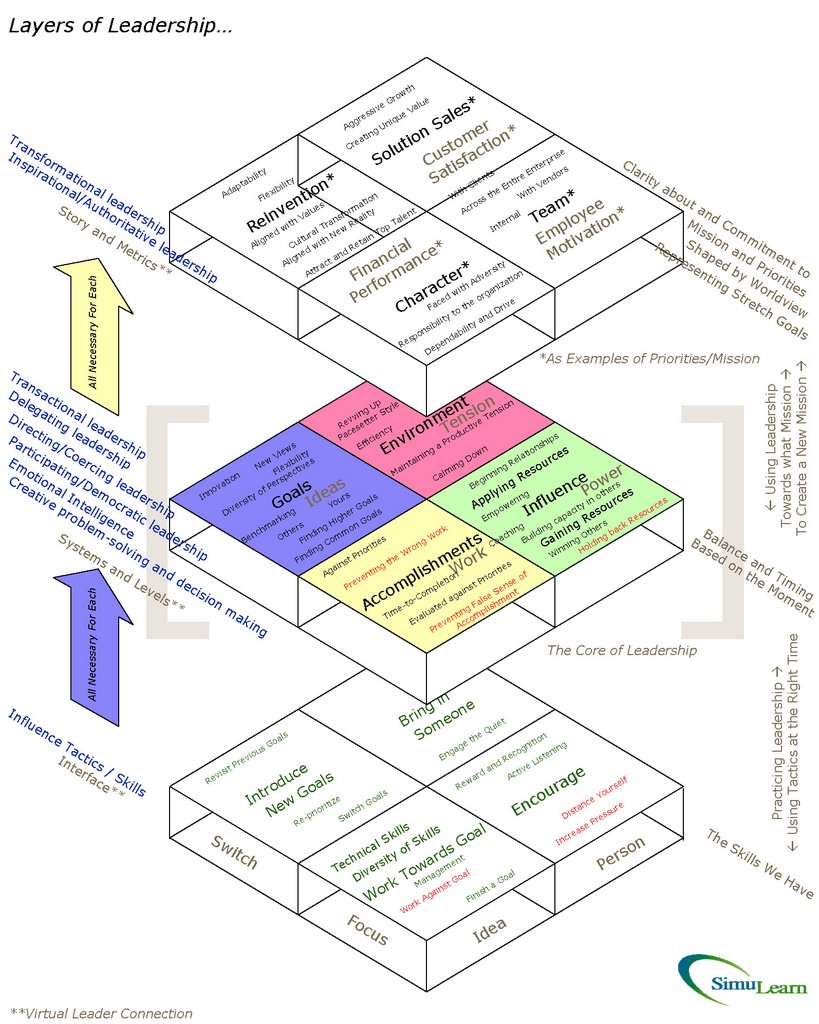
How do you teach leadership? And what is it?

Perhaps the most important "Big Skill" is leadership.

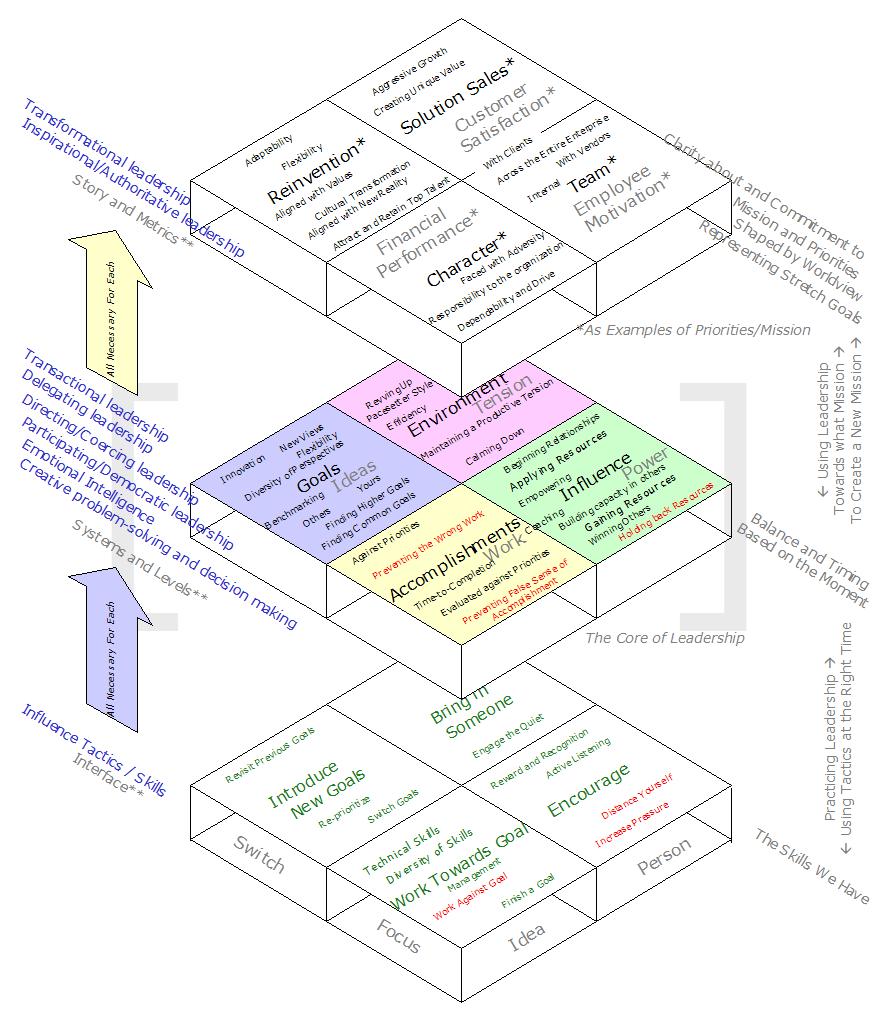
It certainly is the Big Skill to which I have put the most personal research, captured in the below diagram from page 9 0f this Learning Circuits article (email me if you want a copy of the chart as a nice powerpoint slide, quite small filesize-wise, and where everything is actually readable).

Leadership is the ability to get people to do the right work. Leadership connects actions to results, and sometimes even changes the metrics of success.

The challenge of over-simplifying leadership can be summarized in this typical example.

Many organizations in their leadership mission say they value innovation. But do they mean/measure/reward:

  • Individuals coming up with a new idea?
  • Groups creating an atmosphere where new ideas, even bad new ideas, are activly sought and met with serious consideration?
  • Groups actually implementing new ways of doing things?
  • Groups actively sacrificing some level of optimal short term productivity for the sake of innovation?

How does your organization teach/nurture/identify leadership? And how does it define it?

By the way, this past post has a chart that shows how I believe most organizations roll out leadership training, and perhaps most Big Skills.

Friday, April 21

Stories: bad for your mental health?

The pairing of frustration and resolution is at the heart of, well, probably everything to do with life and growth.

But if you look at two example, frustration/resolution in passive stories and frustration/resolution in simulations, you can see why, as I mulled earlier, that stories might be the new white bread, making us feel smarter by tricking us, rather than actually increasing our capacity, leaving us just bloated instead.

In creating a passive story, it is fairly easy to set up a good frustration/resolution pairing.
  • Shark attacks swimmer.
  • Physically attractive ex-girlfriend/boyfriend re-emerges after 10 years with a dark secret.
  • The instructions for a better life/how to avoid a major problem are to follow.

In all of these, whether it be a novel, a movie, or the evening news, we just have to sit back and consume more, and we will get the resolution. Mmmmm. It feels so satisfying, for a few moments. But we are instantly hungry again, and the right masters of the medium will once again tantalize us with another frustration/resolution pairing (or have three or four recursive pairing going on at once, so while we are told the resolution of a more specific paring, we still have the bigger one to resolve).

In an educational simulation, much like a computer game, and of course in learning to ride a bike, swim, speak a foreign language, close a big deal, make a customer happy, or build something, that frustration-resolution can not be closed by passively consuming more. The frustration can only (and not even all of the time) be resolved by actively doing something.

Passive stories are thought to be crowning achievements of our civilization: books, movies, magazine, and most of our school system. We all have intense, positive relationships with at least a few examples of each.

But like white bread and refined sugar, they may just be tricking our minds into addiction, actually reducing our ability to act, not increasing it. And maybe, just maybe, the manifest destiny of our profession is to help people overcome this addiction, not feed it.

(By the way, just because computer games involve active frusteration-resolution, doesn't mean they are not a) self-referential and b) addictive. They hint at solutions, rather than represent them).

(And yes, we have all read books or seen movies that have shaped our lives.)

Thursday, April 20

If you have been in the training industry for more than 3 years, don't bother reading this

I have given my share of speeches on simulation in the last six months. And I have come to a casual observation. It is the people who have been in the training profession for less than three years that actually make simulations happen in their organization.

This is not an age thing. There are plenty of people representing all different ages that are moving ahead. This is not a male-female thing.

The "newcomers" are excited to drive results. They think in terms of weeks and maybe months of making things happen, not months and years. They care about driving results now, and take a few personal risks when the pay-off is significant. They are not interested in proving to me, the sim guy, how smart they are. They are not trying to score intellectual points with their peers. They do not mistake cynicism for wisdom, nor are they process-centric out of the hope that the process will keep them from having to act. They instead want me to make the case, are tough, fair, and then they really want to move ahead. They are problem solvers, not problem creators.

I hope that randomness has placed so many "new-to-training" people who can't wait to act in front of me, and kept away all of the people with a long training background who know how to get things done. But boy, please, someone, prove me wrong!

Tuesday, April 18

SimWord of the Day: Pedagogy: Coaches, Virtual

A virtual coach gives customized help to the player. Unlike a Dictionary, Glossary, Wiki, or Instruction Booklet, coaches tend to have personality. They pop up at the right time, either proactively or in response to a question, and give some help.

Like all pedagogical elements, the virtual coach has to balance giving neither too little help nor too much. A good coaching system can dramatically reduce the amount of real coaching necessary to support a simulation deployment.

Some simulation Genres are easier to coach than others. Branching Stories use discreet nodes, each of which can be tagged with a very specific coach entries (i.e. for node 127b, the coach might say, "you have so far in this situation been very lenient, and now the group is trying to take advantage of you. It may be time to be a little tougher"). You can even have two or three levels of coaching for each node, aligned with the end-learner’s chosen difficulty level or past success.

The more open-ended a simulation is, the harder it is to employ such highly targeted virtual coaches. Some coaches in an Interactive Spreadsheet can be trigger based around milestones (i.e. if at [third quarter, second year], customer satisfaction is below 30%, play coach clip showing advice on how to improve customer sat). Some coaches in interactive spreadsheets can also be table based (if market share drops for more than three consecutive terms, play video highlighting problem and suggesting solutions).

Coaches also don’t have to be perfect, a nice crutch in more open-ended sims. Like life, one can have a virtual board of directors (and using a board of directors well is a critical Big Skill). Each can offer one, “pure” view, such as one advocate for advertising, another for consistency.

Monday, April 17

Simword of the Day: Choke

A mental condition where performance of an individual in an event diminishes in response to his or her perception of the importance of the event.

NetDimensions Insights

A nice endorsement of LCB from Niall Rigby onNetDimensions Insights in which Niall ranks LCB as one of the top 10 resources for programs looking at purchasing an LMS.

Thanks for the thumbs up, Niall. We'll keep working to deserve it in the future.

Sunday, April 16

SimWord of the Day: Accumulator

Accumulator: A repository where “stock” can increase or decrease. The capacity to accumulate is often part of a unit, including the player him or herself.
The stock can be conceptual, abstracted, or real, such as good will, health, or monkeys respectively. Stock may have to be transported by units in a sim, or transported automatically.
The amount of stock may be limited by the capacity of any single accumulator (i.e. one can’t have more monkeys than cages; to get more space, one has to build more cages), per unit (the player can never have more than 50 monkeys) or unlimited (monkey dung). The destruction of the accumulator may result in the destruction of all of the stock, the freeing up of the stock for other units to possess (such as in MMORPGs), or the shifting of the stock automatically to other accumulators.

Scores, where used, are "accumulated."

Saturday, April 15

First Person Shooters represent over a Billion Dollars of R&D

One genre of computer game is the First Person Shooter (FPS).
I wrote in Learning By Doing, "If you are male, first-person shooters are the Manolo Blahniks of the computer game world."
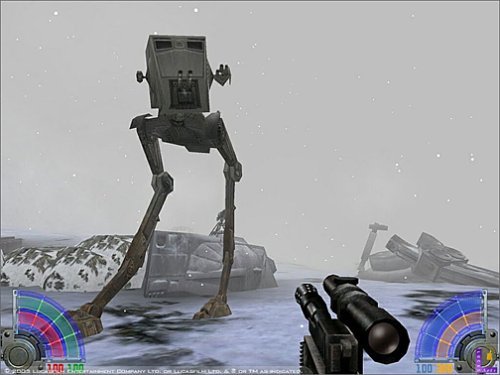
The player seeing the world through the eyes of his or her onscreen counterpart, usually down the barrel of a weapon. The player is a hero (such as in this example from Dark Forces). He or she traverses a 3D map in real-time, trying to reach key locations and solving puzzles while shooting and being shot at by AI controlled units .
The interface is built around movement and aiming. Primary variables include health/armor, location on map, amount of supplies, and perhaps capability.

The genre is mature. It has evolved dramatically. As the title implies, it is first person, which is great. You can move around physically, which is satisfying. The physics, interface, graphics, level design, and puzzles are all so much more refined than even ten years ago. Innovative games have added sneaking around, decisions about which weapons to bring, even what skills to develop. When one adds up all of the developer time spent on creating and improving the genre over the years, it probably adds up to about a billion dollars of research and development. Few other computer applications have been the recipient of so much resources. The result is that most FPS are very accessible.

On the other hand, FPSs are optimized around fun, not learning. The underlying framework is not very interesting. There are very few real activities in the last few centures that line up with the systems and interface that are modelled in FPSs (traversing mazes, finding, picking up, and delivering things, killing things). In fact I would suggest that FPSs are a red-herring when it comes to educational simulations. Expecting them to provide a model for education is like asking a brilliant surgeon to prepare your tax returns.

To me, what are more interesting are games/sims like Full Spectrum Warrior, shown here, that while superficially look like FPSs, have completely different interfaces, strategies, and nurture the develop of different situational awareness and scrambling techniques. But of course it represents a new genre that is necessarily much more raw, less refined by several orders of magnitude, than FPSs.

Sports games, such as golf, can also look superficially like a FPS, but again have completely different systems and interfaces, and are correspondingly more raw as well (somewhere between FPSs and Full Spectrum Warrior).

I look forward to when the conversation increasingly shift from "computer games, yeah or nay?" to ""what is the expertise that a given game does contain, and then can contain?"

Part of the SimWord of the Day Series....

Friday, April 14

SimWord of the Day: Game Engines

Game Engine -- the application/code that is used as the basis for building a game. In games there is generally one primary engine (The graphics engine, for movement, 3D rendering, and resolution) and a few smaller engines that power other aspects of the game (AI, Sound, Input). Game engines represent a trade-off between ease of use and diversity of possible experiences. Many game engines are optimizes around one type of game genre, like first person shooter or real-time strategy, compromising its ability to enable educational simulations.
Oh, and selecting the right game engine, from the hundreds or even thousands, is an adventure.
Famous examples include the Quake, Unreal, Half-Life, and Lithtech 3D engines.
  • MIT’s Revolutions uses the Aurora Engine from Bioware
  • RoadQuiz and many other educational simatulions uses RenderWare as the 3D renderer
  • Delta3D is an open source game engine being built at the MOVES Institute at the Naval Postgraduate School in Monterey.
  • There is free game creation system called Game Maker.
  • There is Unity Pro.
  • Blitz3d is an indy engine, costs $80.00, and has a huge support online community.

There is also PopCap Framework, Torque 3D, Blitz BASIC, and even Director and Flash. Funnily enough, even large game developers are increasingly using the smaller tools to quickly mock up game play and interfaces.

Part of the SimWord of the Day Series....

Thursday, April 13

Simword of the Day: Genre - Virtual Experience Space


Welcome to another month of Simwords of the Day!

Today's word is Virtual Experience Space.

I have argued that there are four types of "common" simulations out there today, branching stories, interactive spreadsheets, game-based models, and virtual labs.

One emerging type of simulation genre is Virtual Experience Space.

Students in traditional role plays often explore some created experience space as input to their work. This space is defined though prop documents handed out over the course of the role play, and interactions with people, including the instructor, playing assigned roles.

Now, using relatively commonplace web technology, instructors can create fictitious, scalable situations using large, hypertexted, multimedia repositories for students to explore (for examples, go here). The media can include emails, video interviews with the CEO or other clips, and PowerPoint presentations, all accessed through a common portal (or portals if there are multiple teams).

Furthermore, only certain links in the repository can be open at the start of the role play. Then new links could open up based on different types of triggers.


  • At certain time intervals, the instructor (or the simulation on its own) opens up some links that create the effect, for the students, of time passing. This could simply represent the start of a new week or, more dramatically, of an external event happening, such as a hostile takeover or the death of a senior executive. Again, video clips and emails would become available to the role players that were not there before. Of course, time can also cut off certain links, making them no longer accessible.
  • If a player in the role play was reading an email, he or she might want to ask a follow-up question of the fictional character. He or she would “email” the character. Then either an automated system or the instructor would “reply” to that email, opening up a link that would result in a new email appearing in the person’s in-box. During the beta roll-outs of virtual experience spaces, the instructor has to be “live,” carefully monitoring the queries of the students, creating new information that will then be refined and added to the canned experience in the next iteration.

By accessing this type of space, consultants can learn enough to create recommendations, projects, and plans, even hooking up ficticious characters, that can then be evaluated by real-humans for anything from evacuation plans to new web sites to IT infrastructure to strategic plans.


Tuesday, March 28

The Genetic Differences Between Games and Instructional Design (Clark Quinn Beats Me to the Punch)

Darn Clark! And here I was going to spring this same post. Anyway, since you already spilled it, I want to follow and extend a bit.

What Clark posted was a little re-cap of part of the keynote that Nintendo president, Satoru IwataIwata2_1 delivered to a packed house at this year's Game Developers Conference. I'll say that I was in the audience that packed the San Jose Civic Auditorium (we were actually 2-3 deep standing around the top and some were left outside - the capacity is slightly over 3,000). Let me just say - the dude was ON! Forget the problems of english not being a first language - Iwata was engaging, funny, personable and darned interesting.

Clark, in his post, points to a section of Iwata's speech in which he (Iwata) lays out the "Four I's" that Nintendo uses as game development standards. They are:

"First, is it truly innovative - something different from what has come before? Second, is it intuitive? Do the control of the game and the direction of gameplay seem natural? Third, is it inviting? Do you want to spend time in this world? And finally, how does it measure up in terms of interface? Can the player connect in new ways?"

Here is what I want. Quick - someone start talking to me about how these are not valid design considerations for learning. Start telling me about how what we do is serious and this stuff is just frivolous, meaningless - dare I say the "F" word? Fun? Tell me about constraints. Tell me how learning is different from gaming. Tell me about how so much of our thinking about learning is calcified and how we as an industry seem to have lost the ability to think within frameworks such as this. Someone tell me how putting the "next" button in the lower right-hand corner (oohhh maybe with rounded edges instead of square ones) is inviting, intuitive, innovative or considers the user as a requirements generator in the design of the interface at all!

I swear I think I know what it is - and the news is both good and bad. The good news is that's its not really our fault - phew - as instructional designers, we were just born like this. Like color blindness or being tone deaf- our handicap doesn't prevent us from functioning in the world - just from perceiving it clearly. The bad news is that its genetic - this goes to our core and it reveals the shocking fact that gaming and instructional design (note: I did NOT say learning) come from two distinct evolutionary branches.

Gaming comes from play and art and music  - from a creative place. Where does instructional design come from? There are a few probable fathers but chief amongst them is World War 2. The real drivers were the need for effeciency and effectiveness. Not exactly the most forgiving or indulgent of parents. So now we come to present day and shocker!...processes derived from a need to have a conscript military force rapidly trained in set patterns...are breaking down in the face of generational and technological changes that were never anticipated or dreamt of at the dawn of ISD (at least not by instructional designers).

So we have a practice, a set of ways of knowing what to do, that are radically unable to keep pace (and its getting worse) and all we can seem to talk about is how to generate templates faster. We need to be talking about gene therapy; about some radical treatments that can save the best values of ISD and yet jettison - in some wholesale fashion - the outdated and outmoded ways of thinking about humans and how they learn (but that's really not what we think about is it?).

What is the answer? I don't know. I know enough to listen though when a man speaks who has a set of design principles flexible enough to produce both Super Mario Kart and Brain Age. Let's stretch people...left leg...on three....

Monday, March 27

Let's Talk Some Serious Numbers

OK. So I just got back from a week in San Jose at the Serious Games Summit / Game Developers Conference. I have a lot to post about things I saw/heard there and I'll probably split the postings between here and my blog. I did want to throw these numbers out though as a discussion starter...they are from Philip Rosedale, CEO and Founder of Linden Lab 'ne Second Life.
  • Number of residents: 166,000+
  • Number of ongoing educational or 'Serious' research projects: 100+
  • Size of Second Life: 32,000 acres (bigger than Boston)
  • Amount of real world currency (in US$) traded annually for goods and services (i.e. paid between residents): $160,000,000 (yes, that's million)
  • Number of user-created objects: 10 million
  • Size of user-created data: 10 TBytes (yes, that's a T)
  • Number of unique items sold/traded monthly: 230,000
  • Number of events per day: approx. 500
  • 43% percent female
  • 25% non-US
Keep in mind - Second Life is NOT a game - it is a platform.

BusinessWeek piece on Serious Games

In case you are interested, here is a link to BusinessWeek's new piece on serious games used in corporations.

Take a look at the screen shots through the context of Situational Awareness.

Gaming Classrooms

When showing a great simulation to an instructor, I often get back the following response.

"It seems like students could game this." Then the instructor leans back, smiling triumphantly, as if having delivered the killing blow.

"Well, the simulation represents about 15 hours of student time. Sure, if they wanted to put in an additional 15 or 20 hours, they could probably get a better score not on their successful integration of productive knowledge, but on finding the cracks in the scoring algorithm and level design." I reply. "But that would almost necessarily come after they learned quite a bit."

The instructor shakes his or her head. "The whole gaming thing troubles me. We need to have a higher level of integrity in any kind of grading or scoring."

Here, for the first time anywhere, is what I really want to say:

"Listen. I have been gaming classrooms for my entire life in order to get better evaluations, comments, grades, or certification scores. I have been dressing appropriately, feigning interest in topics that bore me beyond belief, cramming for tests in a way where my command of the information has a half life of hours desperately hoping that I forget the information moments after I write it down not moments before, skimming tangential sources to ask the one question that makes me seem much more knowledgeable than I really am, interviewing past students to see what will be on the test, playing back what the instructor said without understanding it at all, and pretending to take notes when I am really designing a biosphere in the margin. You want to talk about gaming? What do you think all of your students are doing all of the time?"

On the Sublimity of Practice

I am writing up an article on the nine paradoxes of educational simulations for T+D magazine.

When talking about my personal favorite, number four, I had two comments I just couldn't wait to share.

Jake Stahl, Director, Client Systems Delivery, Purdue Pharma, “If Joe Montana said to me that throwing a football is simple, I would agree that from his perspective it is. But can he explain to me in words how to do it, or does he need to show me? Once he shows me, do I now know, or do I need to practice? Once I practice, have I perfected it or do I need to fine tune?”

To Jake's comment, SimuLearn's Ken Kupersmith added, "And, finally when is my skill good enough, or should I always be striving for improvement. Even professional baseball players have a spring training every year to practice and improve, and often they have practice during the season when they do not schedule a game."

So often, formal learning seems like a desperate chase to cover as much ground as possible, inevitably at the expense of depth. We love long lists of learning objectives"covered." But the real magic might be in "learning" less but practicing more.

Friday, March 24

I need your advice on learning profiles

full disclosure - As some of you may know, I joined Thomson NETg in January to run one of their strategic business units called Collaboration (essentially what was KnowledgeNet whom they acquired in late 2004).

Very exciting (at least to me) but what I need is your feedback on a tool that Thomson NETg developed which I think is a hidden gem. By answering 25 online questions it builds a high-level personalized learning profile (for overall learning not just eLearning). I took it and found it to be very useful plus there is little marketing or promotional BS.

A sample question is:
When you get to work on Monday morning, you discover that, over the weekend, a new phone system was installed in your company. The first thing you need to do is to set up your voice mail for the first time. All employees have been given a short manual about the new system.What do you think you would do?
• I would read the manual, then attempt to set up my voice mail.
• I would start setting up my voice mail and never refer to the manual.
• I would start setting up my voice mail and refer to the manual only if necessary.
• I would ask someone else for help before attempting to set up my voice mail.

Knowing that many of you are experts in this field I would really appreciate it if you could look at it and post your feedback in the comments below. Is this useful or just cleverly cloaked marketing?
http://learningprofile.netglearning.com

There is also a good document that goes into the educational theory behind the tool but is more self-promotional:
http://www.netg.com/pdf/NETg_WhitePaper_Profiling_the_Adult_Learner.pdf

Thanks,
Ben

If you get prompted for some reason to login to see this stuff just use my email address ben[dot]watson[at]thomson[dot]com

Wednesday, March 22

"Research" as Pawn to Support the Status Quo

I love research, maybe a bit too much. I love measuring effectiveness. I love making sense of chaos that enables predictability. I love presenting hard evidence.

And yet...

And yet the phrase "we need to do research" more often than not is a code phrase for, "we just don't want to move ahead" without having to justify the action, or to appear in favor of something while trashing it. When George W. Bush, early in his presidency, said that he wanted to study global warming, he did not mean "I really want to act on this; let's make it a priority to understand the exact nature of the problem so that we can apply comprehensive yet targeted solutions," what he meant was, "I don't want to deal with it."

Our industry seems addicted to this best of all excuses, both because it plays to a supposed strength (we are smart people who like talking about using our brains and employing a rigorous process), and our weakness (we hate pulling the trigger).

Monday, March 20

kowabunga dude!

i just had the experience that i'm sure happens to many of us.  i was reunited with a long lost favorite website. the collaborative learning environments sourcebook was one of the first resources i use when i began learning about communities of practice.  unfortunately somewhere along the way i "lost" my bookmark for it.  (thus the power of bookmarking services like blinklist, de.licio.us, and the like.)
Kowabunga

but what struck me as worth blogging about was that i rediscovered this resource through practicing one of the first forms of informal learning that the internet spawned - web surfing.  back in the barbaric dark ages of web 1.0 before rss, news aggregators, blogrolls, technorati tags and folksonomies, most "webbies" would wander around from site to site, following whatever link caught their imagination. 

today the web is about finding information you "know" is there and thus tools from google to tags to rss feeds are created to help you pinpoint what you need to find as quickly as possible.  but back in the day, the internet was still evolving.  you really had no idea what you might find.  there was even a time when browsers didn't have book marks. (i recall having a legal pad with urls scribbled on page after page.)  so you would just sign on, log into a site you knew had some interesting links, pick one and off you would go, surfing from one site to another.  it was like a scavenger hunt every time you went on the net. 

my favorite discoveries back then include a site called "the big red button" where fellow surfers would leave their impressions of their experience having found the big red button (it was picture of a big red button. it didn't do anything. but thousands of people left notes.) and another site which stripped the captions off family circus cartoons and visitors wrote their own captions - most too off color to repeat here.

now don't get the wrong idea, if i'm trying to get a project done and need information or just trying to stay up on the latest in our profession, i'm very happy to use my rss feeds and google to get the job done fast.  but i realized that i've kept my web surfing skills up and i use them regularly to just discover new things.  just to explore and learn.

then i wondered, i never hear anyone talk about surfing the web anymore. 

am i the only one still practicing this ancient craft?  do you secretly sneak off to you computer at work to hang ten hoping to find a site with a wicked cool design that blows you away?  or a site for radical environmentalists in southeastern oregon seeking to protect beavers' rights to dam any river they want?   or a gnarly site with pictures from a berlin burlesque show?

over on eelearning i've posted a flash poll. pop on over there and let me know if you've totally co-opted to the web 2.0 thang, or if you still are with it and get stoked lookin' to catch the big one.  if you have some rad stories to lay on us of your surfin' days, it'd be so chill if you'd lay it out in a comment below.   

Hang_loose

hang loose dudes and dudettes!

Saturday, March 18

JayFeeds - a corporate learning aggregator

Stephen Downes' Edu-RSS had been my favorite source of learning & education news for years. Stephen is on hiatus and I am suffering withdrawal pains, so I figured I'd pick up the slack. I've experimented with half a dozen aggregators but have found none to my liking. They are ugly or incapable of dealing with the number of feeds Stephen maintained. I also realized that many of the listings on Edu-RSS held no interest for me or were topics for which I had other sources I liked.

JayFeeds | JayFeeds - River View

JayFeeds is a group of twenty blogs that I enjoy reading. Most focus on corporate learning. Less is more.


  • Ageless Learner Blog

  • Connect @ EDUCAUSE

  • BABSONKNOWLEDGE.ORG

  • cogdogblog

  • Communication Nation

  • Donald Clark Plan B

  • Edge Perspectives with John Hagel

  • elearnspace

  • Harold Jarche

  • Jane Knight, eLearning Centre

  • Joho the Blog

  • Parkin's Lot

  • Internet Time Blog

  • InformL Blog

  • Robin Good's Latest News

  • Dave Lee's eelearning

  • The Experience Designer Network

  • The Learning Circuits Blog

  • e-Clippings (a division of blogoehlert)

  • elearningpost

  • judith meskill.

  • T+D Blog

  • Currently running on BozPage, I'll change the URLs here when I find a better aggregator.

    Permanent home of JayFeeds

    (Bookmark it because the target URL changes periodically.) I'll also put it in the sidebar of Internet Time Blog.

    If you don't care for my choice, start a new BozPage and make your own.


    Monday, March 6

    This is Your Brain on Poverty

    For some time it was believed that animals grew no new neurons in the cortex of their brains upon reaching adulthood -- their fate was basically sealed by their generic nature. This was apparently proved by Pasco Rakix, a neuroscientist. However, Fernando Nottebohm soon found that adult canaries made new neurons when they learn new songs. So Rakic replied that it was only adult mammals who could not grow neurons. But soon afterward, Elizabeth Gould found that rats do. Thus Rakic zeroed in on primates. Gould found them in tree shrews. It was then only higher primates. Gould found them in marmosets. So Rakic finally zeroed it down to old-world primates who could not grow new neurons. Gould then found them in macaques.

    Now it is almost certain that all primates, including humans, grow new neurons in response to new experiences, and loose neurons in response to neglect. Thus, with all the determinism built into the initial wiring of our brain, experience with our surrounding environment refines and in some cases rewires that initial wiring.

    Along with her discovery, Gould noticed something else -- put the brain under stressful conditions and it starves itself by failing to create new cells. There are severe social implications with this. Environments that are boring, have stressful noises, poverty, etc., have playing fields that are no longer level when compared to enriched environments. The brains that live in impoverished environments never have a chance as poverty and stress are no longer just concepts but are actual parts of a person's anatomy.

    Christian Mirescu, one of Gould's post-docs probably said it best, "When a brain is worried, it's just thinking about survival. It isn't interested in investing in new cells for the future."

    So how is this impacting us? America has one of the highest childhood poverty rates among rich nations (only Mexico's is higher and they are not really all that rich). As David Berliner writes, "The USA likes to be #1 in everything, and when it comes to the percent of children in poverty among the richest nations in the world, we continue to hold our remarkable status."

    Berliner, the Regent's Professor of Education at Arizona State University, started to dig into the data of high-stakes testing and poverty. He discovered that when you take the scores of the poverty-stricken out of the national averages, then the U.S. ranks up there with the best of other nations. Leave them in and we plainly suck -- we are very near the bottom of the heap as compared to other rich nations.

    Thus our high poverty rate ensures that our national student test averages remain low. Our answer -- more high-stake testing. In other words, we keep trying to test a disfigured brain, hoping that it will somehow work its way out of poverty and become a productive member of our society. Yet all too often...

    Woman hold her head and cry
    Cause her son had been shot down in the street and died

    Wanna tote guns and shoot dice.
    all mah life i've been considered as the worst. lyin' to mah mother even stealin' out her purse
    crime after crime
    from drugs to extortion
    i know my mother wish she got a abortion

    Woman hold her head and cry
    Cause her son had been shot down in the street and died


    From "Hold Ya Head" by the Notorious B.I.G. [featuring Bob Marley]


    In the end, poverty becomes both nature and nurture, which helps to ensure that it stays a visious circle.

    Reference

    THE REINVENTION OF THE SELF - Jonah Lehrer From the FEB/MAR 2006 issue of Seed

    Our Impoverished View of Educational Reform - David C. Berliner

    Friday, March 3

    Blogs as knowledge management

    Blogs are knowledge objects that can make bottom-up (i.e. useful) knowledge management a reality. As you may be aware, I've become a champion of using Web 2.0 technology to upgrade corporate learning and performance. In his Journal of the Hyperlinked Organization (JOHO}, David Weinberger describes the role of blogs inside corporations:
    I continue to believe that for many companies the best path to blogging is by using them internally as a knowledge management tool. The dream of KM has been that people will write down what they know. KM regimes, however, have assumed they would have to discipline people into doing that. Blogs entice people to write down what they know and to share it widely. A project blog or a department blog not only surfaces and shares knowledge, it also makes it searchable and archives it. And once a company gets used to internal blogs, it's only natural (if anything about a corporation can be said to be natural) to open up some blogs to trusted customers and partners, bringing them into the intellectual bloodstream of the organization. And then why not open some blogs more widely? Thus companies inch their way into the blogosphere.
    Doesn't this make more sense than paying consultants to install some humongous KM system that nobody uses? Shouldn't we be capturing the know-how of front-line workers who actually know how? Why aren't more organizations getting on board with this?

    jay