Thursday, August 31

Blog Guides and Managing Your RSS Feeds

Based on my experience in visiting blogs for the first time and having a hard time deciding what the content of the blog really was, I decided that what I needed was a blog guide. So, I decided to create a Blog Guide for my own blog and put a permanent link for it on my blog up in the header. Since I just saw a post by Jim Belshaw that referenced it - Personal Reflections: Tony Karrer and eLearning Technology where Jim said:

I do wish more people would follow this approach.


Would it be helpful to have a similar Blog Guide on this blog? On most Blogs? From an IA or ISD perspective, likely most of us would agree that the usual set-up of blogs (recent blog posts + archive by month) is not very helpful when you are a first time visitor trying to evaluate what the blog is all about. My guess is that my first attempt at my guide needs lots of help, but I feel it's better than nothing.

On a similar subject, I recently posted how I Manage My RSS Feeds. This model seems to be working out well for me.

Monday, August 28

The Innovator's Dilemma of Learning

In preparing for a couple upcoming presentations on eLearning 2.0 and I've been forced to deal with several related problems and have come to a realization about a fundamental problem that we face. First, let me walk you through where this is coming from...

Most conference attendees have done little or no preparation and have not sat down to figure out what questions they should be asking coming into the conference. I've written about the need to prepare before:
More Effective Conferences for Learning Professionals - The most important aspect of making sure you get the most you can from the conference is determining what the questions are that you should use to focus you during the conference. Otherwise, you will swim through the sea of sessions and vendors and will not get nearly as much from the conference.
However, even if you sat down ahead of the conference and really thought about the questions that you face in your job, most of the questions are along the lines of:
  • How do I get more interactivity into my courseware?
  • How do I reduce the attrition rate in my course/courseware?
  • What's the best authoring tool to use to build my courseware?

Sound familiar right?

The problem is that all of these questions assume that we are trying to do more of the same. We are trying to build courses/courseware - and that's dying. We are aiming at helping large numbers of novice/new performers even though that ignores most of the learning that occurs in organizations (see Rosenberg's Beyond eLearning - Is that eLearning 2.0?).

The realization is that we are facing the exact issue described by Christensen in the Innovator's Dilemma. He pointed out that many successful companies become unsuccessful when they continually optimize what they are doing well today only to be supplanted by disruptive innovations, e.g., railroad companies not becoming airlines. In learning, we have similar disruptions going on with eLearning 2.0, changing learning landscape and it provided the realization that we have the "The Innovator's Dilemma of Learning" ...

We are spending the vast majority of our time incrementally improving what we are doing today in learning (courses/courseware) instead of taking advantage of learning disruption that is happening all around us.

I know that most Learning and Performance Professionals will tell you all the reasons that "in their environment" they cannot break out of this mold. The Innovator's Dilemma suggests that you may be right, but it doesn't meant that you aren't heading for a rude awakening when you find out you are in railroads instead of airlines. Instead, maybe we should take Seth Godin's advice around Redefining Expectations.

Let's assume for a minute that you didn't have these barriers in your organization. I'm curious to find out what questions readers of this blog would ask at a conference if they assumed that they were not locked in the Innovator's Dilemma of Learning. Here are some that I might ask of other attendees, presenters, vendors, etc. I'm hoping that maybe even some of the other authors on this blog can begin to explore answers to some of these. Maybe I don't need to wait for my next conference...

  • Informal Learning - How can I provide a development process, tools and systems that foster informal learning in a way that I know will have impact on the performance that I care about and that is repeatable? What can I borrow from KM, collaborative learning, and management practices? What does this look like in practice? When do I use it? When are you using it? What effect is it having? How do you know?
  • Personal Learning - What systems, tools, techniques can I use to make myself a better learner?
  • Reference Hybrids - How have you organized landing pages to support both reference and learning modes? How do you define what will be treated as reference and what as learning? What tools are you using today? What do you expect to use in the future? How do you track this kind of learning? Do you have metrics on impact?

So what are your questions?

Wednesday, August 23

Elgg and the Blackboard LMS Patent

Harold Jarche provides a concise yet powerful defense of the Elgg learning environment against the 44 provisions of the Blackboard LMS Patent in his post Elgg and the LMS Patent.  His analysis from a learning professional's viewpoint is critical.

This post is a call to action to any learning professional who wants to preserve open and complete competition amongst vendors (for profit or open source) seeking to assist in the learning process.  Please write a post on your blog (feel free to copy this post if you'd like) with a link to Harold's post and create a trackback to it as well. 

We all know how Google and the other search engines determine what sites to present first in their listings.  Let's make sure that any attorney who searches for information regarding this case finds Harold's post.


technorati tags:, , , ,

Blogged with Flock

Saturday, August 19

Butts in seats does not equal learning

Hours in class meaningless as a measure, especially if a lawyer is the instructor

“Are you excited about the recall election? Arnold’s campaign has a new slogan: ‘Win one for the groper.’” —David Letterman

Arnold Calls His Acts of Sexual Harassment a Joke

October 2003. In a “Dateline NBC” interview aired Sunday evening, Schwarzenegger said of the allegations, “a lot of it is made-up stories. I’ve never grabbed anyone and pulled up the shirt and grabbed the breast and stuff like that.”

But when asked if he denied all the stories about grabbing, he said, “No, not all. But I’m just saying this is not me. What I am is someone that sometimes makes outrageous jokes, someone that is out and says sometimes crazy things that may be offensive because there is a certain atmosphere.”

Assembly Bill 1825

Once Arnold took office, a Democratic state Assemblywoman drafted a bill mandating sexual harassment training for all supervisors (including Terminators). So far, so good.Now lawyers are trying to grab an exclusive on the training. A partner in a San Francisco employment law firm said, “It’s hard to estimate the size of AB 1825 training. A couple hundred million dollars would be my guess.”

There are reports that lawyers are making veiled threats to Calfornia employers that unless they meet the sex discrimination training requirement by conducting two-hour workshops, they risk being assessed massive damages in court. Guess who they recommend to lead the workshops? Lawyers, naturally. It boggles the mind. Can you imagine what two hours with a lawyer lecturer would be like?

Two Hours = what?

The issue hangs on the two-hour requirement specified by the law. As if two hours of butts in seats guarantees anything. As Gloria Gery famously asked, “Why don’t we just weigh them and report how many tons we’ve trained?”

Small mindedness coupled with lawyers lining their pockets is more than I can bear. I am seeking friends’ help to blow the two-hour requirement out of the water.

Protest Letter

I have drafted a letter and am gathering signatures in an attempt to wake up the Commision drafting regulations on this. If you agree with my letter, email me and I’ll add your name as a signer. If you can suggest other potential supporters, please forward this email to them.

Thanks. See you at the victory tail-gate party.


Jay Cross
Berkeley, California
http://internettime.com

P.S. For you non-Californians: the California statute could easily become the model for other states.

Wednesday, August 16

The Future of Media, Part 2

It's taken a bit longer to get to this post, but maybe I was waiting to read Jim Ware's post on The Dark Side of Collaborative Technology. There is a very dark side to web 2.0 that will send a chill up your spine if you think about it too long. Jim only talks about Stephen Colbert's punk on Wikipedia in which he suggested that his audience go change the entry for elephants to show that elephants aren't headed for extinction. The fact of the matter is that there are negative forces on the web looking to take advantage of the moment of novelty when consumers are in awe of the technology. Black mobs from Moscow, rioting youth in France and al Queda all are using the web for their purposes as well.

Now that I've depressed the heck out of everyone, let's talk about the antidote and the reality that Jim was focused on in his post as were the panelists at the Future of Media conference - TRUST. First Jim's key point in his post:

...but trust that produces genuine learning and new knowledge is a fragile thing. It takes time and common experiences to build trust - and that is a major reason why we don't advocate distributed work as a panacea.

His point is a good one. There might be too much trust placed too quickly in applications and people we hardly know. In the flatting world not only is there more and more information coming at us, but there are more and more people coming into our lives on a daily basis. Andy Halliday, CEO of Ourstory.com, pointed out that we take our first step in building trust by listening to or reading other people's stories and sharing ours. As he pointed out, it's not a new invention to seek kindred spirits through storytelling. We just now have more ways to share our stories. The challenge becomes how do we sort through the cacaphony to find those whom we can come to trust.

Verna Allee, one of the world's leading authorities on knowledge management and communities of practice, pointed out in a side conversation (I happened to sit next to here) that there is a clear preference to believe content that carries a real person's name on it over content that carries an institution's name. Content which has no specific authorship (anonymous entries in a best practices database for example) are dismissed my most people without any evidence of their veracity or lack thereof. So finding ways to know we can trust someone is key. Chris Anderson, Editor of Wired Magazine, shared his belief that you can build that trust through reputation, quality of expression, and experience.

Authenticity it was agreed by the panelists is all there is in the future. The blogosphere has opened the world to authentic discourse. Uprooting entire industries in the process. Ironically, it was pointed out that Stephen Colbert and Dave Stewart are considered the most reliable news sources on TV today. Ray Kotcher, CEO of Ketchem PR, agreed saying "there is no use in running. Your story is going to come out. Your good stories and our bad stories will all be known." Knowing who you are, what you can do and telling it honestly is all there is. If you have a competitive advantage, you don't have time to look at the competition. Craig Newmark, Founder of Craig's List, got a roar of laughter when he shared, very quietly, "In reality we have competition, but in practice we ignore it."

John Hagel pointed to a concept he and John Seeley Brown develop in The Only Sustainable Edge that one of the three key sectors of the future economy will be centered around customer relationships. Ray Kotcher agreed asking the question "is media a collection of micro chunks of content or is it first and foremost about relationships." Hagel feels that the true economic unit of the future is going to be attention. The ability to get customers focused on what you can deliver to them to meet their needs is key to business success, he feels. The ability to keep yourself or your organization focused on what you want and need will be real determiner of success in the future.

While it's very true that new technologies are totally disrupting the global society, creating radical changes across the globe, and yes, creating an environment in which click fraud, disinformation campaigns, and identity theft may run rampant for a time. The ability to connect with like minds using the new technology but some very traditional, even ancient human skills of storytelling, authentic presense, and focusing our attention is incredibly exciting.

Thursday, August 10

some housekeeping details

Three bits of housekeeping detail to make everyone aware of.

A NEW VOICE As you've probably noticed due to his very popular first post, Tony Karrer, Ph.D., has joined the LCB Blog Squad. Tony is the founder and President of TechEmpower - a firm dedicated to providing innovative learning solutions to its clients. His blog eLearning Technology has quickly become a must include for eLearning professionals' RSS aggregators. Tony's well thought out ideas and his willingness to engage in open and fair debate will be an asset to the LCB community. Welcome aboard, Tony.

LCB DISCUSSON WIKI
A new topic was introduced this week in the discussion wiki by Suzanne. She has raised the interesting challenge of "What's so great about informal learning?" Join Suzanne for this discussion or the other two discussions currently active on the wiki - "What makes a great simulations designer?" and "Finding sources for public sector projects"

You have to log in to be able to comment. Once you are logged in, you share your ideas by adding or amending the pages of the wiki or using the comment tab at the top of every page to share your remarks regarding that page's content. Please be sure to associate your name in some form or another with your comments made directly on the pages. it just makes it easier for everyone to follow the commentary.

NEW FAQ you may have noticed that our FAQ changed dramatically about an month ago. Our Bravenet FAQ was getting flooded by spam and I just got fed up with spending a hour a day deleting bogus questions.

If you have a question that the FAQ doesn't answer about LCB or have a concern or praise for LCB, please don't hesitate to contact me directly at daveleelcb at comcast dot net. Thanks for all the great conversations!

your humble blogmeister,
Dave Lee

Sunday, August 6

Courses and Courseware Fading - What's Coming Next?

A few recent posts by Jay Cross, Brent Schlenker, and me (Tony Karrer) discuss Course and Courseware Fading - The Future of eLearning. The general sentiment among many in the workplace learning and performance industry is that the course model is beginning to fade and one of our biggest challenges is figuring out what comes next.

Just as it is today when we design a Blended Learning solution, undoubtedly we will have a variety of delivery models and the specific solution will depend on the situation. But, the challenge before us is that we are only just beginning to understand what these delivery models are, how they work, when they best apply, and the process we must use (see Informal Learning - Let's Get Real). Further, as these delivery models evolve (and they will evolve tremendously over the next few years), we will naturally see change in our matching of learning and performance needs to delivery models.

As the new author on the Learning Circuits blog, I'm hoping to help add to this conversation as it is probably the most important question facing us in eLearning today.

Saturday, July 29

Do You Trust Me?

Recently, I had the opportunity to attend a transglobal teleconference on the Future of Media here in San Francisco along with a link to a concurrent session in Sydney, Australia. Despite some audio/visual problems with the link between the two sites, the content of the sessions was thought provoking and painstakingly honest. To hear leaders in the field admit to not really knowing what's going to happen is both refreshing and a bit scary. But that's the reality of where things are at today.

Because of the richness of the evening's content, I'm going to split my reactions up between a couple of posts here on LCB and a couple over on e e learning.

One of the topics that came out in nearly every discussion was that of trust, the role it plays in media today and how it will be even more a factor in the future. Mike Linksvayer (CTO of Creative Commons) and Andy Halliday (CEO of Ourstory) got the evening rolling by positing individual authenticity as vital to success in the flattened internet empowered global marketplace. Sensemaking becomes the real challenge according to Halliday in a world in which, as Linksvayer put it, "90% of everything is crap." We come to trust individuals, and to a lesser extent brands, who we know because we've connected with "their story." Communication has always been about viewing and understanding other peoples’ stories and finding shared experiences according to Halliday.

Chris Anderson (Editor of Wired Magazine and author of the new book The Long Tail) and John Hagel(author of The Only Sustainable Edge) were lively and provocative. In an exchange that Moira Gunn later characterized as "Chris getting about $8000 worth of free consulting out of John" they discussed the intersection of their two books and what it means for media. As to the matter of authenticity and trust Anderson shared that in the new world where "Hollywood is being challenged by YouTube, the recording industry by MySpace, and the media by the blogosphere" all people will have to make decisions on are reputation, quality of expression and expertise. Hagel felt that in a world of more and more content, filtering services and infomediaries would be in greater demand. These filters will be judged on their ability to deliver what a customer is looking for. "I like what you do. Send me more" is one way he characterized it.

The third panel included Dr. Moira Gunn (TechNation on NPR), Ray Kotcher (Global CEO Ketchum PR), and Craig Newmark (Customer Service Representative and Founder Craigslist) continued the trust theme in response to a question regarding old media versus new media from Mark Jones (IT Editor, Australian Financial Review) who was chairing the panel from Sydney.  They also all felt that much of the characteristics of success in the past will remain true for the future although they may be amplified. Newmark pointed to the runaway success of Craig’s List as evidence that building a trusting community is more important to commerce in the 21st Century than the technology upon which they are delivered.

Kotcher added that while in the past public relations firms could help clients avoid talking about negatives, today “there is no were to run. Your story is going to come out. Your good stories and your bad stories. ”Transparency is a reality in today’s world and the only answer is authentic and honest communication.

Gunn told the story of how Compaq computers came to have such a strange name. When Compaq was about to go to Wall Street for it’s IPO, the tradition of the day called for having the appropriate number of notices in the Wall Street Journal before you’re IPO would be considered legit. This usually took companies a minimum of 12-16 weeks. Compaq did an analysis of words that would catch a reader’s eye no matter the context. Compaq was one of two such highly visible words (the other happened to be Iraq!). Thus they affixed the “q” to their name andexecuted their IPO in 3 weeks.

Gunn then suggested that the game is still the same in building trust both with the market and the general public. But now it’s not a matter of notices in the WSJ, but having enough presence in at least 3-4 diverse media before you will be taken seriously. She held Martha Stewart up as the model. With multiple TV shows, books, videos, an online recipe database, Podcasts, videocasts, magazines, retail products for the home, a line of house paints, DVD’s, greeting cards, furniture, wedding planning services, an online florist shop, and a home architectural design group, Martha is everywhere. Even in the face of her conviction on obstruction of justice charge, Martha is still one of the most trusted names out there.

So there’s one synopsis of the Future of Media conference. In the next day or so, I’ll summarize the discussion what the impact on media business practice and what changes in the media will mean for society.

Friday, July 28

brain-mind learning principles

in exploring the new horizons for learning site, i came across an interesting set of articles by renate nummela caine and geoffrey caine.  in their research on the human brain and learning, they established twelve principles regarding how we learn and what prevents us from learning.  their twelve principles are:
  1. All learning is physiological.
  2. The Brain-Mind is social.
  3. The search for meaning is innate.
  4. The search for meaning occurs through patterning.
  5. Emotions are critical to patterning.
  6. The Brain-Mind processes parts and wholes simultaneously.
  7. Learning involves both focused attention and peripheral perception.
  8. Learning always involves conscious and unconscious processes.
  9. There are at least two approaches to memory: archiving individual facts or skills or making sense of experience.
  10. Learning is developmental.
  11. Complex learning is enhanced by challenge and inhibited by threat associated with helplessness.
  12. Each brain is uniquely organized
quoted from 12 Brain/Mind Learning Principles in Action – One Author’s Personal Journey.

i particularly found it interesting that they included #3 (search for meaning in innate) and #5 (the role of emotions).  in my mind, these are two critical aspects of learning that have too often been left out of the mix in workplace learning. 

it's been my experience that there's a believe that employees are lazy and avoid training at all costs because they don't want to learn.  this is an arrogant dismissal of negative feedback.  we've blamed the learners rather than face the fact that we've offered up irrelevant, boring learning experiences.  employees learn every day.  they have to, it's in our nature as human beings.  it's just a matter of what they choose to learn and whether that jives with what the company needs them to learn.

the workplace is generally considred a place where emotions are supposed to be held in check.  even the expression of happiness is often expected to be muted and controlled.  let alone emotions like anger and sadness.  that learning has traditionally ignored the emotions is not surprising.

there are some breakthrough programs which have begun to explore using emotions as a way to stimulate learning.  one such program was regarding for sexual harassment training which began with the learner receiving an email asking them to gather up their files on one of their employees and reporting to their managers' office immediately because of a personnel issue.  imagine how your heart would be racing and your mind would be sorting through all of your interactions with that employee.  your attention would be laser beam as you sat down with your manager.  now granted, poorly conducted, such an approach would be dangerous, so training of the manager in this case would be paramount.  but if done well, the learner would never forget the lesson taught.

all 12 of these principles are thought provoking and have much to say about how the facilitation of learning can and should be approached.  i curious about what the LCB community has to say about them.

technorati tags:, , ,

Blogged with Flock

Saturday, July 8

We're #3! We're #3!

Recently I spent a little time pondering a statement that I've ascribed to for sometime now:

In a ranking of all of the groups in a typical organization who have the responsibility for helping direct the learning of employees or customers,  corporate training would finish 3rd - at best.

What?  3rd!?!?  No Way!

WAY.

It's my belief that an honest appraisal of any good size organization will likely show that two departments would prove to be more efficient and effective in helping their target audience meet their learning needs.  They would be the IT Help Desk and the Customer Service Center.  This doesn't consider the Sales group who through various techniques prepare their field staffs for battle against the competition.  Often without help from the corporate training group.   Throw in a quality OD group or a Finance team who prepare their folks well and it's easy to find L&D dropping to 5th or lower.

So what is it that makes the Help Desk and Customer Service groups better at helping their constituents learn better.  This is the question I found myself pondering the other day.  What do they do and what are the results that would lead people to think they're better at facilitating learning that we are?

First the list of what they do:

  • generally don't teach courses
  • answer the questions their "learners" have at the time they are in greatest need
  • assess each situation and determine the best course of action to answer the learner's need
  • provide the learner with only the answers they need to overcome the current problems
  • have a database of answers to questions that have been asked before and will likely be asked again
  • have a mechanism for escalating the response when the learner's need is of greater breath than can be resolved immediately.
  • track very specific metrics regarding performance and learner response.
  • often have a follow-up mechanism to determine whether their solution to the learner's need is still working several weeks later and to gain feedback from the learner regarding their experience with the group
  • feed overall questions and needs back to the stakeholder groups who can take action regarding the issue to mitigate the same problem in the future.
  • Gather feedback from their stakeholders regarding their effectiveness.
  • Push as much of the process and answers pro-actively to their learners in the form of knowledge bases and FAQ as well as anticipatory actions like alerts and job aides.

Now I'm by no means saying that there are training departments that do some or many of these same things.  But I doubt that very few do all of these things.  Which is a bit scary.  The help desk and customer service conduct individualized needs assessments on the fly as if they were an emergency room triage unit.  Who needs attention immediately and what exactly does each person need?  It's individualized attention from first contact to resolution (change in knowledge or behavior for the learner). 

Unfortunately much of what the training department has done regarding needs assessment is more akin to a hospital that has just renovated their surgery suite so now every patient who presents themselves with a broken bone, a pain in the chest, pregnant, or needing a wound stitched up gets routed to be treated in the new surgery suite!

What does the above list of activities gain our colleagues? 

  1. They have a very high, documentable success rate.
  2. If they do these things well, they get repeat business.
  3. They are never blasted for try to teach anyone anything.
  4. They understand the real, underlying issues causing learner need much better than we do.
So maybe, as we are looking at ways to improve what we do and provide better value to the companies we work for, perhaps we should do some internal best practices research.  There may very well be a model that already works within our culture just waiting for us to understand and use it.

technorati tags:, , , ,

Blogged with Flock

Thursday, June 29

Big Skill: Conflict Management

Resolving an adversarial situation with the minimum expenditure of force necessary to achieve a satisfactory outcome.

Conflict is often, but not necessarily, a failure of conflict management. When conflict does occur in the context of a successful conflict management approach, it is more contained and productive than either no conflict or a larger conflict, or the conflict supports other agendas including political.

There are environments where certain types of conflicts represent automatic failure of conflict management strategies, including physical in most workplaces, and certain types of chemical or nuclear conflict between nations.

Strategies for conflict management include listening, involving a third-party for mediation, and establishing ground rules.

Conflict management can also include:

  • A “cold war” scenario, where two or more parties live with long term hostilities that never resolves, but that do not result in full scale force either.
  • Proactively dismantling sources of potential conflicts before they occur.

Ironically, preparation for successful conflict management can include building force.

Wednesday, June 28

Conversation between CEO and New Training Professional

[Training Person is riding elevator, when door opens and CEO walks in.]

CEO: You're the training person, right?

TP: Yes I am.

CEO: So what have you done this quarter?

TP: I and my whole department have been doing a lot of research. We are talking to a lot of industry gurus. We have been passionately following all of the hot trends in training.

CEO: Sounds great. What have you learned?

TP: First, we have found that a well designed application needs much less training than a poorly designed one

CEO: Done. Let me move funding from training to application development. What else do you got?

TP: We have figured out that most behavior change comes from motivation, not instruction.

CEO: Great point. Let me jot myself a note to shift budget away from your department and put it into corporate communications and our bonus pool. What else?

TP: According to our new research, most learning happens in casual conversations. So that should be a priority.

CEO: Hmm. I know my infrastructure people handle telephones and cell phones, my facilities management and HR work on office layout, and my IT people support email and instant messaging. So thank you. I will split the rest of the training budget between those three camps. This has been a very productive conversation.

TP: (whoops).

CEO: I just feel badly that such a smart person as yourself doesn't have a job anymore. Oh well. Best of luck to you. I'm sure you'll do fine. Just have your office cleaned out by the end of the day.

[Door opens, CEO walks out]

Tuesday, June 27

Race to the Bottom?

In all of the formal learning industries, including training and education, we have to teach the basic stuff, and we have to put out fires. We have to teach people how to use a portal, or create adequate footnotes. We have to get them their new password. A new compliance law pops up and we have to develop content to deal with it.

But what amazes me is how many people think that is enough. We have gone from tolerating the minutia on the way to greatness to relishing in the minutia.

We have metaphorically inherited our parent's business, and our satisfied with stripping away the vision, the R&D, the new projects, the passion, and prop up the cash cows as they slowly dwindle away. Then we complain that we are not respected, or influential, or growing. We grab onto hot trends, not because we have any urge to implement them, but because we can talk about them with ourselves and customers to keep their interest for a week. "I discuss n technology, but really all customers want is n-1" one vendor told me. What he was really delivering was n-10.

For 90% of the people I meet in this industry, my dominant question really is, what is your excuse for mediocrity? Budgets? Not enough support? Love the small stuff? You're new here? Don't want to take risks? Worry that you will fail? Hate doing pilots? Don't know how to evaluate results? Always working on something else that doesn't help anyone but has to get done? That is the job of the other training group? No one will return your calls? Think the biggest skill based problem in your organization really is using the advanced features in PowerPoint? The meanies over in IT won't let you touch anything? Too busy to do your job because you are doing other people's job?

By the way, for the other 10% of the industry, with whom many I have had the pleasure of working, thank you so, so much. I deeply respect all of you, and remain your humble servant.

Saturday, June 24

If you haven't practiced, you haven't learned anything

Let me try to rephrase this conversation a bit.

(And please, please read this post, not just the headline, before commenting.)

If you haven't practiced, you haven't learned.

To paraphrase Abe Lincoln, who said "Give me six hours to chop down a tree and I will spend the first four sharpening the axe,"

I would say, "Give me six hours to learn something and I will spend the last four practicing."

Now, a digression/caveat: In the same way that:

  • knowing how to read offloads memory, so to does
  • using well designed and supported applications offloads learning about processes and even simple facts (if you count the spell-checker), (having said that, there might be a competitive advantage in using a tool that is not infinitely well supported, and I can only hope my competitors are too lazy and whiny to learn how to use it well) and
  • learning basic techniques such as Instant Messaging with your network and using Google offloads having to store large quantities of "just-in-case" facts and even perspectives. [FOR ALL RESPONDERS - THIS MEANS ASKING OTHER PEOPLE FOR HELP - SORRY FOR BEING OBLIQUE]

But what is left after all of that offloading are the big skills, which you have to learn, your boss has to learn, your co-workers have to learn, your employees have to learn, your senior management has to learn, and any company in which you invest has to learn.

So:


  • It is easy to think you understand how to do something (specifically, a big skill) theoretically. Although gaining a theoretical understanding before hand, the locker-room before the game conversation to discuss strategy, is still critical.
  • There is significant work in transferring that skill to the real world. That work includes both mapping the big skill to real life options, and then practicing that in a diversity of situations.
  • Both the mapping and practice are hard, and if not done, the intellectual transfer is stunted. In most cases, students will not do either on their own, wasting the resources spent on the program.
  • All academic programs, despite majors, teach mostly the same thing: how to behave in a classroom, how to write a paper (including basic researching and analysis), how to take a test. That is it.
  • One reason I like sims is that they can provide the mapping through a good interface, and provide a place to practice. That doesn't make it less hard for students to map and transfer, but it allows them to happen predictably and while the students are still in the program, not hoping they will do it after.

Friday, June 23

Big Skill: Communications

At its core, the moving of information. More broadly, the ability to both express oneself effectively through various and appropriate media (writing, speaking, graphics), including understanding audience requirements, needs/pain points, and knowledge, and also effectively listening to others express themselves. Part of communication is knowing what is “in it” for the audience.

All communication has a credibility component.

Communication strategies often need to be created. Having a weekly open house to combat a rampant rumor mill might be critical. As organizations and teams become more distributed, ad hoc (so called “water-cooler”) communication becomes less reliable, and so formal communication technique need to be established.

Picking the right genre is important. Letters have different requirements than email. In fact, the best way to trash someone’s career is to circulate a colleague’s instant-messaging comments reformatted as a letter. Videoconferencing is more formal; web-cams are more casual.

Dynamically customizing the content increases effectiveness. This could be based on audience questions, or for self-paced content, providing alternative paths through the content, such as using hyper-linking.

An effective communication strategy might involve having the audience do some exercises to internalize the information. This could be everything from taking notes at a lecture to playing a marketing mini-game around the release of a new soft drink or movie.

Emotional associations can also be critical. Politicians use the icon of the United States flag. Computer games might tie into famous athletes or movies. Advertisements shamelessly use idealized models, professions, or roles (showing a mother buckling up her children in a minivan while talking about some new fast food product). Create a verbal label for a complicated idea, and you shape the perception of the idea.

There are legal requirements for communications, especially around product recalls and shareholder information. Organizations often have different uses of Public Relations and advertising.

Some communication is passive. What we wear to work or how we style our hair broadcasts our affiliations and even aspirations. Corporations choose colors and fonts carefully.

Some communication strategies are malicious. Spread a lie through so many channels that it becomes thought of as a truth. An ethically-challenged leader leaks a lie to a newspaper anonymously, and then publicly refers to the article as a source of credibility. In the computer world, there are “denial of service” attacks, where many computers try to communicate with a single site in order to overwhelm and shut down the site.

And again, I ask the question that no one will answer. Do you have any formal learning programs around communication? If so, to whom and how? If not, why not: a) it is not important, or b) it is really important, but we don't do it because _____.

Thursday, June 22

The Three Worlds of Knowledge

This post is chained to Peter Isackson's, Saving "knowing" from imminent execution, which is chained to Clark Aldrich's Dead Reckoning. To get beyond what Peter and Clark have described as a "static" and "freeze-dried world of knowledge and Jay and Clark’s comments on "knowledge" and "meaning," we need to look at other models. While this is not meant as a complete answer, I believe it moves it in the right direction.

"What is the object of knowledge?" asks young Grasshopper. "There is no object of knowledge," replies the old Shaman, "To know is to be able to operate adequately in an individual or cooperative situation." "So which is more important, to know or to do?" asks young Grasshopper. "All doing is knowing, and all knowing is doing," replies the Sage, and then continues, "Knowing is an effective action, that is, knowledge operate effectively in the domain of existence of all living creatures." [paraphrased from Maturana & Varela].

One of the most popular epistemology models (except in the behavioral sciences) is Sir Karl Popper's writtings on the Three Worlds of Knowledge. The knowledge/learning/management professions seem to prefer and stay within the realm of Michael Polanyi's concept of personal and tacit knowledge. However, Polanyi's epistemology is narrower and has a limited basis for understanding knowledge as compared to Popper’s work, which provides a broader epistemological foundation.

Click to enlarge

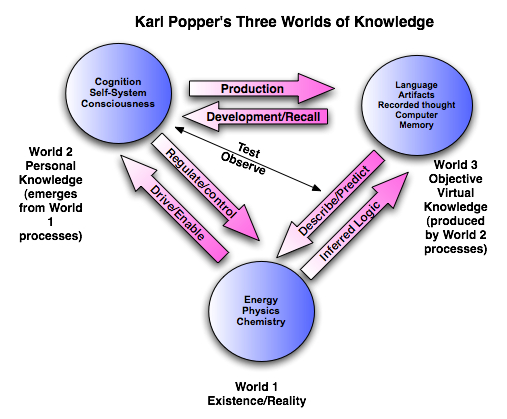
Karl Popper theorizes that there are three worlds of knowledge:

  • World 1 is the physical universe. It consists of the actual truth and reality that we try to represent, such as energy, physics, and chemistry. We may exist in this world, however, we do not always perceive it and then represent it correctly.

  • World 2 is the world of our subjective personal perceptions, experiences, and cognition. It is what we think about the world as we try to map, represent, and anticipate or hypotheses in order to maintain our existence in an every changing place. Personal knowledge and memory form this world, which are based on self-regulation, cognition, consciousness, dispositions, and processes. Note that Polanyi's theory of knowledge is based entirely within this world.

  • World 3 is the sum total of the objective abstract products of the human mind. It consists of such artifacts as books, tools, theories, models, libraries, computers, and networks. It is quite a diverse mixture that ranges from a claw-hammer to Maslow’s hierarchy to Godel's proof of the incompleteness of arithmetic. While knowledge may be created and produced by World 2 activities, its artifacts are stored in this world. Popper also includes genetic heredity (if you think about it, genes are really nothing more than a biological artifact of instructions).


And of course, there are various relationships between these three worlds:

  • World 1 drives and enables world 2 to exist, while world 2 tries to control and regulate world 1.

  • World 2 produces world 3, while world 3 helps in the recall and the training/education/development/learning of world 2.

  • World 3 describes and predicts world 1, while world 1 is the inferred logic of world 3.


In addition, since world 2 is composed of people, we can use our senses to cut across boundaries and observe and test the exchanges and relationships of worlds 1 and 2.

Thus, knowledge surrounds us (world 1), becomes a part of us (world 2), and is then stored in historical contents and contexts by us (world 3 artifacts).

In this framework are two different senses of knowledge or thought:

  • Knowledge in the subjective sense, consisting of a state of mind with a disposition to behave or to react [cognition].

  • knowledge in an objective sense, consisting of the expression of problems, theories, and arguments.


While the first is personal, the second is totally independent of anybody's claim to know -- it is knowledge without a knowing subject.

A T ~ T H E ~ F I S H H O U S E S


by Elizabeth Bishop

It is like what we imagine knowledge to be:
dark, salt, clear moving, utterly free,
drawn from the cold hard mouth
of the world, derived from the rocky breasts
forever, flowing and drawn, and since
our knowledge is historical, flowing, and flown.

Thus, knowledge goes far beyond the knowing/doing dichotomy. . . it is drawn, derived, flowing, historical, and forever.
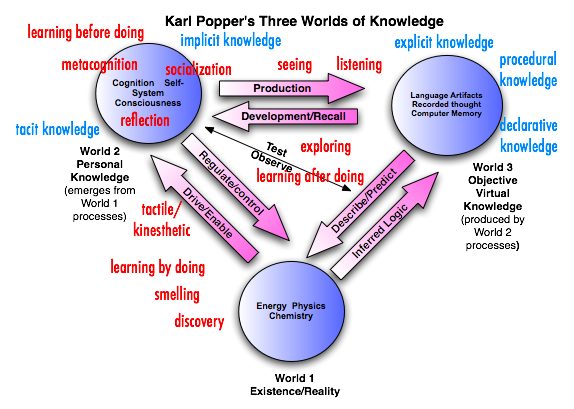

Click to enlarge

A few examples:

S E N S E S


Give a baby an object and one of the first things they normally do is "mouth" it. While this is sometimes done to massage their gums due to cutting teeth, it is also performed to learn about the object. Babies are just as curious about their surroundings as we are. The mouth and tongue are filled with sesitive nerve endings that allow them to not only feel, but also taste objects. Thus our first learnings are done by hearing, seeing, tasting, and feeling not only our hands, but also with our mouths.

Our senses are basically multifaceted in that we learn about world 1 through our senses and then create world 3 artifacts within world 2, which in turn helps others in their quest of learning by using their senses to understand world 3 artifacts in order to live more productively within world 1 (whew -- what a breath full). In addition, we test the interrelations of worlds 1 and 2 with our senses.

M I R R O R ~ N E U R O N S


Our brain contains a special class of cells, called mirror neurons, that fire not only when we see or hear an action, but also when we carry out the same action on our own. Our survival depends on understanding the actions, intentions and emotions of others, and by using these special mirror neurons, we are able to grasp the minds of others through direct simulation, rather than through conceptual reasoning. Thus knowing and doing become one -- at least in our minds!

Mirror neurons reveal how we partly learn; why people respond to certain types of sports, dance, music and art; why watching media violence may be harmful; and why we may like voyeurism or pornography. We are simply hardwired for imitation.

For more information, see the video and audio clips.

L I S T E N I N G


Listening is instinctual -- we can automatically home in on specific conversations at large gatherings. And as Chomsky theorized, it is hard-wired within us for children do not really learn to understand the spoken word, they just do it. In addition, listening frees our hands and eyes so we can take notes, draw mind maps, and do other useful things with our hands (create 3rd world artifacts).

People normally enjoy listening to others. . . it is part of our social nature. Listening to someone directly can often be quite special to many, because rather than going through a world 3 artifact to gain insights to other’s knowledge, we remain in world 2 and thus get it straight from the cognitive source, rather than an artifact. Plus, we can directly interact with the person through the use of questions, gestures, and other interactive means.


SimWord of the Day: Business Process

A set of repeatable structured activities that add (or seem to add) predictable value, (including creation, marketing, refinement and transportation) at a predictable cost to an enterprise.

Business processes can be around transforming ideas, money, people, and products, delivering a service, branching to alternative processes, or triggering an action. There is often the movement and enrichment of some container of value, whether a widget to be painted or a form to be approved (or kicked back). Inventories are kept.

They often have an owner that takes responsibility for them. Some business processes are core, and presumably unique, while others are tangential.

Business processes can be ongoing (infrastructure), or triggered by an event.

Improvements to an organization can be made within a process (business process redesign), or changing processes (called business process re-engineering).

Business process can be simple or complex, and need to be connected to other business processes, sometimes through paths. Processes can also be done in parallel, avoiding a chain reaction of failures. A string of business processes can be called a value chain. And the integration between the processes is called “the process fit” which can be as strategically significant as the process itself, avoiding delays. Business processes maps are also called business process diagrams.

Business processes often need units, resources, and can be represented on a map by structures.

Business processes can be automated.

In many cases, when we come to organization, we don't know what the processes even are, and have to probe.

Ownership can vary. A business process can be
· done internally (retailer’s employees stock shelves),
· outsourced (retailers contracts independent workers to stock shelves), or
· transferred completely to another organization (retailer asks vendors to stock shelves, or retailer becomes online retailer and asks vendors to ship directly to customers).

Typically, the more important the business process, the more control the enterprise wants to use.

Wednesday, June 21

Simword of the Day: Save the Game

Creating a file that completely describes all of the variables in a game, including location of units, states, mission status and inventory items.

Accessing saved games allows players to both:

  • Leave the game, and come back later, creating an infinite length pause (called bookmarking in SCORM-speak), or
  • "start-over” from that point, presumably to try new tactics or strategies, or maybe even relive a great sequence.

Saving a game (and the corresponding “three lives” granted in an arcade style game) represents the purist departure from a game/simulation and reality. It necessarily breaks the illusion of the experience. It also changes behaviors, rewarding high-risk behavior. (Funnily enough, in the old arcade games, there was a real financial consequence to dying.) And yet for-entertainment simulation require the contrivance, and even the most pure simulation-hawk would advocate practicing in a sim by replaying a situation over and over until mastered, as one might with a tennis backboard or batting cage.

Some strategy games, like Rise of Nations, have campaign modes that do not allow players to “backtrack” via save games. Players have to live with the consequences.
Some science fiction games, such as System Shock 2, have tried to work the notion of save games into the story using re-incarnation machines when the player dies.

The more open-ended a game is, the larger the save file.

save points

A technique that only allows a player to save their progress at pre-established triggers, such as after a completed task, rather than whenever they want. This increases the suspense and the sense of jeopardy for the player, but can lead to frustration if the player has to replay a same sequence over and over again, especially if the sequence includes some linear aspects (especially pedagogical), and/or easy, repetitive play. Educational simulations have stricter save game policies than computer games.

One variation: some games save the game automatically and invisibly to the player. Clever designers put automatic save points before a difficult challenge to keep the player from having to backtrack too far, or right after a new level has been loaded, preventing the player from having to wait a second time as the level reloads. Automatic save points do not preclude open ended saving options.

Tuesday, June 20

Feedback from Virtual Leader

I love getting participant feedback from Virtual Leader, in most because it feels so different than feedback from other programs. Here's one quote I just got yesterday, going to the idea of situational awareness.

The Virtual Leader simulation requires a lot of attention to detail. It has brought me an awareness of how critical it is to be conscious of the entire surroundings. I had no idea how intense it is to consciously consider everything that goes on around you when working with a group of people.

If you want a pdf of reactions to VL, just send me an email at clark.aldrich@simulearn.net.

Monday, June 19

Saving "knowing" from imminent execution

This posting is meant as a follow-up to the discussion Clark Aldrich and I had going in his post about Dead Reckoning. I'm posting it here because I think it leads the discussion in a new direction.

Most of us are now used to the slogan "learning by doing" and the implicit opposition between "knowing" (brain-based, or even more restrictedly, mind-based) and "doing" which involves a range of associated skills, from perception to reasoning.

I'd like to suggest a way of going beyond the simple dichotomy "knowing/doing" and, in a valiant attempt to rescue knowledge from oblivion (or the perils of rational management, as the first term of KM), propose a list of various approaches to building (rather than just acquiring) knowledge:

. knowing from sensing (perception with its multiple facets),
. knowing from being told by someone who, we believe, already knows,
. knowing from doing,
. knowing from playing by the explicit rules,
. knowing from playing by the implicit rules,
. knowing from playing beyond the rules (explicit or implicit),
. knowing from being expected to know or being recognized as someone who knows (or is in a position to know).

The second one is primarily what we associate with the old school and traditional pedagogy. But focusing on this alone may be doing an injustice to the notion of knowledge, which need not be static. The third one -- much bandied about these days -- encompasses all the playing modes that follow. The last one is the most mysterious, but I think much more common than we suppose. I think it deserves some special attention.

In the perspective of these types of "coming to know", knowing and doing are not opposed. In fact, they are closely linked. The essential ways of building knowledge (doing and being, rather than the passive "being told") are extremely varied.

My question to Clark is, "can these distinctions have any meaning or potential development in simulation"? I expect that they can. The last three seem to be fairly specific to forms of informal (i.e. unplanned and unprogrammed) learning. Knowledge gained in this way may of course subsequently be formalized, but it could be argued that deep learning takes place only through the conversion of the informal into the formal. (I'm not saying I'm ready to argue that, only to entertain the idea and therefore open the debate).

Any takers?