I have been getting some grief around the web for my post suggesting that SL is not a training tool. May I beg the community for some help?
Please respond to this post with use cases, examples either real or theoretical, of people learning in Second Life.
Wednesday, November 22

Is Level 1/Smilesheets BAD for training?
It is commonly referred to as Kirkpatrick Level 1. Did the students enjoy the program?
1) Quality advocates say that such feedback is important. Buzz marketers would say that the students are your best advocates, so you want them to be happy. It keeps the instructor on their toes.
2) There are plenty of people including Kirkpatrick who say that the information is fairly worthless.
3) Also, I have seen many situations where training groups use it because it is the easiest metric. It lets them off the hook from doing other evaluations.
But I heard an argument yesterday from a 30 year veteran that had me thinking beyond the 2) and 3).
4) Does it put the students in the wrong mentality? Does it, as the instructor described yesterday, put the students in a mindset of learning back and saying, "OK, show my what you got? The lessons are your responsibility to teach, not mine to learn? Entertain me! Make it fun?" Does it position too much training as entertainment not training as responsibility to shareholders?
What do you think?
1) Quality advocates say that such feedback is important. Buzz marketers would say that the students are your best advocates, so you want them to be happy. It keeps the instructor on their toes.
2) There are plenty of people including Kirkpatrick who say that the information is fairly worthless.
3) Also, I have seen many situations where training groups use it because it is the easiest metric. It lets them off the hook from doing other evaluations.
But I heard an argument yesterday from a 30 year veteran that had me thinking beyond the 2) and 3).
4) Does it put the students in the wrong mentality? Does it, as the instructor described yesterday, put the students in a mindset of learning back and saying, "OK, show my what you got? The lessons are your responsibility to teach, not mine to learn? Entertain me! Make it fun?" Does it position too much training as entertainment not training as responsibility to shareholders?
What do you think?
Monday, November 20
Second Life is not a teaching tool
Every week or so I hear about a company looking to Second Life as a teaching environment.
First, I have to say that Second Life is a great Web 2.0/massively multiplayer environment. I respect the ability of people to make money in Second Life. I respect the ability of people to "hang" in Second Life. I think it is great that companies are prototyping visual and structural designs in Second Life. I suggest everyone listen to the Business Week podcast.
Having said all of that, Second Life, as is, is not a teaching tool. It is content free. It is closer to a virtual classroom tool, or even a real-world meeting room or water cooler (without the actual water). Any content has to either bubble up from spontaneous conversations (great when they happen, but not predictable or scalable enough to provide an intellectual payoff), or be "brought in."
From a teaching perspective, it is like grabbing a bunch of employees, putting them in the middle of Times Square, each with a laptop and Internet connection, and maybe a box of Lego, a pad of paper, and some crayons. Will magic sometimes happen? Absolutely, as Jay Cross will point out. Will it be a program that is continued and expanded over the years (my own primary metric of success), either bottoms up or tops down? No.
And mostly, I worry that educational simulations will be lumped together with Second Life. When the "Second Life as Teaching Environment" fails due to randomness of value and experience, people will say, "Ah, avatars! Not so good after all."
The reason for my Simword series here is to highlight that the opportunity for educational simulations, and even perhaps subsequent versions of Second Life, to help people rethink
First, I have to say that Second Life is a great Web 2.0/massively multiplayer environment. I respect the ability of people to make money in Second Life. I respect the ability of people to "hang" in Second Life. I think it is great that companies are prototyping visual and structural designs in Second Life. I suggest everyone listen to the Business Week podcast.
Having said all of that, Second Life, as is, is not a teaching tool. It is content free. It is closer to a virtual classroom tool, or even a real-world meeting room or water cooler (without the actual water). Any content has to either bubble up from spontaneous conversations (great when they happen, but not predictable or scalable enough to provide an intellectual payoff), or be "brought in."
From a teaching perspective, it is like grabbing a bunch of employees, putting them in the middle of Times Square, each with a laptop and Internet connection, and maybe a box of Lego, a pad of paper, and some crayons. Will magic sometimes happen? Absolutely, as Jay Cross will point out. Will it be a program that is continued and expanded over the years (my own primary metric of success), either bottoms up or tops down? No.
And mostly, I worry that educational simulations will be lumped together with Second Life. When the "Second Life as Teaching Environment" fails due to randomness of value and experience, people will say, "Ah, avatars! Not so good after all."
The reason for my Simword series here is to highlight that the opportunity for educational simulations, and even perhaps subsequent versions of Second Life, to help people rethink
- their own interface with the world,
- their own situational awareness,
- where they are versus where they want to be,
- and nurture a greater awareness of patterns.
Only by thinking in this new way do we realize why our ability to teach the most important skills, like leadership, relationship management, stewardship, and innovation has been unnecessarily hobbled by an invisible context of linear content.
Having said all of that, maybe the best of all models will be a structured educational simulation front end experience to drive more focused behavior in the virtual worlds. Now that would be blended learning!
P.S. Speaking of Web 2.0, someone showed me Virtual Leader on YouTube! I don't know who put it up, but freaky!
Sunday, November 19
Typical Sim Conversation
Training Person: I can't do simulations. They are too expensive.
Me: Not necessarily. There are many simple models.
Training Person: Could you show me some?
Me: Sure. Here they are.
Training Person: And are these more effective?
Me: Yes. They have very impressive long term productivity benefits.
Training Person: Those are great. But how about multi-player? Do you have any examples of multi-player?
Me: OK. Here they are.
Training Person: Those are cool. But you have any with better scoring and coaching built in as well?
Me: Sure. Here are a few other examples.
Training Person: Animation is really important to me. Do you have any examples of sims also with really smooth animation.
Me: Yup, I have a few right here.
Training Person: The interface still seems a bit rough. Can I see one with a seamless interface on top of everything else?
Me: Sure - how about this?
Training Person: Our corporate colors are blue and red? Is it possible to customize it?
Me: Yes.
Training Person: Wow, that is so fantastic. That really blow me away.
Me: It is impressive.
Training Person: It's too bad, really.
Me: What is?
Training Person: I can't do simulations. They are too expensive.
Me: Not necessarily. There are many simple models.
Training Person: Could you show me some?
Me: Sure. Here they are.
Training Person: And are these more effective?
Me: Yes. They have very impressive long term productivity benefits.
Training Person: Those are great. But how about multi-player? Do you have any examples of multi-player?
Me: OK. Here they are.
Training Person: Those are cool. But you have any with better scoring and coaching built in as well?
Me: Sure. Here are a few other examples.
Training Person: Animation is really important to me. Do you have any examples of sims also with really smooth animation.
Me: Yup, I have a few right here.
Training Person: The interface still seems a bit rough. Can I see one with a seamless interface on top of everything else?
Me: Sure - how about this?
Training Person: Our corporate colors are blue and red? Is it possible to customize it?
Me: Yes.
Training Person: Wow, that is so fantastic. That really blow me away.
Me: It is impressive.
Training Person: It's too bad, really.
Me: What is?
Training Person: I can't do simulations. They are too expensive.
Thursday, November 16
Learning from Fox News
Quick question:
If you had a training program that took participants 15 hours to do (let's say a mixture of synchronous and asynchronous), and
My sense is that even though the ROI of such a program would be through the roof, most training people are so uncomfortable with the negative press that they would not want it in their portfolio.
Am I wrong? What are your thoughts?
P.S.
Here's a podcast on simulations that I did a few days ago that I hope some of you might find interesting called Immerse Yourself - Increasing Learning through Simulation... Gaming Style.
P.P.S.
I have been gathering more simwords - descriptors inspired by computer games and simulations that describe the knowledge and wisdom that book, magazines, and lectures have left behind. Let me know if you want them here.
If you had a training program that took participants 15 hours to do (let's say a mixture of synchronous and asynchronous), and
- half of the participants increased their productivity by, say 20%, in a way that endured over months and even years,
- but the other half hated the experience, and thought it was a waste of time,
My sense is that even though the ROI of such a program would be through the roof, most training people are so uncomfortable with the negative press that they would not want it in their portfolio.
Am I wrong? What are your thoughts?
P.S.
Here's a podcast on simulations that I did a few days ago that I hope some of you might find interesting called Immerse Yourself - Increasing Learning through Simulation... Gaming Style.
P.P.S.
I have been gathering more simwords - descriptors inspired by computer games and simulations that describe the knowledge and wisdom that book, magazines, and lectures have left behind. Let me know if you want them here.
Monday, November 13
Internet access alone raises test scores
Post by Donald Clark points to a study that says: Donald Clark Plan B: Internet access alone raises test scores.
The findings were consistent across both genders – the more time the children spent on the web the higher their academic achievement as measured by standard test scores.
Monday, November 6
November's The Big Question
Are our models (ISD, ADDIE, HPT, etc.) relevant in the future?

October’s The Big Question was great fun and a great success. We had 38 posts regarding the topic “Should all Learning Professionals be Blogging?” There were over 70 comments made to the posts and we had 60 votes in our mini survey.
November's The Big Question is:
Are ISD / ADDIE / HPT relevant in a world of rapid elearning, faster time-to-performance, and informal learning?
The procedure is the same as last month. For details, please see the sidebar.
To follow The Big Question, click on any of the links to participating posts below. Please feel free to comment on this post or any of the others. The aggregated list of all the comments to participating posts can be seen by hitting the MySyndicaat button below.
Enjoy the Conversation!
Tony Karrer
eLearning Technology
Significant Work Needed to Help Instructional Designers
Matthew Nehrling
mLearning World
Choose the Right Door
Tom Haskins
growing changing learning creating
Vetting our use of ID models
Anil Mammen
Tata Interactive Systems
The future of instructional models
Clive Shepherd
Clive on Learning
Is instructional systems design still relevant?
Jay Cross
Internet Time Blog
Jay says, "Sometimes"
Karl Kapp
Kapp Notes
Yes, We Should Keep ADDIE, HPT and ISD Models
Phil Charron
Learning Simulations
ISD, ADDIE, HPT relevant?
Clark Quinn
Learnlets
Not your father’s ISD/ADDIE/HPT
Dennis Coxe
Sailing by the Sound
Is ISD / ADDIE / HPT Relevant?
Dave Lee
eelearning
are we forgetting the forklifts?
Anol Bhattacharya
SoulSoup
Big Question: ISD / ADDIE / HPT: Still relevant?
Karyn Romeis
Karyn's blog
The future of learning design models
Jacob McNulty
Revolutions
What Fate Awaits the Models (ISD, ADDIE, HPT) of Traditional Training?
Geetha Krishnan
Simply Speaking
Not ADDIEing up?
Russ Crumley
Make the Moment
Absolutely Yes
Harold Jarche
Harold Jarche
Wither ISD, ADDIE & HPT?
Wendy Wickham
In the Middle of the Curve
ISD, ADDIE, HPT
Clark Aldrich
Learning Circuits Blog
Web 2.0 and the changing face of editorial content
Dave Lee
eelearning
addie? isd? hpt? - adapt or die!
Tony Karrer
eLearning Technology
The Big Question for November - Future of ISD / ADDIE / HPT?
Web 2.0 and the changing face of editorial content
The pure premise of Web 2.0 is
- let's get rid of editors;
- users submit the content, including primary entries, feedback, ratings, and even clicks.
- recency is absolutely necessary to the value of content;
- a critical mass volume is necessary in the tens of thousands, if not much higher
- the value of content is best determined by the wisdom of the masses through user rating, user volume.
- meaningful 1:1 relationships can come from participation in communities
What does that change, if anything, the training model?
Friday, November 3
eLearning Technology: How Do People Interact with Blogs?
This is a slightly different topic but relates to The Big Question for October: Should All Learning Professionals be Blogging? Some interesting comments are being left about How Do People Interact with Blogs?
Thursday, November 2
LCB Busts a Move
Last week I surfed on over to Technorati to do a quick check on Learning Circuit Blog's ranking. We've generally been in the 40,000 to 60,000 range with some a great degree of consistency.  Well you can imagine the double take I did when I saw the listing you see on the left here.
25,173! That's way cool. Obviously, The Big Question had the impact we had hoped it would have. 28 of you posted a response to your own blog and came back here and told us about it. 5 of you participated in The Big Follow-up Question. On top of that just nosing around Tony and I uncovered several more posts and references to The Big Question that had not been reported back to LCB. That's at least 38 people who took part. Of particular note was that 11 of the 38 participants were folks who had never posted a comment to LCB before. While they may have been lurking previously, this was a new level of participation for them.
We also had 6o responses to the mini quiz. See the final results in the sidebar.
The Big Question definitely says something about the power of networks. Just what is something I've decided to take some time and figure out. I've collected much of the participation and reaction to The Big Question. But I could use the help of those who participated by posting a response to your blog. Did you see a change in your Technorati or Alexa ranking? (or any of the other ranking services is fine.) Do you have actual numbers say from the end of September and from mid- to late October. If you do and wouldn't mind my adding them to my data, please drop me an e-mail at dcleesfo (at) gmail (dot) com. I'd like to see if there was a consistent change or was the change limited to a few people's blogs. I'm planning on doing this analysis for at least two more months, if not longer. So if you either didn't participate by posting a response to your own blog or or you didn't check your rankings before and after, but you'd like to moving forward, check your technorati, alexa and/or other rankings this weekend and either jot it down or send it to me. Then make a note to check again around the 20th of November and send the information on to me.
I'll share my findings with the LCB community whenever it seems appropriate. It is also my intent to report data in the aggregate. I'll only use screen shots or specifics about your blog in public reports with your knowledge and consent.
Get ready. The next The Big Question launches on Monday!
 Well you can imagine the double take I did when I saw the listing you see on the left here.
25,173! That's way cool. Obviously, The Big Question had the impact we had hoped it would have. 28 of you posted a response to your own blog and came back here and told us about it. 5 of you participated in The Big Follow-up Question. On top of that just nosing around Tony and I uncovered several more posts and references to The Big Question that had not been reported back to LCB. That's at least 38 people who took part. Of particular note was that 11 of the 38 participants were folks who had never posted a comment to LCB before. While they may have been lurking previously, this was a new level of participation for them.
We also had 6o responses to the mini quiz. See the final results in the sidebar.
The Big Question definitely says something about the power of networks. Just what is something I've decided to take some time and figure out. I've collected much of the participation and reaction to The Big Question. But I could use the help of those who participated by posting a response to your blog. Did you see a change in your Technorati or Alexa ranking? (or any of the other ranking services is fine.) Do you have actual numbers say from the end of September and from mid- to late October. If you do and wouldn't mind my adding them to my data, please drop me an e-mail at dcleesfo (at) gmail (dot) com. I'd like to see if there was a consistent change or was the change limited to a few people's blogs. I'm planning on doing this analysis for at least two more months, if not longer. So if you either didn't participate by posting a response to your own blog or or you didn't check your rankings before and after, but you'd like to moving forward, check your technorati, alexa and/or other rankings this weekend and either jot it down or send it to me. Then make a note to check again around the 20th of November and send the information on to me.
I'll share my findings with the LCB community whenever it seems appropriate. It is also my intent to report data in the aggregate. I'll only use screen shots or specifics about your blog in public reports with your knowledge and consent.
Get ready. The next The Big Question launches on Monday!
Wednesday, November 1
If you aren't piloting, you aren't doing your job, and you probably won't keep your job
I have seen hundreds of situations in the last 36 months where a training group had a training experience they said they wanted to consider for implementation.
- Around 25% did not evaluate the program at all.
- Around 25% evaluated the program by skimming it.
- Around 20% evaluated the program by asking a few friends to skim it.
- Around 20% evaluated the program by putting in a small group and asking the participants if they liked it.
- Finally, around 10% evaluated the program by putting a group through it and measuring the effectiveness.
Wednesday, October 25
A Short Experiment: Six Word Lesson Plans
I don't know how many of you have seen it, but over at WIRED, they did an article in which they asked a series of writers to follow in the footsteps of Ernest Hemingway and write an entire story in just six words. Hemingway wrote "For sale: baby shoes, never used" and declared it his finest work.
I have always been a fan of the Webby Awards and their restriction of only 5 words for acceptance speeches. You can see the great results here. I have also just listened to the podcast from IT Conversations featuring Kathan Brown talking , in part, about how constraints push creativity into new places. Along those lines and with a big tip o' the hat the the genius behind the creation of the Big Question - I have my only little contest going.
Let's see who can write the best lesson plan of learning objective in only six words. I have also posted this challenge on my humble blog and would love to see the results go either place (I promise to share all results in both places).
Let's have some fun and see what ideas constraints might bring us!
I have always been a fan of the Webby Awards and their restriction of only 5 words for acceptance speeches. You can see the great results here. I have also just listened to the podcast from IT Conversations featuring Kathan Brown talking , in part, about how constraints push creativity into new places. Along those lines and with a big tip o' the hat the the genius behind the creation of the Big Question - I have my only little contest going.
Let's see who can write the best lesson plan of learning objective in only six words. I have also posted this challenge on my humble blog and would love to see the results go either place (I promise to share all results in both places).
Let's have some fun and see what ideas constraints might bring us!
UPDATE
Harold Jarche picks up the gauntlet first - here
Peter Isackson adds one with an artistic feel
Geetha Krishnan weighs in with an over-arching set
Dave Lee jumps into the mix with this great entry
Lee Kraus has one here that really resonates
My buddy Brent Schlenker has the Apple-induced six worder here
Jay Cross make his move and brings some other 'possible' entries with him like one from Roger Schank. p.s. Buy The Book.
Stephen Downes joins the fray and follows the narrative idea from the original WIRED story nicely.
Monday, October 16
DevLearn Handouts and A Success Story: Elearning and Instructional Design Musings
The sessions at DevLearn went really well. You can find handouts from DevLearn sessions and you can find my session handouts at:
What’s Now and What’s Next in e-Learning: Technologies and Practices
Not sure if you'll need any special permissions to get these. If you do, let me know and I'll post them somewhere else.
Now, let me say that many presentations I give, I know that when Monday rolls around after the conference, there won't be any real action. But today, I've received several emails that indicate real action is being taken and even one person sent me a link to their new blog that they decided to create as their next step out of my presentation. Here's the blog:
Elearning and Instructional Design Musings
Of course, now I have big expectations. (Actually, a pretty good write-up of thoughts around DevLearn can be found.)
Kudos to all of you taking action!
What’s Now and What’s Next in e-Learning: Technologies and Practices
Not sure if you'll need any special permissions to get these. If you do, let me know and I'll post them somewhere else.
Now, let me say that many presentations I give, I know that when Monday rolls around after the conference, there won't be any real action. But today, I've received several emails that indicate real action is being taken and even one person sent me a link to their new blog that they decided to create as their next step out of my presentation. Here's the blog:
Elearning and Instructional Design Musings
Of course, now I have big expectations. (Actually, a pretty good write-up of thoughts around DevLearn can be found.)
Kudos to all of you taking action!
Tuesday, October 10
The Big Follow-up Question
What a great conversation our Big Question generated last week. As Tony has summarized, it seems most everyone agrees that blogs are great tool for acheiving some vital professional development characteristics that every learning professional should have:
If you think it's important that everyone be blogging, how do we get there? If you agree the goals that I've just listed are important, but blogs aren't the answer. What is? Blog about how you would take steps to improve the quality of learning experiences using blogs - or other technologies.
The form for submitting posts regarding the big follow-up question has been closed. However, if you have a post in response and would like to have it added to the list below, please contact dave lee at blogmeister (at) mac (dot) com
vital professional development characteristics that every learning professional should have:- being self-reflective,
- being collaborative,
- being rigorous in supporting our positions,
- open to feedback,
- understanding our point of view and learning to share it,
- working knowledge of new technologies,
So, What Can We Do About It?
If you think it's important that everyone be blogging, how do we get there? If you agree the goals that I've just listed are important, but blogs aren't the answer. What is? Blog about how you would take steps to improve the quality of learning experiences using blogs - or other technologies.
The form for submitting posts regarding the big follow-up question has been closed. However, if you have a post in response and would like to have it added to the list below, please contact dave lee at blogmeister (at) mac (dot) com
Sunday, October 8
Community Net Worth
In my assumed role as devil's advocate, I'll be bold and make another observation about the negatives of blogging. Using the very example of this blog, doesn't the "everybody blogging" (or everybody wikiing) principle inevitably result in what I'm tempted to call "learning labyrinths" in which focus can only be provided by individual participants or learners? What I mean is that there's little hope for community focus, which in turn means that even tentative conclusions about what is discovered, learned, validated, etc. is either the result of a peremptory use of authority (wherever it may be situated) or the vaguely perceived subjective impression of which way the wind is blowing for the majority.
That said, at least for this group, learning labyrinths appear to be fun. They could also become a productive tool if we had both a strategy for managing such complex and unpredicatable entities as well as the means and know-how to carry the strategy out. But it's a lot of work (as well as virtual juggling), as Dave's efforts and successive adjustments demonstrate. As at least one element of progress towards a strategic goal I would suggest the need to plan and successfully execute a refocusing phase at some point. But to do so requires taking on major responsibility as a guide or guru, which raises the question of roles and the exercise and abuse of power in "teaching" relationships.
My one "positive" suggestion is that, as in marketing, the place to start is not with the product and its features but the marketplace and its structure. We're engaging in something that concerns a broadly defined community (the "learning" profession) and proceeds through the spontaneous generation of smaller communities of discourse. That much, at least, seems clear from this experiment. One way of finding out about one's marketplace is, of course, to launch the product and test the reaction; but it's usually considered wiser to examine the intended target audience first to see what it's capable of taking on board.
Now that the first wave of bloggers and blog-readers have read the initial results both in the form of serious utterances, straw polls and comic reformulations (thanks, Tony for that refreshing exercise), whither go we? Do we know more about our marketplace or do we simply know more about the individuals who have so far participated?
That said, at least for this group, learning labyrinths appear to be fun. They could also become a productive tool if we had both a strategy for managing such complex and unpredicatable entities as well as the means and know-how to carry the strategy out. But it's a lot of work (as well as virtual juggling), as Dave's efforts and successive adjustments demonstrate. As at least one element of progress towards a strategic goal I would suggest the need to plan and successfully execute a refocusing phase at some point. But to do so requires taking on major responsibility as a guide or guru, which raises the question of roles and the exercise and abuse of power in "teaching" relationships.
My one "positive" suggestion is that, as in marketing, the place to start is not with the product and its features but the marketplace and its structure. We're engaging in something that concerns a broadly defined community (the "learning" profession) and proceeds through the spontaneous generation of smaller communities of discourse. That much, at least, seems clear from this experiment. One way of finding out about one's marketplace is, of course, to launch the product and test the reaction; but it's usually considered wiser to examine the intended target audience first to see what it's capable of taking on board.
Now that the first wave of bloggers and blog-readers have read the initial results both in the form of serious utterances, straw polls and comic reformulations (thanks, Tony for that refreshing exercise), whither go we? Do we know more about our marketplace or do we simply know more about the individuals who have so far participated?
Thursday, October 5
Throwing a Big Community Net
I have a few new aspects of "The Big Question" to announce. Both are designed to bring everyone in the greater LCB community a bit closer to each other and to enhance the conversation.
Capturing the Big Conversation
Through the magic provided by Cocomment and MySyndicaat we now have a chronological listing of all the comments made to all of the blog postings regarding The Big Question. To let you in on the secret behind this list here's what I did:
A Poll For Our Lurkers
Following good community design, we've posted a flash poll in the sidebar to give anyone and everyone a change to participate in the discussion. The first poll is simply a repeat of The Big Question - Should Every Learning Professional be Blogging? Whether you've posted to your blog, commented on a post, or have just been sitting back enjoying the discussion, go voice your opinion in our poll.
Now back to the conversations!
Capturing the Big Conversation
Through the magic provided by Cocomment and MySyndicaat we now have a chronological listing of all the comments made to all of the blog postings regarding The Big Question. To let you in on the secret behind this list here's what I did:
- Captured the comments conversation for each post with the cocomment widget (whether there was a comment made to the post yet or not)
- From the cocomments "your conversations" page I then found the RSS feed for each post and it's comments(this is generated once there is at least one comment on the post)
- I then fed these RSS feeds in to a MySyndicaat feedbot.
- (Then I leaned on MySyndicaat's support service because I could only generate the first comment for each post)
- Giovanni from MySyndicaat got me the last mile by fixing a setting in my feedbot and Voila! We have the page you can link to by clicking on this button where ever you see it.

A Poll For Our Lurkers
Following good community design, we've posted a flash poll in the sidebar to give anyone and everyone a change to participate in the discussion. The first poll is simply a repeat of The Big Question - Should Every Learning Professional be Blogging? Whether you've posted to your blog, commented on a post, or have just been sitting back enjoying the discussion, go voice your opinion in our poll.
Now back to the conversations!
Wednesday, October 4
The Big Question for October:
Should All Learning Professionals Be Blogging?
 The Big Question is a new monthly feature on Learning Circuits Blog. We want everyone in the LCB community to join in - from the comfort of your own blog. Each month we will pose a question we think is of interest to the learning community.For info on how it will work, please see the Sidebar.
The Big Question for October is:
Should All Learning Professionals be Blogging?
- Dave Lee - eelearning - did your great-great-great-great grandfather write a novel?
- Tony Karrer – eLearning Technology - LCB's Big Question - Should All Learning Professionals be Blogging?
- Brent Schlenker - Corporate eLearning Development - Should All Learning Professionals be Blogging?
- Jim Belshaw - Managing the Professional Services Firm - Should All Learning Professionals be Blogging - Practical Issues
- Rodolpho Arruda - Noverim Me, Noverim Te - Pessoas que trabalham com educação deveriam ter seu blog? (Don't worry, Rodolpho posted in English for us monolingual US people.)
- Stephen Downes - Half an Hour - Should All Learning Professionals be Blogging?
- Harold Jarche - The Big Question
- Bill Bruck - Blogging and the Nature of Dialog
- Matthew N. mLearning World Learning Circuits Asks- Should All Learning Professionals Be Blogging?
- Mark Oehlert eClippings Learning Circuits Asks- Should All Learning Professionals Be Blogging?
- Barry Sampson Learn Me Happy The Learning Circuits Blog: The Big Question for October: Should All Learning Professionals Be Blogging?
- HowCron e-Training in the Trenches Should All Learning Professionals be Blogging?
- Geetha Krishnan Simply Speaking Should All Learning Professionals Be Blogging?
- Jane Interactive-HE in FE Should All Learning Professionals Be Blogging?
- Karl Kapp Kapp Notes The Learning Circuits Blog: The Big Question for October: Should All Learning Professionals Be Blogging?
- Rovy Bronson Situativity Should We All Blog?
- Nancy White - Full Circle Online Interaction Blog: The Big Question for October: Should All Learning Professionals Be Blogging?
- Bronwyn Clarke - Should All Learning Professionals Be Blogging?
- Tony Karrer - eLearning Technology: Top Ten Reasons To Blog and Top Ten Not to Blog
- Dave Wilson Learning Reflections The Learning Circuits Big Question
- Clive Shepherd Clive on Learning Should all learning professionals be blogging?
- Tony Karrer eLearning Technology Blogs vs. Discussion Groups or Mis-Understanding Blog Reading and Blog Communities
- Dave Lee eelearning blogs are awesome
- Clark Quinn LCB Big Question of the Month
- Peter Isackson Learning Circuits Blog Community Net Worth
- Mohamed Amine Chatti Mohamed Amine Chatti´s ongoing research on Technology Enhanced Learning Should All Learning Professionals Be Blogging?
- David Wilkins Performance-based Learning The Big Question -- Should All Learning Professionals be Blogging?
- Terence Armentano, M.Ed., The eLearning Spotlight and Resources Should all Learning Professionals be Blogging?
Check out all 54 comments responding to these posts. Just click on this button whenever you see it!
Wednesday, September 27
Picture Books
Crammer and Wasiak's Change the Way You See Everything is about "Asset-Based Thinking" -- increasing your focus on what is right, rather than what is wrong (deficit-based thinking). The book starts off with the premise that our brains are hard wired for DBT that makes us concentrate on personal gaps and weaknesses rather than our strengths.
However, while the words have changed, it is basically what Donald Clifton writes about in Soar with Your Strengths.
While neither book does much to back up their point with any evidence as they lack any real research, the Parable of the Rabbit, from Clifton's book, is perhaps the most interesting part of the two books and more than likely all you need to read to understand what both authors are driving at.
However, the real point of the post is the way Crammer and Wasiak's book is designed -- pictures fill up the pages just as much as the text, if not more. While I like a good picture to help understand or reinforce the text, it seems that Change the Way You See Everything goes beyond this. While beautiful to look at, it seems, well, quite gimmicky. Many of the photos do nothing to help understand the book.

Change the Way You See Everything
Perhaps the one book that pulled this off successfully was McLuhan's The Medium is the Massage, who uses pictures to create a montage demonstrating the effects of the media.

The Medium is the Massage
This typographic experimentation by authors can be quite good at times, such as Rick Moody's The Diviners. While the book was only so-so, the author blocked out a page of text to depict a page read by a character that has itself been blocked out, leaving only the words "such" and "thirst."

The Diviners
If the visual carries the same narrative weight as the text itself, then it often becomes superfluous, and if it replaces the text, then it almost seems to become a shorthand for language itself. Yet if the author is successful with the visual, then it works in parallel with the text to promote understanding. As a learning designer, how do you know when to use a visual? And when do you know to stop before it comes to the point of being gimmicky?
However, while the words have changed, it is basically what Donald Clifton writes about in Soar with Your Strengths.
While neither book does much to back up their point with any evidence as they lack any real research, the Parable of the Rabbit, from Clifton's book, is perhaps the most interesting part of the two books and more than likely all you need to read to understand what both authors are driving at.
However, the real point of the post is the way Crammer and Wasiak's book is designed -- pictures fill up the pages just as much as the text, if not more. While I like a good picture to help understand or reinforce the text, it seems that Change the Way You See Everything goes beyond this. While beautiful to look at, it seems, well, quite gimmicky. Many of the photos do nothing to help understand the book.
Change the Way You See Everything
Perhaps the one book that pulled this off successfully was McLuhan's The Medium is the Massage, who uses pictures to create a montage demonstrating the effects of the media.
The Medium is the Massage
This typographic experimentation by authors can be quite good at times, such as Rick Moody's The Diviners. While the book was only so-so, the author blocked out a page of text to depict a page read by a character that has itself been blocked out, leaving only the words "such" and "thirst."
The Diviners
If the visual carries the same narrative weight as the text itself, then it often becomes superfluous, and if it replaces the text, then it almost seems to become a shorthand for language itself. Yet if the author is successful with the visual, then it works in parallel with the text to promote understanding. As a learning designer, how do you know when to use a visual? And when do you know to stop before it comes to the point of being gimmicky?
Thursday, September 21
What's a CLO to do?
Recently I've had the circumstances to discuss the role of a CLO in a couple different environment. With the new input I've discussed and pondered, I've come to a high level definition of what a CLO's responsibilities are. Would love feedback from anyone who cares to chime in by commenting on this post.
The Role of a Chief Learning Officer
A CLO’s responsibility is to create an environment in which all involved are meeting the company expectations for performance and are exceeding their personal value proposition. Creation of this learning culture must be executed in a fashion that is effective, of the highest quality, efficient and meets or exceeds the company’s financial expectations for the work.
How does a CLO meet this responsibility? By providing:
The Role of a Chief Learning Officer
A CLO’s responsibility is to create an environment in which all involved are meeting the company expectations for performance and are exceeding their personal value proposition. Creation of this learning culture must be executed in a fashion that is effective, of the highest quality, efficient and meets or exceeds the company’s financial expectations for the work.
How does a CLO meet this responsibility? By providing:
RESOURCES – What type of resource (printed, online, people, tuition reimbursement, etc.) will vary. What is vital about resources is that they be up-to-date, accurate, timely and accessible.
TRAINING - At times people want and/or need to be taught directly. Training should be clearly aligned with enterprise and personal expectations.
CONNECTIONS – The CLO helps people connect with one another to enable learning between people. This would include work teams, affinity groups, professional practice networks, expertise databases, collaboration tools, techniques to enhance interpersonal communication.
CONSISTENCY – Consistency helps people anticipate what is likely to happen in a given situation. Being able to predict accurately what will happen, creates a pleasurable reaction in the human brain that counteracts any fear that my be arising because of change. Consistency must be achieved both horizontally and vertically.Horizontal – This is consistency across training offering or the design of online learning modules. When content, processes, or situations are created to share common components, the resulting consistency provides the learner with the opportunity to focus on the real tasks, rather than being mired in trying to figure out how a book is written or how a software program can be installed on their computer.FEEDBACK - Whether in the form of formal evaluations or surveys, after action reviews, or simply deproccessing the day’s events, a company has to practice being reflective. Self-reflection is difficult as individuals. When group-think settles in options and possibilities begin to shut down.
Vertically – Vertical consistency can be subtle (everyone using the same terms for equipment and tools) or very overt (assuring that skills being taught to entry level associates is the same as the skills managers are being told to evaluate). This also includes the idea of walking the talk. If you say you want people to take risks, then don’t punish failure. If you want an open and host work environment, don’t reward information hoarding or ridicule someone for asking a “stupid question.”
Wednesday, September 13
Roles in Educational Simulations and Role-Plays
Quick question.
How might you describe the different "people" in this room:
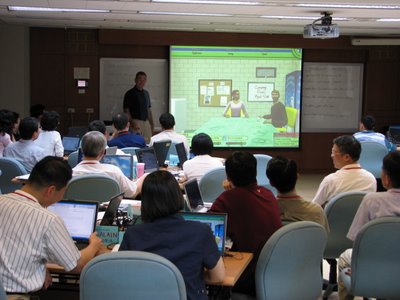 Real people and avatars? Coaches, students, and characters? Teammates and competitors? Buddies? Colleagues? Leader and followers?
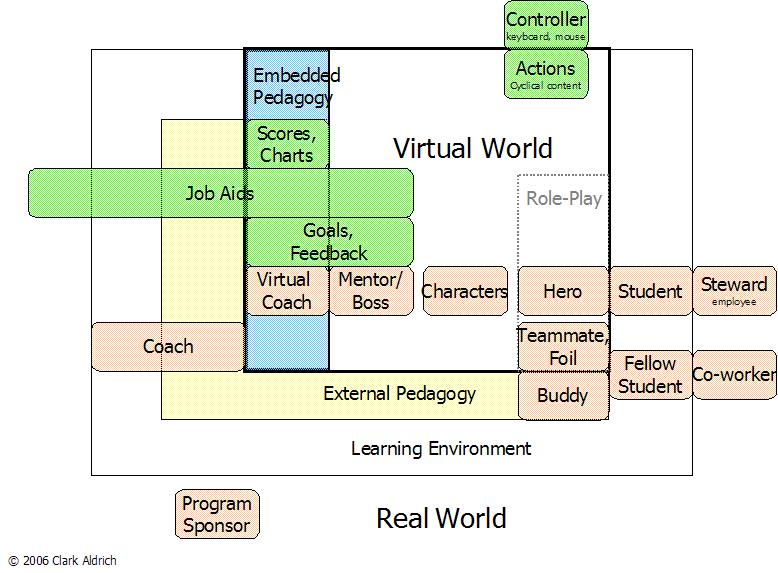
A challenge in discussing educational simulations is that the same person has different roles, depending on if you are looking at the context of the virtual world, the classroom, and the real world. For example, the same person can be a hero in the context of the sim, a student in the context of the class, and a project manager/steward in the context of the enterprise.
Likewise, coach can refer to an embedded, pre-scripted avatar and/or a real person.
Characters in the sim can only exist in the sim, or be controlled by other students. A colleague of yours (context: real world) can help you either by being a teammate (context: virtual world) or a buddy (context: classroom). (The difference being a teammate helps you in the sim, a buddy helps you understand the sim.)
It is further interesting to note what a simulation adds to the more traditional concept of a role-play.
Productive comparisons and best practices require a common vocabulary. I have working definitions of all of these role, but here's a first draft at a chart to put it all together.
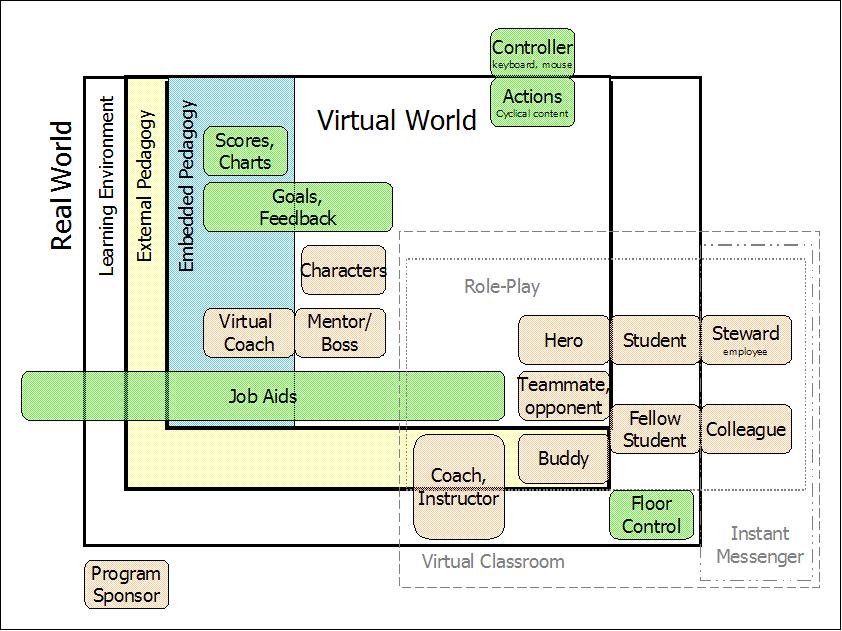
As always, I would appreciate any feedback.
Subscribe to:
Posts (Atom)

 Posts
Posts