I had to brush up on project management skills over the weekend. Did I read a book on it? No. Did I find someone who was an expert to help me? Nope.
I downloaded Open Workbench (for me, a random open-source project management tool) and played around with it. I mapped a few of my projects into it. I looked through all of the fields and capabilities. And I learned quite a bit, including what I needed to know, plus a lot more that I am very happy to know.
For those home schoolers looking at math curricula, I would suggest Microsoft Excel. Whatever math you need to know, you can learn by getting deeper and deeper into Excel functionality, including calculus, logic, probability, graphing, and more.
And you can learn by trial and error, by playing, by experimenting. You discover the material; you own the material.
There are plenty of dangers, I suppose, with having the tool be the curriculum. I am sure academics will be happy to tell me what they are. But increasingly mature software tools represent philosophies, approaches, domain knowledge that is much more sophisticated than the more trivial linear experts. And you can learn by doing.
My grandparents learned to read by picking up the classics out on the farm. Bach learned music, I am told, by copying over the sheets of the great composers before him. I wonder if today's tools will be considered tomorrow's classics?
Monday, August 29

Saturday, August 27
E-Learning: Channels, piracy, and outrage PLUS REGULATIONS
I was thinking about the earlier post on how will we know we are getting close to e-learning meeting its potential. I thought of one more, slightly further down the road.
- Regulations! How long until we see- WARNING - Use this e-learning product only as specified. It is against the law to use this e-learning product in a manner inconsistent with its labeling.
Friday, August 26
A Snapshot of Leadership Training in the Enterprise

As part of rolling out Virtual Leader, it has been interesting for me to note how most organization who do formal leadership training actually do formal leadership training.
I think most terms are self-evident, but external coaching can also include board involvement. Tools include focused performance support.
The high-potential focus is not exclusive of other manager and supervisor leadership training.
Wednesday, August 24
MoodleQuest
I am going spend about two weeks now trying to get up to speed on Moodle, ultimately evaluating it (against other tools) for implementation.
I will share relevant data and artifacts as I come across them.
All comments are appreciated.
I will share relevant data and artifacts as I come across them.
All comments are appreciated.
How to Optimize Organizational Learning (inclusive)
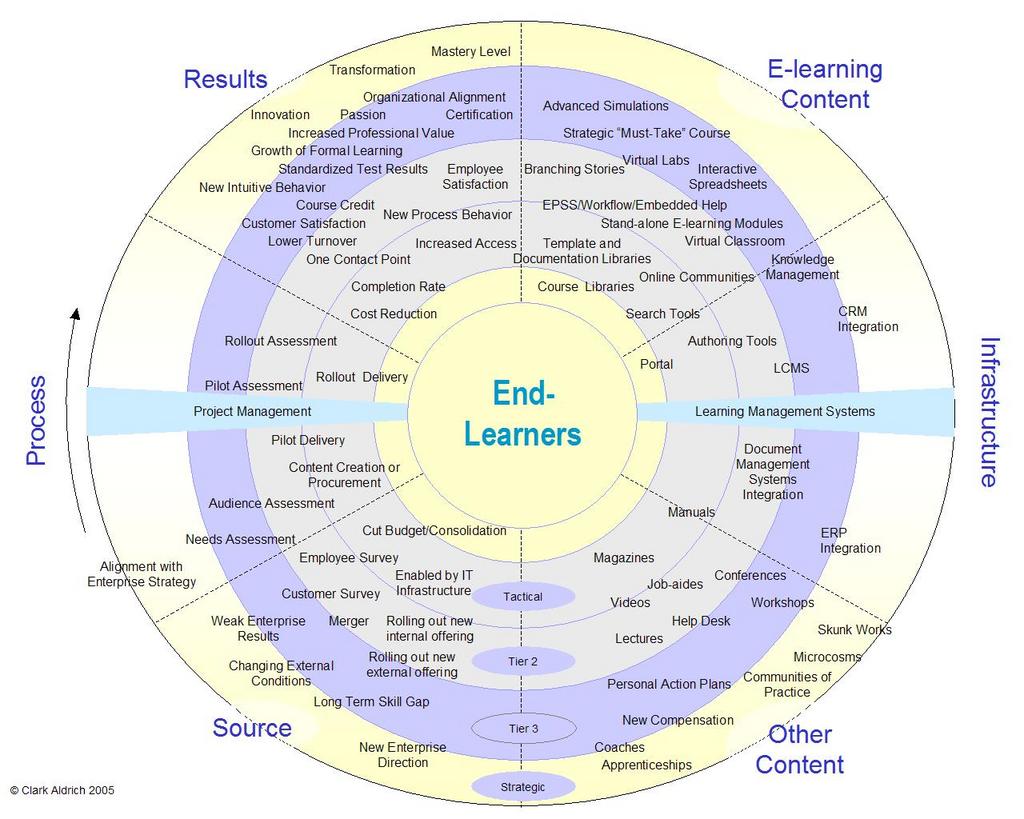 Here is the newest version of my accord chart. I continue to update it based on experiences in the field and even comments from this blog! It is a snapshot of all of our various options, the arrows in our quiver. Each have trade-offs; each have benefits. The question is no longer, which to do, but more, can you do each at the right time?
As with the consolidation chart, I am happy to send it anyone who emails me for it.
Tuesday, August 23
How to Optimize Organizational Learning
Recently while researching on the web on topics regarding Communities of Practice I came across the Community Intelligence Labs (CoIL) website. While it seems the website may have gone the way of the Brontosaurus (the last update was in Feb 2004), it's resources are still there for the viewing. Among them I found the following 14 guidelines on How to Optimize Organizational Learning written by Entienne Wenger in the summer of 1996 for the Healthcare Forum Journal.
I thought it would be interesting to get your take on these 14 guidelines now 9 years after Wenger first penned them. He introduced these guidelines with:
I thought it would be interesting to get your take on these 14 guidelines now 9 years after Wenger first penned them. He introduced these guidelines with:
Here are the 14 guidelines to help you work with rather than
against the inner logic of organizational learning:
against the inner logic of organizational learning:
Obviously, 9 years later, some of these guidelines are either proven or widely held to be true. I also would say it's obvious that communities of practice are thriving that would indicate that these guidelines are being well applied. Some of the questions I'd like to hear the LCB community chime in on are:
- View learning as work and work as learning. Recognize learning in all it's forms in order to find ways to nurture it and connect it across the organization.
- Count on the informal. That is where work gets done.
- If there is a learning problem, look for patterns of social participation and exclusion.
- Keep learning as close to practice as possible.
- Treat Communities of practice as assets.
- View individuals as members of communities of practice, not by stereotyping them, but by honoring the meaningfulness of their participation.
- Encourage the formation and deepening of communities of practice by legitimizing the work of pulling them together and valuing the informal learning they facilitate.
- Manage boundaries between communities of practice as opportunities for learning.
- Expect transformations, misunderstandings, and reinterpretations when people, artifacts and information cross boundaries of practice.
- Value the work of brokering learning among communities; it often does not look like work.
- Be attuned to the emergence of new practices at boundaries.
- View the organization as a constellation of interconnected practices.
- Put communities of practice in charge of their learning, recognizing that they need access to other practices in order to proceed.
- Make sure that the organizational apparatus is in the service of practices, and not the other way around.
- Are any of these guidelines obsolete, or impractical to such a level, that they should be struck from the list?
- Which among the 14 are the "pain points" that corporate cultures just can't seem to get past, thus blocking the emergence of vibrant CoP's?
- What's the role of collaborative technologies to date in this? Have they helped nudge along a very slow adaptation process? Or have then hindered the effort?
Monday, August 22
What's your most memorable conference experience?
What makes for a conference event with impact? I'm building a list of what works best. What's your most memorable conference event? What delivered the most learning impact? I'll tell you mine; tell us yours in the Comment section.
About ten years ago I attended a presentation by the late Gordon MacKenzie, the "creative enigma" of Hallmark Cards and author of the wonderful book Orbiting the Giant Hairball. He hung a clothesline across the stage at the annual meeting of the Instructional Systems Association and pinned a dozen doodles on 8 1/2" x 11" sheets to it. The audience would point to a sheet, and Gordon would tell its story.
Gordon's stories were heartfelt, emotional, and often very personal. At times it felt like the story was telling Gordon rather than the other way around. Gordon broke into tears several times, and tears streamed down our faces in empathy.
Gordon shared another story with me over lunch. When he started a day with no particular objective, he would tell himself that during the day he was going to be amazed. And he always was. Gordon taught me a lot about feelings and sensitivity to others that day. He also demonstrated that the sequence of stories in a presentation isn't always that important. I mourned when his widow told me Gordon had passed on.
About ten years ago I attended a presentation by the late Gordon MacKenzie, the "creative enigma" of Hallmark Cards and author of the wonderful book Orbiting the Giant Hairball. He hung a clothesline across the stage at the annual meeting of the Instructional Systems Association and pinned a dozen doodles on 8 1/2" x 11" sheets to it. The audience would point to a sheet, and Gordon would tell its story.
Gordon's stories were heartfelt, emotional, and often very personal. At times it felt like the story was telling Gordon rather than the other way around. Gordon broke into tears several times, and tears streamed down our faces in empathy.
Gordon shared another story with me over lunch. When he started a day with no particular objective, he would tell himself that during the day he was going to be amazed. And he always was. Gordon taught me a lot about feelings and sensitivity to others that day. He also demonstrated that the sequence of stories in a presentation isn't always that important. I mourned when his widow told me Gordon had passed on.
"Grand Theft Auto"ing Edutainment Software
Grand Theft Auto might be the worst game series ever, in part because it might be the best.
Almost Microsoft-esque, GTA has absorbed and fairly seamlessly integrated different genres, including driving games, first person shooters, fighting games, gambling games, flight simulators, adventure games, shopping games, role-playing games and more.
My last post got me thinking. What if one took a GTA approach to edutainment software?
What if you could create, over multiple iterations, an experience that both included a generic, open ended "real-world" environment with specific missions to increase capability?
You could absorb:
I'm in!
Almost Microsoft-esque, GTA has absorbed and fairly seamlessly integrated different genres, including driving games, first person shooters, fighting games, gambling games, flight simulators, adventure games, shopping games, role-playing games and more.
My last post got me thinking. What if one took a GTA approach to edutainment software?
What if you could create, over multiple iterations, an experience that both included a generic, open ended "real-world" environment with specific missions to increase capability?
You could absorb:
- Pet simulators/trainers
- Lemonade stands
- Tycoon (designing interactive environments, such as store layouts and zoos)
- Designing (building cars for example, or new computers, or new clothes. If a persistant world had a GTA visual structure, you could see hundreds of people wearing your trendy new hats as you walked down the street)
- Business building/ logistics
- Logic games
- Historic settings
- Physics simulators
- Medical/vet
- Ecosystems/genetic engineering
- Space
- Traffic Emergencies
- Negotiation simulators
I'm in!
Once a Booming Market, Educational Software for the PC Takes a Nose Dive
The New York Times ran a piece today about the crash and burn of the K-12 educational software market. To sum it up, once thriving, large, and profitable, the industry niche today, well, isn't.
I would be the first in line to buy any software that helps my son. But my own personal experiences with the "edutainment" software was pretty unsatisfying.
There were technical problems, production problems, quality problems, and just uninspired content problems.
Often times, the game elements, such as the cartoon rabbit, were not things to which my son could relate.
The general genre itself, the adventure game punctuated by unrelated, abstract exercises, was pretty uninteresting, especially as it was disconnected from the content.
I wrote in Learning By Doing:
Some game-based models use adventures games, a genre popularized in early computer games. Students traverse maps, either from a firstperson or top-down perspective, looking for pieces of information or performing small tasks to unlock new parts of the map.
This was the model for much of the early educational software. ("Sure Miss Squirrel, you can come into our clubhouse filled with toys and friends. But you have to identify these right four physics laws to get the key." There are also corporation examples, that might read, "Sure Mrs. Squire, you can come into the executive board room filled with stock options and great contacts, but you have to identify the right four ethics policies to get the key.")
Besides the reasons mentioned by the article, Will Wright has mentioned one reason he thought was the problem: increasingly kids are choosing/buying software, not adults.
Here are some reflections I have for the edutainment marketplace:
I would be the first in line to buy any software that helps my son. But my own personal experiences with the "edutainment" software was pretty unsatisfying.
There were technical problems, production problems, quality problems, and just uninspired content problems.
Often times, the game elements, such as the cartoon rabbit, were not things to which my son could relate.
The general genre itself, the adventure game punctuated by unrelated, abstract exercises, was pretty uninteresting, especially as it was disconnected from the content.
I wrote in Learning By Doing:
Some game-based models use adventures games, a genre popularized in early computer games. Students traverse maps, either from a firstperson or top-down perspective, looking for pieces of information or performing small tasks to unlock new parts of the map.
This was the model for much of the early educational software. ("Sure Miss Squirrel, you can come into our clubhouse filled with toys and friends. But you have to identify these right four physics laws to get the key." There are also corporation examples, that might read, "Sure Mrs. Squire, you can come into the executive board room filled with stock options and great contacts, but you have to identify the right four ethics policies to get the key.")
Besides the reasons mentioned by the article, Will Wright has mentioned one reason he thought was the problem: increasingly kids are choosing/buying software, not adults.
Here are some reflections I have for the edutainment marketplace:
- Interactivity is key, with real interactivity around the learning, not just propping up workbook style content.
- Math is especially tricky. Math doesn't exist on its own! Math is itself a pedagogical layer, a set of tools to better understand the world. It needs to be handled as such, not futher burried under more and more layers of abstractions.
- Game elements need to be specific to the user. Anything interjected to be "fun" has to be able to be modded very easily, almost like skins. Any student should have a choice of at least five different themes.
- Building rewards creativity, and gives more ownership to the player.
Having said all of that, edutainment needs to be re-invented. As with American car manufacturers after producing Gremlins and Falcolns, there is so little credibility that a new brand has to emerge.
Saturday, August 20
E-Learning: Channels, piracy, and outrage
I said back in a speech in 1999 that e-learning was over-rated in the short term and under-rated in the long term.
I believe that statement is probably more true today, at least for the formal learning area. (Tools like Google and IM have proven the killer-apps for the informal areas.)
Wearing my analyst hat, I am looking for at least three things to see when formal e-learning hits the big time:
I believe that statement is probably more true today, at least for the formal learning area. (Tools like Google and IM have proven the killer-apps for the informal areas.)
Wearing my analyst hat, I am looking for at least three things to see when formal e-learning hits the big time:
- One is channels. We have talked about this on this blog. When e-learning becomes its own category at Amazon, that will be a milestone. The best producer of the types of simulations I would call branching stories, WILL Interactive, created an experience about sexually transmitted diseases. Users play one of two characters as they live an afternoon and an evening, making key decisions. The experience is honest, educational, relevant, and potentially life saving. Why isn't this in every library in the United States? There are plenty of people "studying" simulations. I would say to all of them, use your resources instead to go on a mission and get that single experience widely distributed. You will both learn more, and help more, than studying eight year olds playing computer games or bringing together academics and corporate people to talk about best practices in simulation design.
- The second is piracy. Are people ripping off e-learning courses? Are e-learning courses being downloaded, tinkered with, and being resold on the black (or gray) market? Are some government officials in a poorer nation deciding that it is worth a bit of heat to distribute knock-offs of life improving exeriences? Why not?
- The third is outrage. We are seeing a tiny taste of it with University of Phoenix. At some point, however, the success of formal e-learning will be putting a lot of professors out of work. More importantly, there will be complaints of vast homoginization of high school and university content. Ironically, there will be a race, between using simulation techniques to actually better preserve local ways of doing business, and the the propagation of single ways (much, much better skills than are possible today) that will threaten to erase diversity of knowledge. Buzz words like mono-knowledge will get headlines.
Are we there yet? We are not even close.
Friday, August 19
San Francisco and Los Angeles as different (but complementary) models for Formal Learning
There continues to be a movement in corporate formal learning programs to uber-empower the learner and focus the role of content designers to a more infrastructure role. Google and Instant Messenger are the perfect model for many. And I mostly agree with this "Bay Area" position.
But I also believe that "Passionate learners come from Passionate designers." Call it the "Los Angeles" take. The best movies, television shows, books, and computer games come from people passionate about the content, (although they rely on and assume the infrastructure). This passion was often true during the mom and pop instruction era, and it has to be more true in the era of scalable instructional content as well.
Being involved in, and watching, this passion around content is one reason why the educational simulation/ serious games movement is very interesting to me.
But I also believe that "Passionate learners come from Passionate designers." Call it the "Los Angeles" take. The best movies, television shows, books, and computer games come from people passionate about the content, (although they rely on and assume the infrastructure). This passion was often true during the mom and pop instruction era, and it has to be more true in the era of scalable instructional content as well.
Being involved in, and watching, this passion around content is one reason why the educational simulation/ serious games movement is very interesting to me.
Thursday, August 18
Smackdown Learning
I find myself drifting to Kathy Sierra's blog, Creating Passionate Users, because it seems a lot like creating passionate learners. Plus it is wacky and inspirational.
I have no clue how I first stumbled on it, but take a look at this recent entry- The Smackdown Learning Model.
I have no clue how I first stumbled on it, but take a look at this recent entry- The Smackdown Learning Model.
What happens to your brain when you're forced to choose between two different--and potentially conficting--points of view? Learning. That's what makes the smackdown model such an effective approach to teaching, training, and most other forms of communication.Cognitive dissonance meets Celebrity Deathmatch. You gotta love/hate it.
SimJournal: The "problems" with richer content
Simulations require more content than linear content. Much more. This changes a lot.
- There is an exploration of failure. Most corporate people don't like talking about, let alone mapping out, things that went wrong. Obviously finding people to talk about failure in detail is difficult.
- You can't be politically correct at the expense of accuracy when creating a simulation. Can you imagine making a simulation of a car that works the way the designers hoped a car would drive, instead of the way a car really drove? Of course not. Likewise, simulations that present idealized world views are quickly found out.
- The more content, the harder it is to translate to other languages. Many people act as if ease of translation of a course is a good thing, not a bad. Of course it takes less time and resources, but less content is less content. Some say, "simulations get into cultural issues and behavior, which makes them harder to localize." I say, "simulations get into cultural issues, so they actually work."
I think the best quote about simulations comes from outside the field:
Nineteenth-century mathematicians discovered to their discomfort that as the conceptual machinery of mathematics became more precise, it became more difficult.—David Berlinski, The Advent of the Algorithm
Wednesday, August 17
SimJournal: Stumbling upon a great score
Every once in a while, some one will do very well in Virtual Leader, but doesn't know why and can't repeat it.
The tools are there to analyze the play, but they quickly move on, assuming that they are just naturally good. Then they hit a wall, sometimes even replaying the same situation, get stuck, and then get very frusterated.
For some people, this strikes them as being unrealistic. But the more I think about it, the more I realize how very realistic it is. There are too many managers who got lucky a few times, and then are desperate not to understand their own success, but just assume they are naturally gifted and get promoted.
Simulations will continue to change our view of learning, and even our view of ourselves.
The tools are there to analyze the play, but they quickly move on, assuming that they are just naturally good. Then they hit a wall, sometimes even replaying the same situation, get stuck, and then get very frusterated.
For some people, this strikes them as being unrealistic. But the more I think about it, the more I realize how very realistic it is. There are too many managers who got lucky a few times, and then are desperate not to understand their own success, but just assume they are naturally gifted and get promoted.
Simulations will continue to change our view of learning, and even our view of ourselves.
Tuesday, August 16
Computer Games and Classrooms already share one limiting feature
People, such as myself, are advocating a time when classrooms borrow more lessons from computer games. But they already share one, not-so-great similarity. They are both self-referential.
- Doing well within the world of a computer game, be it buying the biggest house or uniting the world, is in itself victory. There is no need to transfer that to the outside world before getting the accolades. And you are not directly better prepared to actually buy a bigger house, or unite the world, for having played the game.
- Similarly, most classrooms are self-referential. Getting the 'A' does not mean that you were successful outside the classroom, just inside.
Now in both cases, there may be correlations. The 'A" student and great gamer might be better able to get and perform complex jobs. And in the case of the 'A" students, they can stay in the self-referential academic world indefinitely, eventually getting tenure. But there is also the opportunity to 'game' the systems, building skills sets that actually hurt the opportunity for success outside the enclosed environments.
With all of that as background, I found these ideas on massively multi-player online role playing games (thanks, Kevin Kruse for sending it to me) very interesting. There are at least two parts to it. One is what happens when games have consequences outside the self-reference. The second is, how can gamers, like our life-long academics, never leave the self-reference and do quite well.
Still, with the exception of a few monks, the vast majority of us are going to have to transfer skills, knowledge, and perspectives between these various walled gardens. Smoothing those transitions are both quite difficult and, I suspect, world-changing.
Monday, August 15
Learning to Control our Moods
In Do Androids Dream of Electric Sheep?, author Philip Dick imagined a society where people regularly took drugs to change their mood.
The only two pills I personally take are vitamins and the occasional Tylenol. I love my morning coffee, enjoy a dose of chocolate every couple of days, and probably have one alcoholic drink a month, on average.
But I realize that I am increasingly using my Ipod (with no music, mind you, just podcasts) as my personal mood regulator. I listen to IT Conversations when I want to build a healthy motivation and "white collar" work level, including driving to a meeting. I listen to political commentary when I want to physically rev myself up, say when doing yard work. And I listen to movie reviews at the end of the day to wind down.
I noticed a similar trend in myself when I started organizing Internet bookmarks/favorites by day of the week. Some clicks were better for Monday, and others for Friday or Saturday.
I believe this kind of mood awareness/engineering may become increasingly relevant for both deploying personalized learning programs and even planning formal learning events.
The only two pills I personally take are vitamins and the occasional Tylenol. I love my morning coffee, enjoy a dose of chocolate every couple of days, and probably have one alcoholic drink a month, on average.
But I realize that I am increasingly using my Ipod (with no music, mind you, just podcasts) as my personal mood regulator. I listen to IT Conversations when I want to build a healthy motivation and "white collar" work level, including driving to a meeting. I listen to political commentary when I want to physically rev myself up, say when doing yard work. And I listen to movie reviews at the end of the day to wind down.
I noticed a similar trend in myself when I started organizing Internet bookmarks/favorites by day of the week. Some clicks were better for Monday, and others for Friday or Saturday.
I believe this kind of mood awareness/engineering may become increasingly relevant for both deploying personalized learning programs and even planning formal learning events.
Friday, August 12
Criticizing the person versus criticizing the idea
One aspect of Virtual Leader that I have liked is that it forces players to differentiate between criticizing ideas and criticizing the people who sponsor them.
And yet, the exact mixture of the two provides a lot of additional information as to how raw, even how religious, the conversation is getting.
A post I made on schools and business hating each other definitely hit a bit of a nerve with some people outside our community, posting in.
But no topic raises such primal emotions as talking about post-literacy. The very idea that books are "just" a technology, three steps forward and one step back (my own working definition of any technology), strikes some people as blasphemous. It comes off as anti-book, as if being pro-automobile is the same as being anti-walking. One friend asked me not to use the phrase around her.
We are going to have to begin talking about post-literacy. The irony is that as we explore the topic, our love for reading and writing will become more heightened, not less.
And yet, the exact mixture of the two provides a lot of additional information as to how raw, even how religious, the conversation is getting.
A post I made on schools and business hating each other definitely hit a bit of a nerve with some people outside our community, posting in.
But no topic raises such primal emotions as talking about post-literacy. The very idea that books are "just" a technology, three steps forward and one step back (my own working definition of any technology), strikes some people as blasphemous. It comes off as anti-book, as if being pro-automobile is the same as being anti-walking. One friend asked me not to use the phrase around her.
We are going to have to begin talking about post-literacy. The irony is that as we explore the topic, our love for reading and writing will become more heightened, not less.
Thursday, August 11
Flow
 Dutch composer Simeon ten Holt wrote Canto Ostinato (mp3 file) for various instruments and flexible duration. Ten Holt uses repetition and minimalist permutations to create an original, evolving work with ever-shifting moments. These parts are woven together into an overlapping and flowing whole.
 One popular arrangement is to have three or four pianos facing each other in the center of a room, and normally, unlike conventional performances, the audience is allowed to move and surround the performers as they play.

Canto Ostinato has 106 figures or parts and the players themselves, decide on the stage, how many times they repeat each section, etc. Ten Holt has said, "that what happens on-stage is like you're looking at an object from different angles, and the object is changed by the input people put into it. If you look at an object from above or below, it's still the same object, but the colours are different, the shapes are different, and that's what happens on-stage. So the players' input is very important."
Canto Ostinato has become a metaphor for a new approach to design (Thackara, 2005). The composer, score, musicians, stage, and audience all interact in subtle, yet complex ways. Neither the musicians or the audience knows exactly what will happen next as the arrangement is quite flexible. But they are not flying blindly as there are principles and to a point, a score. Thus, the situation itself, in a sense, becomes designed.
Flows are not just one element of social organization, they are the expression of the processes dominating our economic, social and symbolic life - Manual Castells in The Rise of Network Society.
Notice how this relates to performance management. There is a space of flows in each performance situation -- techniques, technologies, information, sounds, symbols, people, and the performance itself. Yet, like the Canto Ostinato, while there is a score (goal or blueprint); life unfolds anew, thus, each situation basically designs itself.
Fredick Taylor's Scientific Management tried to freeze the performance and then totally script it. While Taylor's method focused primarily on the process itself, flow is more about helping people to develop so that they can perform. The manager becomes more like Ten Holt in that he or she givers her players a score to follow and conducts them, while at the same time giving them the freedom so that the situation is allowed to design itself, rather than just becoming a carbon copy. Thus, rather than just simply following a script, interaction becomes a major part of the performance.
Reference
1. Arrangement (mp3 file) by Jeroen Van Veen
Evaluation of Formal Learning Programs is a marketing activity
One should not evaluate a formal learning program to justify that the money and time were well spent. One should evaluate a formal learning program to get resources for the next program.
If there is a "level 6" evaluation of a training program, it is, "did it lead to growth of the training program/growth of the training group/promotion of the sponsor?" If not, all other metrics are irrelevant.
Of course lessons learned should make the next program (the X+1 program) better. But the driver of those improvements is to get an even better evaluation of X+1 than of X, so that selling the X+2 program is easier.
There are those who view marketing as selective truth telling at best and lying at worst. That is too bad, because ultimately marketing is evolving the premise for a sustainable vendor relationship. It involves as much listening as talking.
Credibility is hugely important, therefore. Honesty is a sine que non of any sustainable brand. But the culture of the group has to be growth through success, not just introspection. Evaluations should be done looking forward and outward, not backwards and inward.
If there is a "level 6" evaluation of a training program, it is, "did it lead to growth of the training program/growth of the training group/promotion of the sponsor?" If not, all other metrics are irrelevant.
Of course lessons learned should make the next program (the X+1 program) better. But the driver of those improvements is to get an even better evaluation of X+1 than of X, so that selling the X+2 program is easier.
There are those who view marketing as selective truth telling at best and lying at worst. That is too bad, because ultimately marketing is evolving the premise for a sustainable vendor relationship. It involves as much listening as talking.
Credibility is hugely important, therefore. Honesty is a sine que non of any sustainable brand. But the culture of the group has to be growth through success, not just introspection. Evaluations should be done looking forward and outward, not backwards and inward.
How effective is your learning evaluation?
The evaluation of training is too important to be left to trainers.
At the individual intervention level, at the strategic enterprise level, and at all points inbetween, the quality assurance processes applied to formal learning initiatives in most organizations are, in my experience, rudimentary at best.
Training departments are usually stretched thin, and don’t have the time or resources to do a “proper” quality assurance job at either the course level or at the aggregate departmental level. Implementing a regimen that elevates the strategic importance of evaluation (across all levels) and places it on a more professional level will do two vital things. It will improve significantly the effectiveness and efficiency of all learning activities; and it will save a tremendous amount of unnecessary, un-useful, or redundant work.
My fear is that with the advent of LMS-based evaluation and record-keeping, the information we have about the quality of our learning activities is becoming more narrowly focused, and its usefulness is becoming further diluted. Just as LMS functionality tends to constrain the nature of our design of instruction, it constrains the nature of our inquiry into its impact.
I’d like to see more training departments creating evaluation units and staffing them with a trained expert or two who can help get past the simplistic "smile-sheet & ROI" approach and start building systems that put the important issues on the dashboards of individual trainers, instructional designers, and senior learning managers.
At the individual intervention level, at the strategic enterprise level, and at all points inbetween, the quality assurance processes applied to formal learning initiatives in most organizations are, in my experience, rudimentary at best.
Training departments are usually stretched thin, and don’t have the time or resources to do a “proper” quality assurance job at either the course level or at the aggregate departmental level. Implementing a regimen that elevates the strategic importance of evaluation (across all levels) and places it on a more professional level will do two vital things. It will improve significantly the effectiveness and efficiency of all learning activities; and it will save a tremendous amount of unnecessary, un-useful, or redundant work.
My fear is that with the advent of LMS-based evaluation and record-keeping, the information we have about the quality of our learning activities is becoming more narrowly focused, and its usefulness is becoming further diluted. Just as LMS functionality tends to constrain the nature of our design of instruction, it constrains the nature of our inquiry into its impact.
I’d like to see more training departments creating evaluation units and staffing them with a trained expert or two who can help get past the simplistic "smile-sheet & ROI" approach and start building systems that put the important issues on the dashboards of individual trainers, instructional designers, and senior learning managers.
Subscribe to:
Posts (Atom)

 Posts
Posts


