Tuesday, March 28

The Genetic Differences Between Games and Instructional Design (Clark Quinn Beats Me to the Punch)

Darn Clark! And here I was going to spring this same post. Anyway, since you already spilled it, I want to follow and extend a bit.

What Clark posted was a little re-cap of part of the keynote that Nintendo president, Satoru IwataIwata2_1 delivered to a packed house at this year's Game Developers Conference. I'll say that I was in the audience that packed the San Jose Civic Auditorium (we were actually 2-3 deep standing around the top and some were left outside - the capacity is slightly over 3,000). Let me just say - the dude was ON! Forget the problems of english not being a first language - Iwata was engaging, funny, personable and darned interesting.

Clark, in his post, points to a section of Iwata's speech in which he (Iwata) lays out the "Four I's" that Nintendo uses as game development standards. They are:

"First, is it truly innovative - something different from what has come before? Second, is it intuitive? Do the control of the game and the direction of gameplay seem natural? Third, is it inviting? Do you want to spend time in this world? And finally, how does it measure up in terms of interface? Can the player connect in new ways?"

Here is what I want. Quick - someone start talking to me about how these are not valid design considerations for learning. Start telling me about how what we do is serious and this stuff is just frivolous, meaningless - dare I say the "F" word? Fun? Tell me about constraints. Tell me how learning is different from gaming. Tell me about how so much of our thinking about learning is calcified and how we as an industry seem to have lost the ability to think within frameworks such as this. Someone tell me how putting the "next" button in the lower right-hand corner (oohhh maybe with rounded edges instead of square ones) is inviting, intuitive, innovative or considers the user as a requirements generator in the design of the interface at all!

I swear I think I know what it is - and the news is both good and bad. The good news is that's its not really our fault - phew - as instructional designers, we were just born like this. Like color blindness or being tone deaf- our handicap doesn't prevent us from functioning in the world - just from perceiving it clearly. The bad news is that its genetic - this goes to our core and it reveals the shocking fact that gaming and instructional design (note: I did NOT say learning) come from two distinct evolutionary branches.

Gaming comes from play and art and music  - from a creative place. Where does instructional design come from? There are a few probable fathers but chief amongst them is World War 2. The real drivers were the need for effeciency and effectiveness. Not exactly the most forgiving or indulgent of parents. So now we come to present day and shocker!...processes derived from a need to have a conscript military force rapidly trained in set patterns...are breaking down in the face of generational and technological changes that were never anticipated or dreamt of at the dawn of ISD (at least not by instructional designers).

So we have a practice, a set of ways of knowing what to do, that are radically unable to keep pace (and its getting worse) and all we can seem to talk about is how to generate templates faster. We need to be talking about gene therapy; about some radical treatments that can save the best values of ISD and yet jettison - in some wholesale fashion - the outdated and outmoded ways of thinking about humans and how they learn (but that's really not what we think about is it?).

What is the answer? I don't know. I know enough to listen though when a man speaks who has a set of design principles flexible enough to produce both Super Mario Kart and Brain Age. Let's stretch people...left leg...on three....

Monday, March 27

Let's Talk Some Serious Numbers

OK. So I just got back from a week in San Jose at the Serious Games Summit / Game Developers Conference. I have a lot to post about things I saw/heard there and I'll probably split the postings between here and my blog. I did want to throw these numbers out though as a discussion starter...they are from Philip Rosedale, CEO and Founder of Linden Lab 'ne Second Life.
  • Number of residents: 166,000+
  • Number of ongoing educational or 'Serious' research projects: 100+
  • Size of Second Life: 32,000 acres (bigger than Boston)
  • Amount of real world currency (in US$) traded annually for goods and services (i.e. paid between residents): $160,000,000 (yes, that's million)
  • Number of user-created objects: 10 million
  • Size of user-created data: 10 TBytes (yes, that's a T)
  • Number of unique items sold/traded monthly: 230,000
  • Number of events per day: approx. 500
  • 43% percent female
  • 25% non-US
Keep in mind - Second Life is NOT a game - it is a platform.

BusinessWeek piece on Serious Games

In case you are interested, here is a link to BusinessWeek's new piece on serious games used in corporations.

Take a look at the screen shots through the context of Situational Awareness.

Gaming Classrooms

When showing a great simulation to an instructor, I often get back the following response.

"It seems like students could game this." Then the instructor leans back, smiling triumphantly, as if having delivered the killing blow.

"Well, the simulation represents about 15 hours of student time. Sure, if they wanted to put in an additional 15 or 20 hours, they could probably get a better score not on their successful integration of productive knowledge, but on finding the cracks in the scoring algorithm and level design." I reply. "But that would almost necessarily come after they learned quite a bit."

The instructor shakes his or her head. "The whole gaming thing troubles me. We need to have a higher level of integrity in any kind of grading or scoring."

Here, for the first time anywhere, is what I really want to say:

"Listen. I have been gaming classrooms for my entire life in order to get better evaluations, comments, grades, or certification scores. I have been dressing appropriately, feigning interest in topics that bore me beyond belief, cramming for tests in a way where my command of the information has a half life of hours desperately hoping that I forget the information moments after I write it down not moments before, skimming tangential sources to ask the one question that makes me seem much more knowledgeable than I really am, interviewing past students to see what will be on the test, playing back what the instructor said without understanding it at all, and pretending to take notes when I am really designing a biosphere in the margin. You want to talk about gaming? What do you think all of your students are doing all of the time?"

On the Sublimity of Practice

I am writing up an article on the nine paradoxes of educational simulations for T+D magazine.

When talking about my personal favorite, number four, I had two comments I just couldn't wait to share.

Jake Stahl, Director, Client Systems Delivery, Purdue Pharma, “If Joe Montana said to me that throwing a football is simple, I would agree that from his perspective it is. But can he explain to me in words how to do it, or does he need to show me? Once he shows me, do I now know, or do I need to practice? Once I practice, have I perfected it or do I need to fine tune?”

To Jake's comment, SimuLearn's Ken Kupersmith added, "And, finally when is my skill good enough, or should I always be striving for improvement. Even professional baseball players have a spring training every year to practice and improve, and often they have practice during the season when they do not schedule a game."

So often, formal learning seems like a desperate chase to cover as much ground as possible, inevitably at the expense of depth. We love long lists of learning objectives"covered." But the real magic might be in "learning" less but practicing more.

Friday, March 24

I need your advice on learning profiles

full disclosure - As some of you may know, I joined Thomson NETg in January to run one of their strategic business units called Collaboration (essentially what was KnowledgeNet whom they acquired in late 2004).

Very exciting (at least to me) but what I need is your feedback on a tool that Thomson NETg developed which I think is a hidden gem. By answering 25 online questions it builds a high-level personalized learning profile (for overall learning not just eLearning). I took it and found it to be very useful plus there is little marketing or promotional BS.

A sample question is:
When you get to work on Monday morning, you discover that, over the weekend, a new phone system was installed in your company. The first thing you need to do is to set up your voice mail for the first time. All employees have been given a short manual about the new system.What do you think you would do?
• I would read the manual, then attempt to set up my voice mail.
• I would start setting up my voice mail and never refer to the manual.
• I would start setting up my voice mail and refer to the manual only if necessary.
• I would ask someone else for help before attempting to set up my voice mail.

Knowing that many of you are experts in this field I would really appreciate it if you could look at it and post your feedback in the comments below. Is this useful or just cleverly cloaked marketing?
http://learningprofile.netglearning.com

There is also a good document that goes into the educational theory behind the tool but is more self-promotional:
http://www.netg.com/pdf/NETg_WhitePaper_Profiling_the_Adult_Learner.pdf

Thanks,
Ben

If you get prompted for some reason to login to see this stuff just use my email address ben[dot]watson[at]thomson[dot]com

Wednesday, March 22

"Research" as Pawn to Support the Status Quo

I love research, maybe a bit too much. I love measuring effectiveness. I love making sense of chaos that enables predictability. I love presenting hard evidence.

And yet...

And yet the phrase "we need to do research" more often than not is a code phrase for, "we just don't want to move ahead" without having to justify the action, or to appear in favor of something while trashing it. When George W. Bush, early in his presidency, said that he wanted to study global warming, he did not mean "I really want to act on this; let's make it a priority to understand the exact nature of the problem so that we can apply comprehensive yet targeted solutions," what he meant was, "I don't want to deal with it."

Our industry seems addicted to this best of all excuses, both because it plays to a supposed strength (we are smart people who like talking about using our brains and employing a rigorous process), and our weakness (we hate pulling the trigger).

Monday, March 20

kowabunga dude!

i just had the experience that i'm sure happens to many of us.  i was reunited with a long lost favorite website. the collaborative learning environments sourcebook was one of the first resources i use when i began learning about communities of practice.  unfortunately somewhere along the way i "lost" my bookmark for it.  (thus the power of bookmarking services like blinklist, de.licio.us, and the like.)
Kowabunga

but what struck me as worth blogging about was that i rediscovered this resource through practicing one of the first forms of informal learning that the internet spawned - web surfing.  back in the barbaric dark ages of web 1.0 before rss, news aggregators, blogrolls, technorati tags and folksonomies, most "webbies" would wander around from site to site, following whatever link caught their imagination. 

today the web is about finding information you "know" is there and thus tools from google to tags to rss feeds are created to help you pinpoint what you need to find as quickly as possible.  but back in the day, the internet was still evolving.  you really had no idea what you might find.  there was even a time when browsers didn't have book marks. (i recall having a legal pad with urls scribbled on page after page.)  so you would just sign on, log into a site you knew had some interesting links, pick one and off you would go, surfing from one site to another.  it was like a scavenger hunt every time you went on the net. 

my favorite discoveries back then include a site called "the big red button" where fellow surfers would leave their impressions of their experience having found the big red button (it was picture of a big red button. it didn't do anything. but thousands of people left notes.) and another site which stripped the captions off family circus cartoons and visitors wrote their own captions - most too off color to repeat here.

now don't get the wrong idea, if i'm trying to get a project done and need information or just trying to stay up on the latest in our profession, i'm very happy to use my rss feeds and google to get the job done fast.  but i realized that i've kept my web surfing skills up and i use them regularly to just discover new things.  just to explore and learn.

then i wondered, i never hear anyone talk about surfing the web anymore. 

am i the only one still practicing this ancient craft?  do you secretly sneak off to you computer at work to hang ten hoping to find a site with a wicked cool design that blows you away?  or a site for radical environmentalists in southeastern oregon seeking to protect beavers' rights to dam any river they want?   or a gnarly site with pictures from a berlin burlesque show?

over on eelearning i've posted a flash poll. pop on over there and let me know if you've totally co-opted to the web 2.0 thang, or if you still are with it and get stoked lookin' to catch the big one.  if you have some rad stories to lay on us of your surfin' days, it'd be so chill if you'd lay it out in a comment below.   

Hang_loose

hang loose dudes and dudettes!

Saturday, March 18

JayFeeds - a corporate learning aggregator

Stephen Downes' Edu-RSS had been my favorite source of learning & education news for years. Stephen is on hiatus and I am suffering withdrawal pains, so I figured I'd pick up the slack. I've experimented with half a dozen aggregators but have found none to my liking. They are ugly or incapable of dealing with the number of feeds Stephen maintained. I also realized that many of the listings on Edu-RSS held no interest for me or were topics for which I had other sources I liked.

JayFeeds | JayFeeds - River View

JayFeeds is a group of twenty blogs that I enjoy reading. Most focus on corporate learning. Less is more.


  • Ageless Learner Blog

  • Connect @ EDUCAUSE

  • BABSONKNOWLEDGE.ORG

  • cogdogblog

  • Communication Nation

  • Donald Clark Plan B

  • Edge Perspectives with John Hagel

  • elearnspace

  • Harold Jarche

  • Jane Knight, eLearning Centre

  • Joho the Blog

  • Parkin's Lot

  • Internet Time Blog

  • InformL Blog

  • Robin Good's Latest News

  • Dave Lee's eelearning

  • The Experience Designer Network

  • The Learning Circuits Blog

  • e-Clippings (a division of blogoehlert)

  • elearningpost

  • judith meskill.

  • T+D Blog

  • Currently running on BozPage, I'll change the URLs here when I find a better aggregator.

    Permanent home of JayFeeds

    (Bookmark it because the target URL changes periodically.) I'll also put it in the sidebar of Internet Time Blog.

    If you don't care for my choice, start a new BozPage and make your own.


    Monday, March 6

    This is Your Brain on Poverty

    For some time it was believed that animals grew no new neurons in the cortex of their brains upon reaching adulthood -- their fate was basically sealed by their generic nature. This was apparently proved by Pasco Rakix, a neuroscientist. However, Fernando Nottebohm soon found that adult canaries made new neurons when they learn new songs. So Rakic replied that it was only adult mammals who could not grow neurons. But soon afterward, Elizabeth Gould found that rats do. Thus Rakic zeroed in on primates. Gould found them in tree shrews. It was then only higher primates. Gould found them in marmosets. So Rakic finally zeroed it down to old-world primates who could not grow new neurons. Gould then found them in macaques.

    Now it is almost certain that all primates, including humans, grow new neurons in response to new experiences, and loose neurons in response to neglect. Thus, with all the determinism built into the initial wiring of our brain, experience with our surrounding environment refines and in some cases rewires that initial wiring.

    Along with her discovery, Gould noticed something else -- put the brain under stressful conditions and it starves itself by failing to create new cells. There are severe social implications with this. Environments that are boring, have stressful noises, poverty, etc., have playing fields that are no longer level when compared to enriched environments. The brains that live in impoverished environments never have a chance as poverty and stress are no longer just concepts but are actual parts of a person's anatomy.

    Christian Mirescu, one of Gould's post-docs probably said it best, "When a brain is worried, it's just thinking about survival. It isn't interested in investing in new cells for the future."

    So how is this impacting us? America has one of the highest childhood poverty rates among rich nations (only Mexico's is higher and they are not really all that rich). As David Berliner writes, "The USA likes to be #1 in everything, and when it comes to the percent of children in poverty among the richest nations in the world, we continue to hold our remarkable status."

    Berliner, the Regent's Professor of Education at Arizona State University, started to dig into the data of high-stakes testing and poverty. He discovered that when you take the scores of the poverty-stricken out of the national averages, then the U.S. ranks up there with the best of other nations. Leave them in and we plainly suck -- we are very near the bottom of the heap as compared to other rich nations.

    Thus our high poverty rate ensures that our national student test averages remain low. Our answer -- more high-stake testing. In other words, we keep trying to test a disfigured brain, hoping that it will somehow work its way out of poverty and become a productive member of our society. Yet all too often...

    Woman hold her head and cry
    Cause her son had been shot down in the street and died

    Wanna tote guns and shoot dice.
    all mah life i've been considered as the worst. lyin' to mah mother even stealin' out her purse
    crime after crime
    from drugs to extortion
    i know my mother wish she got a abortion

    Woman hold her head and cry
    Cause her son had been shot down in the street and died


    From "Hold Ya Head" by the Notorious B.I.G. [featuring Bob Marley]


    In the end, poverty becomes both nature and nurture, which helps to ensure that it stays a visious circle.

    Reference

    THE REINVENTION OF THE SELF - Jonah Lehrer From the FEB/MAR 2006 issue of Seed

    Our Impoverished View of Educational Reform - David C. Berliner

    Friday, March 3

    Blogs as knowledge management

    Blogs are knowledge objects that can make bottom-up (i.e. useful) knowledge management a reality. As you may be aware, I've become a champion of using Web 2.0 technology to upgrade corporate learning and performance. In his Journal of the Hyperlinked Organization (JOHO}, David Weinberger describes the role of blogs inside corporations:
    I continue to believe that for many companies the best path to blogging is by using them internally as a knowledge management tool. The dream of KM has been that people will write down what they know. KM regimes, however, have assumed they would have to discipline people into doing that. Blogs entice people to write down what they know and to share it widely. A project blog or a department blog not only surfaces and shares knowledge, it also makes it searchable and archives it. And once a company gets used to internal blogs, it's only natural (if anything about a corporation can be said to be natural) to open up some blogs to trusted customers and partners, bringing them into the intellectual bloodstream of the organization. And then why not open some blogs more widely? Thus companies inch their way into the blogosphere.
    Doesn't this make more sense than paying consultants to install some humongous KM system that nobody uses? Shouldn't we be capturing the know-how of front-line workers who actually know how? Why aren't more organizations getting on board with this?

    jay

    Sunday, February 19

    Build a better flipchart and the world will beat a path…

    As everyone on this blog knows, I’m eternally searching for a flipchart killer and have never failed to express my disappointment with the trends most of us (including myself) think will:
    1. do the job,
    2. convince people that it’s sufficiently worthwhile (in terms of functionality) for them to adapt to,
    3. provide the comfort zone for them to adopt it as their standard landscape.

    I have to thank the poster Socinian for drawing my attention to Croquet, which looks to be a key element in the revolution awaiting us. Why? Because in many ways it emulates the flipchart… and even does a bit more! It creates flexible 3D space (potentially the comfort zone, but that will depend to some extent on the use of graphics to create the right atmosphere) and within that space it allows for multiple and varied display opportunities (thus emulating the flipchart), which can be used in classical or non-classical ways. Its peer-to-peer architecture means that actions and activities can be freely initiated and shared, objects and creations can be explored and developed in common. (At least that’s the impression I get from the 90 minute video presentation). It also appears to integrate communication technology in a way that (to my naïve view) will potentially put Breeze and its competitors in the Model-T class. In short, it respects the personality of all the users, whether trainers, facilitators or learners. It also breaks down the limits on the kinds of actions one can engage in during learning sessions, while at the same time highlighting the social dialogue-based nature of all significant knowledge exchange and development, opening up the possibilities for deployment of imagination, initiative and fantasy, and thereby highlighting one of the constraints of “mere” simulation (where the rules are never those of normal human behavior since freedom of initiative is bound by the constraints of the program). And of course it looks nicer than the nicest flipchart.

    But if it’s “better” and broader than simulation and other more traditional e-learning modules (from drills to interactive video) and more powerful than a flipchart, it doesn’t invalidate them or cancel them out: it can integrate them into its working space, re-establishing just proportions in a (virtually) human setting and giving them the value they deserve as tools within a process and environment rather than be-all and end-all solutions. As you may surmise, I’m looking forward to seeing Croquet on all our desktops and am beginning to look at ways to harness its power for meeting specific needs.

    But for all its breadth Croquet won’t do the whole job, even though it appears to come close. Nobody wants to live their whole life in a 3D graphic environment. Alice herself had other things to do than dream of the world on the other side of the looking glass. Another exciting find that may help define the future is ODEO, an application that allows anyone to use audio for asynchronous dialogue and personal podcasting. It's absolutely simple to use. For me it already provides a viable and effective (though partial) answer to the need for e-coaching, especially in the fields I’m most concerned with: communication skills.

    We are (at least for others) our voice. Voice has long been neglected in learning and the arrival of the Web has exaggerated in many ways the domination of the written word, thereby adding to the neglect of voice. (One of the nice things about flipcharts is that they recode talking as writing and therefore require speech input). ODEO – absolutely free of charge – allows anyone to communicate with voice or already recorded audio to selected people (e.g. a group of learners) or to the whole world (podcast) and, in bloglike manner, to allow those who receive the message to reply vocally. It’s asynchronous (in contrast to the totally synchronous Croquet) and therefore makes it possible to create an ongoing and controled vocal dialogue, to plan phases of work and practice. In short, it can be a vital tool in coaching learners on two major fronts: evolution of the expressive personality (social skills and personal image, an unrecognized key to success and even to "good grades") and mastery of domain-linked discourse (the basis of authentic learner output, something that has always been neglected in knowledge-based learning strategies, but which is one of the key outcomes of informal learning).

    Our new Web culture is one of sharing discoveries and insights. I was delighted to discover these two initiatives, which are the result of fantastic work by a lot of dedicated, imaginative and talented people. I’m sure there are others. This is an invitation to those who know more about these and similar things to enter the fray and start looking at the real value that’s being created. One of these days I may have to envisage retiring my flipchart!


    Monday, February 13

    Homeschooling and the Creative Class

    My son Slater was included in this week's BusinessWeek piece on home-schooling. Some nice phrases:,
    • vowed he'd never put his kid through the eye-glazing lectures he endured in school
    • done by a growing number of creative-class parents
    • No longer the bailiwick of religious fundamentalists or neo-hippies looking to go off the cultural grid, homeschooling is a growing trend among the educated elite
    • The No. 1 motivation, research shows, is concern about school environments, including negative peer pressure, safety, and drugs. In some circles homeschooling is even attaining a reputation as a secret weapon for Ivy League admission.
    • conventional education: a mass-production institution that is failing to adapt. Schools, critics say, are like old industrial assembly lines, churning out conformists who could function well in rote factory jobs or rigid corporate hierarchies but not in New Economy professions that demand innovation and independent thinking

    Evolving the formal learning model is incredibly difficult and complicated. Everything needs to change, from curricula to expectations to content providers to role of parents and businesses to teacher training and promotion to lawmakers.

    As I have mentioned here, when a SimuLearn team went to China to begin the localization process of Virtual Leader, they were invited as guests of the State by the Ministry of Education, and put up in the same suite that is used for Presidents and other Heads of State.

    When thinking about the revolution, I sometimes think that, a la Quality, it will happen overseas first, and then after ten years of economic pounding, the US would be forced to respond. While I still think that is the probably scenerio, movements like this one, and people who are dedicated not at an intellectual level but a lifestyle level, give me hope that it can not only start but also happen at home.


    Saturday, February 11

    Personalized Learning- Lessons from Tim, Pizza Hut and Betty

    Data can help personalization, but data is a means, not an end. I stumbled into a nice reminder of that. Tim Sanders, Leadership Coach at Yahoo delivered an interesting keynote at DigitalNow last year. Follow the link below to learn how the CEO of Pizza Hut and a single customer shared a great experience when he called her.

    Tim Sanders - Betty the Pizza Lady (Windows Media, 7 very worthwhile minutes)

    How can we data mine the impersonal performance results to create this sort of memorable, high-impact experience for learners?

    Tuesday, February 7

    OK, Now Let's Talk about Me!

    Well not about me. Let's talk about Learning Circuits Blog.

    In the Learning Circuits Blog Wiki, our current topic of discussion is LCB and its future. We've just finished a year of activity on LCB that saw increased publication by the author team, increased participation by our readers through comments, and a five-fold increase in the number of visitors. So why examine what we are doing and consider changing what we do?


    Simply, we're not sure that what we are doing is really serving those we seek to involve. One result of this "self-reflection" might be that we find out, everyone is happy and we shouldn't touch a thing. But we've had indicators that this may not be the case. The author team is struggling to balance LCB and the rest of their obligations and participation by others is sporadic.

    Add to this the introduction of new capabilities through new technologies that have enhanced our ability to share and communicate with each other. We've begun to wonder if there isn't a better way.

    One of the clear mandates that has come from conversations amongst the Blog Squad is that we need to involve you and the others who come to LCB to read and participate in the discussions held here. After all, this is your blog, your community.

    So through this wiki and a soon to be posted survey that you're encouraged to complete, we want to know what you want from LCB. The more participation in this discussion, the better chance we have of making it a dynamic site you'll come to because it enhances you as a professional.

    I and the Blog Squad invite you to join us in the LCB Discussion Wiki for a lively dialogue about making LCB a better LCB! When you enter the wiki you will have read only rights. If you would like to add your comments or change anything that appears on the discussion you need to login. You will find a button at the top of the page that reads "log in to edit." (When asked for a user ID and password, enter your name or a screen name for the user ID and "learning" as the password.)

    Dave
    your humble blogmeister

    Honesty, Oprah, and the Formal Learning Industries

    The Oprah/James Frey conversation, the Enron trials, even a recent post here got me thinking.

    The Formal Learning Industries absolutely requires honesty, for Big Skills and technical ones.
    • Honesty in the end-learner.
    • Honesty in the subject matter expert.
    • Honesty in the creation and delivery of Formal Learning material.
    • Honesty in the conversation between program manager and sponsor.
    Honesty is more than just not technically telling a lie, although that is a good place to start. Some common recent public dishonesty:

    • Stating something that one thinks and hopes to be true as definitely true.
    • Not saying something that is highly relevant because the question wasn't asked the right way.

    For getting the truth from a SME:

    • Zooming in, getting more detail.
    • Asking surprising or novel questions.
    • Interviewing multiple people, and at multiple times.
    • Building a model, like a simulation or even a time line.
    • Doing anonymous interviews.
    • We love a good story. But if a story sounds too good, too neat, to be true, it probably is.

    For getting the truth from end-learners:

    • Doing 360s and sharing results before a program.
    • Interviewing customers and co-workers.

    We are at a time when the truth seems to be constantly under attack, from spammers to advertisers to writers to leaders.

    Lack of honesty hurts all industries, but it devastates ours.

    Monday, February 6

    Money Motive Can Revitalize Classrooms

    Steve Mariotti left his import/export business to become a New York City teacher. He has taught at some the city's worst schools. At first he says he was a horrible teacher who often lost control of his classes.


    One day he asked the kids what was wrong with his teaching style. One kid said, "Well, we did it because we can't stand you. You are boring." He replied, "Well was there ever at time when I was a good teacher, when I touched you or taught you something that had any value?" The same young man said, "The only time you really had value to us, to me, was when you told us about your import/export business. And you'd bring ladies shoes in from Agra, India, add $1 on for insurance and freight, take it down to the Lower East Side and sell them for $7, and your income statement would be $126,000," Mariotti recalled.

    The student had remembered that story from the beginning of the term. "Here was a guy that had been defined as - as brain-damaged, emotionally upset. People were afraid of him. And he'd re-created in total a Harvard Business School income statement," Mariotti said.

    It is not just about the "greed" (making money), but also about a good story that has real impact. People, no matter what age, must see a learning moment as relevent and important. If that teaching or training moment has no real impact on the learners' lives, then why should they bother to remember it? While it may seem logical for one to learn math, our emotions have more much more impact upon us because they personaly inform us as to what is really important in our lives. And good stories, like Mariotti's, work because they are able to draw the learners in, rather than simple tell them something.

    Full 20/20 story, to include a short video, at ABC's site.

    Saturday, February 4

    Report from ASTD TechKnowledge 06

    TechKnowledge 06This morning, hundreds of us packed the ballroom of the new Hyatt Regency Colorado Convention Center for the opening of TechKnowledge 06. Incoming ASTD president Kevin Oakes thanked the Rocky Mountain Chapter, advisory boards, hard-working staff, platinum sponsors, silver sponsors, planning committees, and others. Kevin and I go back quite a ways; Oakes Interactive was hawking multimedia training before the Web was invented. If I'm not mistaken, Kevin is the first educational technolgy specialist to lead ASTD.


    TechKnowledge 06Elliott Masie took the stage to encourage us to adopt Extreme Learning. We should devote half our time to making incremental improvements in what we've already got, for instance fine-tuning and revamping existing programs. The other 50% should go into things that are dramatically different.

    He demonstrated a cool little device that projects a working keyboard on virtually any surface. (Elliott advises you not to use this as a sample of dramatically different thinking unless you want to lose your job.)

    What if we started every day with a five-minute learning clip?

    Business Week's one-question customer service evaluation: would you recommend this to a friend? Not a bad measure for the training business. Who's going to be first to base a training manager's pay on this?

    Elliott described a cardiologists' conference where four large videoscreens are showing surgery live. An expert panel gives advice. The entire audience clicks in answers to questions. The Wisdom of Crowds meets medicine.

    Elliott offers a new recruit three hours of face time. She says she'll take a pass, asks if he doesn't have a CD version. "Why would you want a CD instead of a live CEO?" The fearless recruit says, "You don't have a fast-forward button."


    Excerpted from Internet Time Blog. Would you like to see more excerpts from other blogs posted to Learning Circuits Blog? Leave a comment.

    SimWord of the Day: Throttle

    The degree to which we can predictably facilitate in the transfer of Big Skills depends quite a bit on the ability to accurately capture them. If we don't do a better job of capturing them, we will be forever stuck on the training justification infinite-loop.

    One reason for some lack of success in transferring big skills is that most of us in the knowledge-capture biz think too much in terms of linear content, and therefore have crippling blind spots. These posts are designed to challenge that.

    One critical modeling analogy is the throttle. With a throttle, there is a simple analog relationship between input and output. The harder you press on the gas pedal, the more fuel goes into the engine, and then the faster the car goes (unless you are out of gas, or you hit a tree, you are topping out, or....).

    We all use management throttles every day.

    • How hard to push the under-performing employee?
    • How much funding do we put towards a project?
    • How much of our own time do we spend responding to a critical email?
    • How active do we want to be on that conference call?
    • How hard to push a security initiative?
    • How hard to look for nutritious food, versus being content with what is at the buffet table?
    • How much do we care about our job?
    In capturing domain expertise, the throttle is an input mechanism, and must have a defined relationship to one or more simulation systems.

    Part of the SimWord of the Day Series....

    Friday, February 3

    Further Beyond the Blog?


    Just when you thought it was over, it's BACK!

    Well kind of.

    We received a email from Jim Belshaw, CEO of the Ndarala Group, a consultancy in Rosebery, Australia. Seems the Australian Higher Education system and training are being assailed much in the same manner as Sam Adkins and David Grebow have done here in the States via LCB.

    Ndarala has published a very nice staff paper Special Feature: Is Training Snake Oil? revisiting Sam's Post and the comments that followed. Jim wrote asking permission to affiliate their article with our Beyond the Blog: Snake Oil Revisited. Given the quality of the article I gave him the go ahead to us the Beyond the Blog logo with the article and I'm adding a link to their article to the BtB archive.

    Wednesday, February 1

    SimWord of the Day: Scramble

    Scramble: Using a mixture of reflex and practiced tactics in an attempt to get to a better, more strategic, situation.

    I love watching people play real-time simulations. You can tell by watching their eyes when they go from being in control to suddenly loosing it. Things go wrong. They panic. They flail. Then, something happens to the eyes. They gain resolve. They scramble. And , sometimes, they regain control, and are once again humming at a strategic level.

    I used to think that you don't really know another country until you are really bored there. Likewise, you don't really know what it is like to be an expert until you have to scramble with the content.

    Pilots learn to scramble all of the time in a good flight simulator. Those few real-time business simulations likewise create atmospheres where they earn to think through the panic.

    Students scramble all of the time, of course. But when history students scramble, it is around the school-context of preparing a homework paper, not the type of scrambling that a historical leader had to do at a critical time in their lives.

    I know that some people will just not get this entry (and I worry I am one of them). Creating an atmosphere that encourages a content-specific scramble seems utterly bizarre when talking about traditional linear content, and completely natural in the next wave of educational simulations.

    Part of the SimWord of the Day Series....

    Tuesday, January 31

    Another Lesson from Google...

    Fair warning people, if you also read my e-Clippings blog (that goes for both of you), you'll see me post this there as well...let's just say I am fired up. Wanna know why? Try looking here. What you'll see at that link is a bunch of stories about how Google's stock took a monster hit today (12-20% depending on what time you're looking at). Why? Because the company ONLY reported a 4th quarter growth in profits of 82%!!!! Shameful!! Their net income was $372 million compared with $204 million last year. Their crime? They missed economic projections. Because of some tax issues, etc. blah blah blah. They are still approx. 20% ahead of Yahoo! in market share.

    Why is Mark fired up about this? Why am I so upset that I'm speaking in the third person? Because how in the world are you supposed to convince ANYBODY to invest in anything as hard to touch as the value of learning when these freaking idiots are willing to dump Google stock when its profits only rose by 82%!?!? I swear to you, the short-sighted nature of the American Stock Market is both staggering and appaling. I don't even own Google stock and yet I am horrified by these reactionary market spasms. Someone tell me what fundamental of Google's business changed by 20% overnight? NOTHING!!

    You (present company and readers excluded of course) knee-jerk, reactionary, no vision, short-term, Gordon Gecko wannbe, fundamentals ignoring, panic stricken, ridiculous caricatures of humans! I swear you will be the death of innovation and creativity in the American marketplace if not the world!

    Monday, January 30

    Peter Struck Me (actually something Peter wrote struck me)

    I'll keep this little trend of responding to and playing off other's posts going here - Peter wrote:
    "I would suggest we start looking at what I call the sense of “identity” (personal, social, professional), a permanently evolving entity or bundle of beliefs that is nevertheless based on some deeply stable elements (personality, culture, social status, etc.). By failing to take into account this major factor, the officially recognized pleasure and pain involved in learning become superficial or trivial and we’re left wondering why the planned training didn’t work (face to face, eLearning or simulation, it matters little)."
    Yea! Exactly! I think this is such an important idea not only because we need to understand this to create better opportunities for learning (note I didn't say create better learning) but because to a degree that has never been possible before, users can now create their own learning experiences based on this sense of "identity" that Peter describes so well.

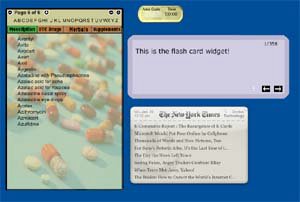
    Here is a picture illustrating some of what I mean:


    That's a screenshot of my desktop with some Widgets running. One is a drug reference manual, one is pulling RSS feeds from the NY Times (could be changed to be ANY RSS feed), one is a customizable flashcard widget and one is a lookup program for area codes. They are all free. They are all customizable with no scripting skills. I think they can allow a user to construct an environment customized to their ever-changing identity. I also think they point one way forward for us - to build platforms instead of applicaions and to teach people how to construct and operate in these environments and not try to teach them what to learn. We can't keep up with that anyway.

    I'll end my little rant with one final thought - do we assume that in the absence of instruction that no learning occurs? If the answer is that of course we know that learning occurs regardless of the presence of really well-designed instruction, then shouldn't we look at how that learning already occurs and look to maximize those opportunities for people?

    SimWord of the Day: Paths (Player-created)

    Players create paths on maps, especially in tycoon style games, to connect processes and places, and direct and sometimes limit units' movements.

    Paths can be:

    • Bidirectional or one way;
    • Narrow/bottleneck or broad;
    • Free to use or toll;
    • Expensive to build or cheap or free;
    • Too few or too numerous;
    • Connect the right things or connect the wrong things;
    • Perment, or temporary;
    • Wear down with use, or increase with use;
    • Aligning of interests;
    • Physical, contractual, virtual, informational;
    • Connecting of people, processes, work units, or even information and alignments.

    What is so interesting to me about paths is that CEO's spend so much of their time talking about them. I can't count the number of times I have heard:

    • How do I create better communication between different departments? How do I get different groups to know what other groups are doing.
    • How do I build a relationship between customers and designers?
    • How do I get better access to another company's technology or markets?
    • How do I access the design skills of Italy, the tech savy of San Francisco, and the cheap labor of China?
    • How do we align with shareholders?
    • How do I find the right person for the job?
    • Are the current organizational lines right, or should I reorganize (destroy old paths and create new ones)?
    A few examples:
    • Xerox' PARC research center has a permanent video link to their sister research organization in France, connecting two well traveled hallways.
    • Every canal ever dug.
    • This very blog entry is a path between my thoughts and at least four other people (I am not sure what the actual number is. It might be as high as twelve).

    Like many of these SimWords, everyone could probably write a great paragraph on when and why to build new paths and destroy old ones. Yet the effective, no, intuitive ability to do that across a multitude of fronts differentiates between success and failure for many of us.

    Sunday, January 29

    Is you is or is you ain't my ism?

    I started writing this as a reply to Don’s message about behaviourism (see below) and the link to the film. It quickly got too long to be a simple reply and so I’m posting it here.

    I love the whole idea – and social practice -- of taking an obvious truth and setting up elaborate experiments to prove it. The real art is to leave people with the impression that you've summed up everything that needs to be said about the subject simply because you have proved that what is obvious is true. People are not only paid to create this proof of the obvious, but they even make careers out of it. And it doesn't stop there: the clever ones can turn it into an "ism".

    Do you realize how many people would be unemployed if this wasn’t the case (today as well as in 1948)? But the benefits to society as a whole are even greater. By turning their obvious truth into an ism clever scientists stimulated the economy. How many people that then made careers out of studying the ism (and extending its scope) would have been absolutely idle (and on welfare) if it hadn’t existed?

    Behaviorism is the one of the star isms of the 20th century. If I were a historian, I would call the 20th century the “century of isms”. A few years ago I visited an exhibition on early 20th century art at the Gropius museum in Berlin with Jay Cross and was particularly struck by the fact that in the period represented (roughly 1900 to 1930) every artist seemed to belong to an ism, or created one as a brand for his innovative style. Many of them I had never heard of.

    Behaviorism teaches us that you can’t learn without motivation and that motivation can be associated with the pleasure (and pain) principle. From there it’s easy – and “scientifically necessary” (question of good marketing) -- to maintain that this accounts for everything, since pleasure and pain can be found everywhere. But it’s like saying I drink wine because it contains water (which it does) and quenches my thirst (which it also does).


    Behaviorists would be right if they maintained that the same thing that drives rats in cages applies to people with ipods and cell-phones.. or enough money to buy a bottle of wine. It does. But the same thing that applies to wine and that goes beyond pleasure and pain (sociability, loss of inhibitions, poetic inspiration, a bright tunnel towards the ultimate truth, etc) applies to our use of anything that serves either educational or recreational purposes. Much of our pleasure is communion; much of our pain is boredom. Bored rats – as the film shows us – are called, not “bored” but “satisfied”. They lie down and wait to be hungry again or to receive a shock from a sadistic researcher. They don’t go looking for an ipod or obsessively consult their e-mails.

    What strikes me as being particularly significant is the fact that, with or without the behaviorists, we have always known that motivation conditions whether people learn or fail to learn. The most surprising fact –where is the bar that releases the food pellets? – is that nobody seems to be motivated to understand where motivation comes from. Maslow gave us some hints: it comes from needs (perceived or unconscious) which stretch across Maslow’s full range, whether hierarchical or not. But it also contains a lot of mysterious (because repressed) components that Maslow didn't try to describe.

    If only we knew what these mysterious components were or where they come from! I would suggest we start looking at what I call the sense of “identity” (personal, social, professional), a permanently evolving entity or bundle of beliefs that is nevertheless based on some deeply stable elements (personality, culture, social status, etc.). By failing to take into account this major factor, the officially recognized pleasure and pain involved in learning become superficial or trivial and we’re left wondering why the planned training didn’t work (face to face, eLearning or simulation, it matters little).

    Take the ipod example. It’s mostly (but not always) a solitary pleasure, but if it wasn’t a social phenomenon how many people would be so hooked on it and especially organize a significant part of their lives around it? There is an ipod culture, which I still know precious little about, but I sense it is seriously emerging. I'll leave the commentary to others, in order to further my own social learning.

    If we knew how to explore these phenomena (or cared enough to know), we might be able to begin to assess the factors that are at play in social and informal learning. Behaviorism encourages us to focus on single, isolated learning goals: how to get the pellet to fall or to stop the electric shock. Social and informal learning embrace a quantity of associated (and often necessarily associated) goals in a much more holistic framework. Why not go for the whole instead of the parts. Open up the bright tunnel towards truth. Or to quote Jon Hendricks, "Gimme my wine".

    Saturday, January 28

    Motivation, Learning, Rewards and Today's Technology

    Wanting psychology to be a more precise science, researchers in the field of psychology turned to physics and created "behaviorism", which is based upon Newton's one-way cause effect mechanics.

    Behaviorism attempts to explain behavior without referring to unobservable internal forces such as thoughts or needs. It explains behavior by focusing only upon the behavior that can be observed: the behavior itself and the environmental events that proceed and follow it, which thus becomes its main weakness in a learning environment -- behaviorism is about the observable, yet learning takes place within the unobserable -- the mind.


    I have always found behaviorism a quite interesting concept, although mostly wrong. Thus, when I came across this documentary on rats, I wondered how yesterdays' behaviorists would describe today's generation as they "pushed" the keys on their computers, cell phones, and iPods. How would they describe their drive? What is their reward?

    Note: the page that the movie is located on is Motivation and Reward in Learning (1948)

    Wiki Help

    I have a quick question, spurred on by Jay's post below..

    A client asked me the other day, "what is the best way for a division of a large company to launch and maintain a public wiki, including what is the best software?" I had some ideas, but I would greatly value what others would suggest.

    ASTD TechKnowledge

    Sunday I hop on a plane for Denver, the locus of ASTD's TechKnowledge conference. In the past, this was generally an introductory conference, with lots of very basic material. It was perfect for newbies.

    This year's TechKnowledge looks to be more sophisticated. Elliott Masie delivers one keynote, Ray Kurzweil the other. If you read Internet Time Blog, you already know I'm a tremendous fan of Ray's work. His notion of the acceleration of time is enough to rattle any of our cages. The radical changes we will experience in the next decade underpin my plea that organizations adopt more natural, informal, flexible approaches to learning. Get this: in the 21st century, we will experience the progress not of a hundred years, but of 20,000 1999-style years!

    On Tuesday the 31st, I'll be talking about informal learning and how I'm designing the Unworkshops we announced yesterday. Our first unworkshop focuses on using blogs, wikis, and other web tools to improve learning effectiveness, so participants will create a blog, start a wiki, give a podcast, and so on: learning by doing. Forgive the self-promotion; I'm excited about the unworkshops and really looking forward to hearing what Ray has to say. Please say hi if you see me wandering the aisles in Denver. Or do they say "Howdy" in Denver?

    Thursday, January 26

    SimWord of the Day: Playing out Information

    One of the most interesting things about both good movies and good computer games is the way that information is played out.

    For linear content, movies are a great model.

    • There are back stories, giving necessary context and information, which some directors play out seamlessly and some do not.
    • Another technique is to have a character be the audience proxy and to ask the questions or make the statement that most people in the audience would ask. "Why don't you just go to the police?" or "You had an affair? What are you, crazy?"
    Computer games must teach skills that are actually used and improvised upon, not just parrotted back on a test, which turns out to be even harder than telling a complicated story.

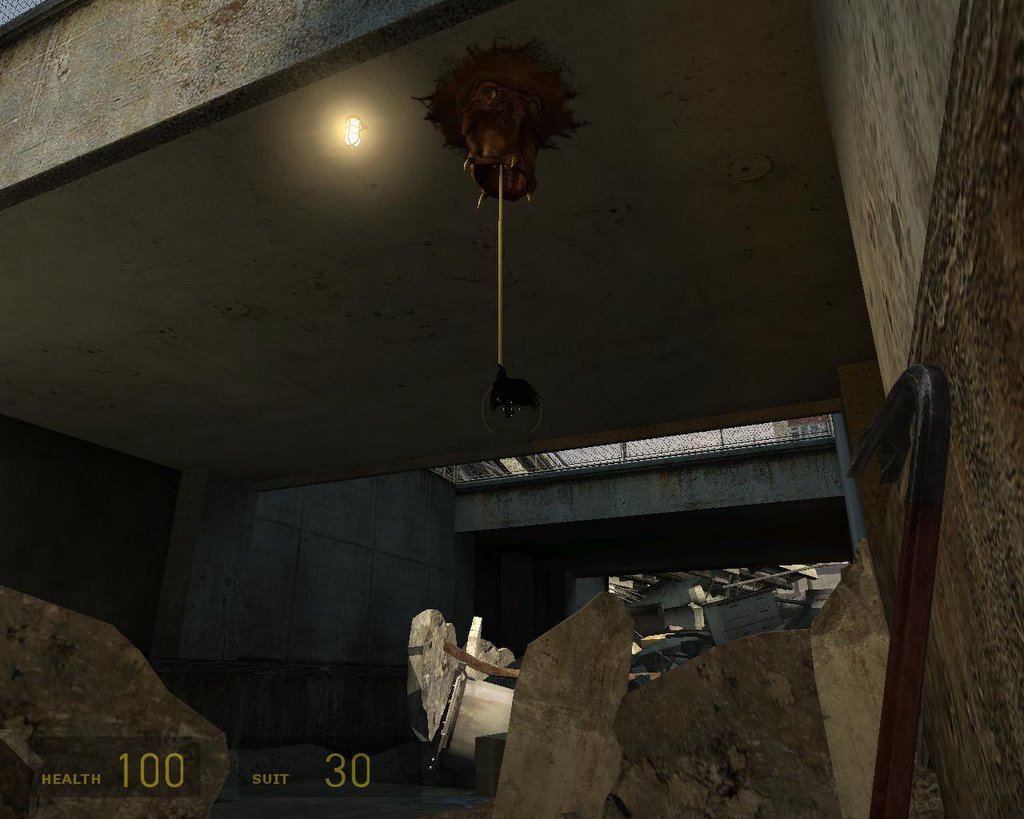
    In Half Life 2, there are creatures that are mounted to ceilings with long tongues hanging down that grab things and pull them up to eat them.

    One technique to inform the player might have been an encyclopedia-like screen giving some information about these creatures. Another would be to have a virtual colleague say something like, "Careful - those tongue creatures are hungry and once they grab you, it's over."

    Instead, Half-Life 2 carefully builds the awareness in the player, and then pushes it. They first (in this screen shot) show the player what these creatures do by, in this case, having an unwary crow get scooped up. Then they expose the player to simple situation with a single creature. A few levels later, the player has to get through dozens of these creatures using increasingly clever techniques, including improvised hybrid strategies learned from other parts of the game.


    The Instructional Design fascists say, "tell them what you are going to tell them, tell them, tell them what you told them."

    What they are really training their audiences is how to be idiots.

    Thank goodness computer games have more respect for our intelligence.

    Wednesday, January 25

    SimWord of the Day: Rubber Banding

    In making a computer game, rubber banding is the technique to allow computerized opponents to bend the rules to keep things exciting and "close" for the player. The term comes from racing games, where you can imagine a giant rubber band extending out from the player's car to pull lagging cars forward and winning cars back.

    Rubber banding is a "game element," something done to make an experience more fun, in this case at the expense of accuracy.

    There will be debates about this technique. Let's look at very specific examples of using rubber banding in racing situations.

    If the racing educational simulation is to build familiarity with a map (travelers racing around a foreign city to get a comfort of the layout, students racing through a functioning ancient city), or to become aware of principles (driving tiny vehicles through magnetic fields), because the learning objective is not winning a race, "rubber banding" would increase interest without undermining the learning experience. If the course was on winning a race, be it chariot, NASCAR, or UPS truck, this technique would cripple the learning.

    Once again, we all must get very specific in discussing the pros and cons of educational simulations in general, and any one in particular.

    Saturday, January 21

    Pirate Sites Illegal Sales Hits Close to Home

    Startling but true!

    There are illegal websites out there that make electronic copies of popular books and encourage people to download them for free. These pirate sites make their money off advertisements, including Google ads.

    A friend recently pointed me to an illegal copy of one of my books, SATFOL, which was sponsored (without his knowledge, of course) by "Elliott Massie"!

    It is a strange world in which we live.

    (Originally posted by Clark Aldrich on Saturday, January 21, 2006)

    SimWord of the Day: The Ninth Paradox of Educational Simulations


    The Ninth Paradox of Educaitonal Simulations states that a good educational simulation takes traditional linear training just to use.

    SimWord of the Day: Constituents

    We have talked a bit about units, little creatures that interact in a computer game or educational simulation.

    While most simulations have broad categories of units, increasingly when describing constituents, be they customers or voters, the more accurate simulations use at least ten or fifteen variables to capture attributes such as spending ability, preferred/trusted media, relationships with other units, and interests and concerns.

    Then, when it comes to such questions as "will they buy from you or a competitor?" "for whom will they vote?" or "are they happy?" the sim does the necessary fuzzy logic to come up with a discreet answer.

    In physics, we have wrestled with the question of: is something a wave or a particle?

    Simulation designers will likewise wrestle with the question, is behavior best modeled by an abstract high level system, or by creating individual units.

    Thursday, January 19

    Teaching Simulation users to do their own After Action Review

    At the end of each play of SimuLearn's Virtual Leader, a student see a series of charts that provide reflections on his or her performance. Here is a piece that we created to help students evaluate their own performance.

    Tuesday, January 17

    SimWord of the Day: Tracking Quests

    Pedagogy in educational simulations is that layer on top that makes things easier to understand. It includes charts and advice, as well as prereading and after action reviews. Done well, it speeds the learning and avoids the development of superstitious behavior.

    One truism of edSims is that the same pedagogy that helps in doing the simulation also helps people understand real life. In fact, some early educational simulations had better pre-canned pedagogy than simulation, and enterprises stripped away the simulation and just deployed the pedagogy.

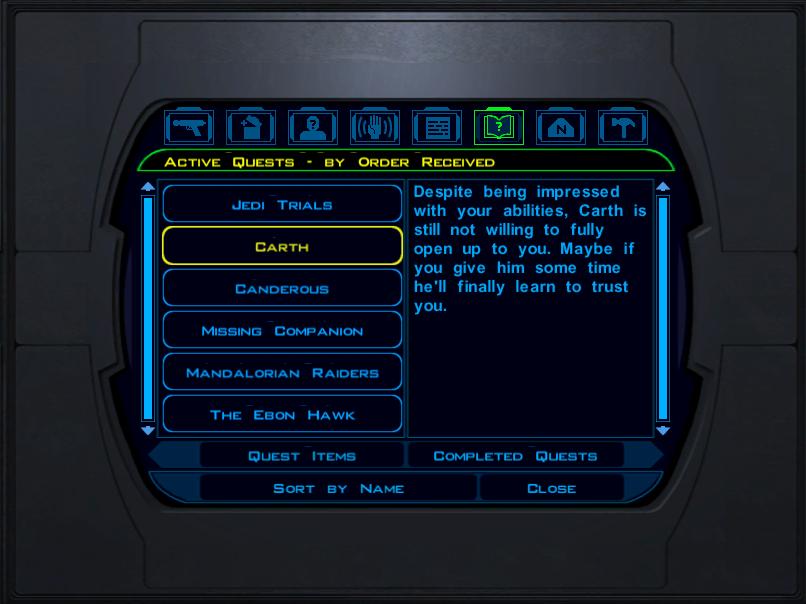
    A nice piece of pedagogy is a constant list of core activities/goals/quests, with updates on little steps either completed or that need to be completed. This is especially useful where there are more than two quests going on at a time, like in this example from Star Wars: Knights of the Old Republic.

    Monday, January 16

    SimWord of the Day: Big Skills

    There are a list of skills that could be classified as soft skills, but I prefer the term "Big Skills." These skills have a few attributes:

    • These skills are critical to almost any job, but more than vocational, they are truly life skills.
    • We practice them, in some form or another, almost every day.
    • Schools, self-help book, and enterprise training programs have done a terrible job at facilitating their adoption, although they talk incessantly about them.

    I know I have given various lists before, but enough people have emailed me about them that I beg your indulgence in posting them again. These skills include:

    • Business Process Improvement and Business Process Reengineering:
    • Contracting, Sourcing and Outsourcing :
    • Communication.
    • Conflict Management
    • Cost Benefit Analysis
    • Creating and using boards and advisors
    • Creating new tools
    • Decision-making
    • Ethics
    • Innovation/adaptation
    • Leadership
    • Negotiation
    • Nurturing/stewardship
    • Project Management/ Program Management
    • Relationship management
    • Researching
    • Risk Analysis, Management/Security
    • Solutions sales
    • Teamwork
    • Turning around a bad situation

    Some call these 21st century skills, which they are, but they are also 20th century, 19th century, 18th century... and so on.

    My premise is that educational simulations will make considerable headway in allowing the formal development of these skills, and that they will be hard to scalably teach without using simulations.

    Sunday, January 15

    Watson: Come Here, I Need You

    A couple of years ago, I was discussing the timeliness of training with a colleague. See said to me, "It would be ideal if we could have the right training ready when the employees asked us for it." I responded, "No, ideal would be that we have learning content ready before they ask for it."

    Recently I ran across a tool that tries to do just that. Watson 2.0 is a nifty little search tool that sits in a sidebar on your desktop. When you work in any one of several programs (right now it supports Word, Powerpoint, Outlook, Internet Explorer and Firefox on the PC), it analyzes the content in your document and automatically conducts a search on the key words it's come up with.

    Watson returns the results from 5 domains of content - the Web, News, Blogs, Shopping, and Desktop. In the free version, which I have loaded for the time being - it searches are of the entire web.

    With the professional (for pay)version, you can eliminate specific sites or specify sites for Watson to definitely include as high priority. You can also, in enterprise wide installations, have it search your intranet.

    Check out the screen clip I took when I loaded my resume into Word and let Watson do it's thing. (click on the image to see a larger version.) Watson 2.0 is to the right. The terms highlighted in yellow are the search terms Watson used. Doing this with my resume has lead me to some very good professional, as well as developmental, resources that I had not yet stumbled upon. For those wondering what "Shopping" hits came up for my resume, it was primarily books on training. You wierdos!

    This last feature really sounds like a potential winner. I can imagine working on a prosposal at work and having all the historical data that is related to my project presenting itself to me as I type! I wouldn't have to go research it. It'd be there as I need it. Talk about capturing corporate knowledge in a useful fashion!

    Check out Watson 2.0. The free version has most of the functionality of the for a fee version, so you won't be out anything but your time.

    SimWord of the Day: Scoring

    It is a mainstay of computer games, sports, classrooms, even standardized tests - the score. It is the single number that allows easy comparison and ranking. Usually the higher the score the better, although there are a few exceptions like golf. A is good. F is bad.

    If you believe more in evaluation than formal learning, you might shoot for a scoring system that follows a nice bell curve, with some winners, some loosers, and most lumped in the middle.

    We like to pretend that academic scores/grades are instructional, but really they are motivational. The reason to work hard is to get a good score, as opposed to using the score to figure out how to improve.

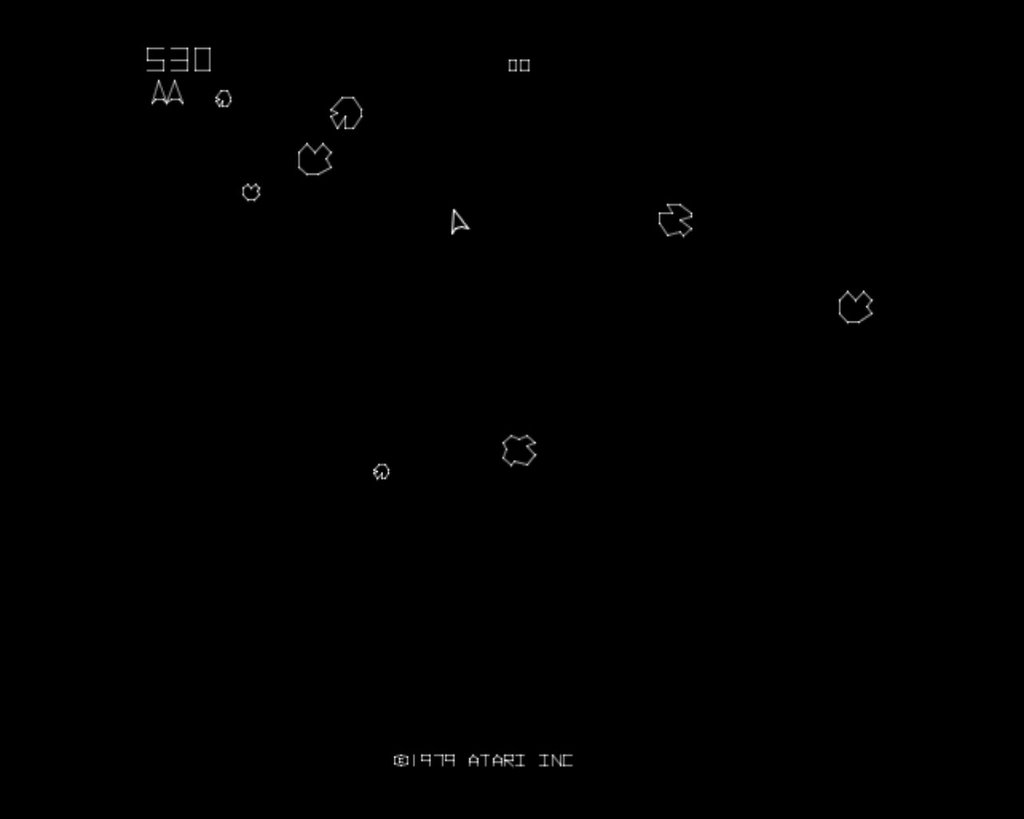
    We also like to pretend that scores are scientific, when in fact they represent a massive editorialization of what is important, and by how much. Shooting a big asteroid is 50 points. Shooting a little asteroid is 100 points. Dodging an asteroid is worth nothing.


    Scores in educational simulations seem to work best if they are built around the academic standard of

    • 69 and below = D = unacceptable
    • 70-79 = C = good try but plenty of room for improvement
    • 80-89 = B = solid
    • 90 - 100 = A = great

    This seems natural to those on the outside and a good cultural standard to follow (imagine using an educational simulation twice, the first time getting a score of 24, and the second time, 190), but for designers, squeezing the world of outcomes into that range is as natural as being a yoga master. And putting absolute numbers to actions should make anyone at least a little uncomfortable (try putting numeric values to the activities you did today).

    Having scores unquestionably increases usage and focus. But the greater the reliance on scores for motivation, the more students will worry less about learning the material and more about gaming the system - finding logic shortcuts to exploit, and actually subvert the learning.

    Friday, January 13

    SimWord of the Day: The Eighth Paradox of Educational Simulations

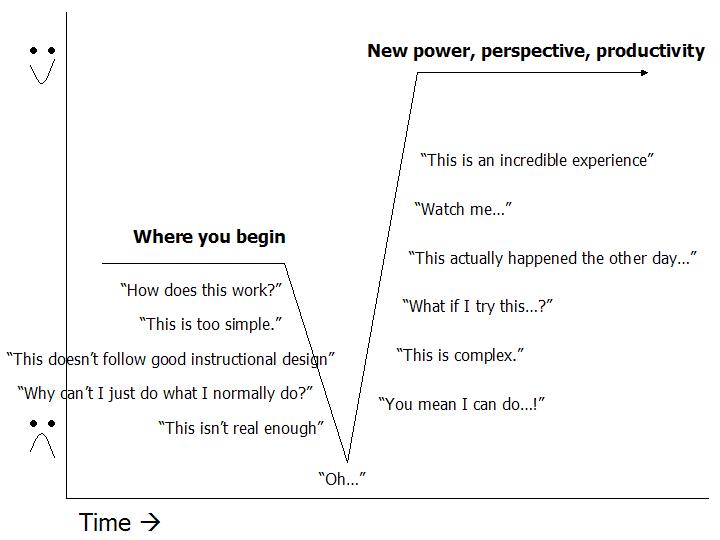
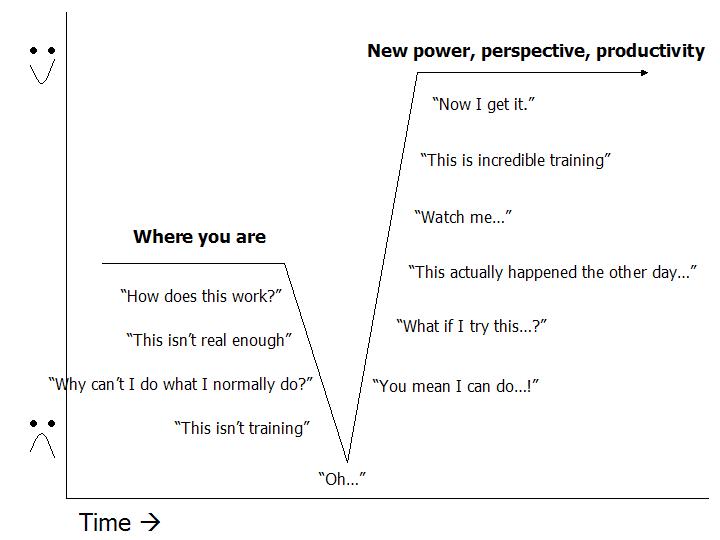
    The eighth paradox, and this is true of any transformation (from getting a big promotion to moving to a better house), is that things get worse before they get better, even when the transformation is sought after and desired. New clarity only follows frustration. New power comes from not being able to do things the way you have in the past.

    Maybe this song will help, I mean chart will help, about the experience of going through a tranformative educational simulation:

    Real simple why Web 2.0 is important...


    ...because it exposes and links. I know this is probably so clear to those of us who are immersed in it but I think we need to "stay on message" with other folks. Social networking, Web/Learning 2.0 - whatever - these are all aimed at exposing, revealing and linking. If your situation doesn't call for that, these technologies aren't right for you - no harm no foul. Why is this important?

    ...because informal learning will just stay something you do personally within your own close-knit network and not a phenomenona we understand and can use to imporove organization performance UNLESS we use some of these tools and the concepts behind them to reveal, expose and illuminate the networks of informal learning that they are creating. I have this feeling that we need a whole new lexicon for talking about the instructional impacts of furl, del.icio.us, frappr, etc. Of course, its early - I could be wrong.

    P.S. Clark - you must promise to collect all of your SimWords somewhere....

    Thursday, January 12

    SimWord of the Day: Communities

    The less someone knows about computer games, the more he or she thinks of them as a solitary activity. Instead, computer games have driven and modeled online virtual organizations, and educational simulations will have to go even further.

    Roles when there are multiple people include:
    • opponents and team members,
    • buddies,
    • instructors,
    • facilitators,
    • leaders and followers,
    • mentors,
    • support and front-line, just to name a few.
    Technologies that have to be considered for any good collaborative educational sim include:
    • Message board/Forum
    • Application sharing
    • Authentication
    • Avatars to represent players
    • Chat rooms/Instant Messaging
    • Public/private message
    • Email Integration
    • Calendaring
    • Video Conferencing
    • Floor control for the facilitator
    • Whiteboard
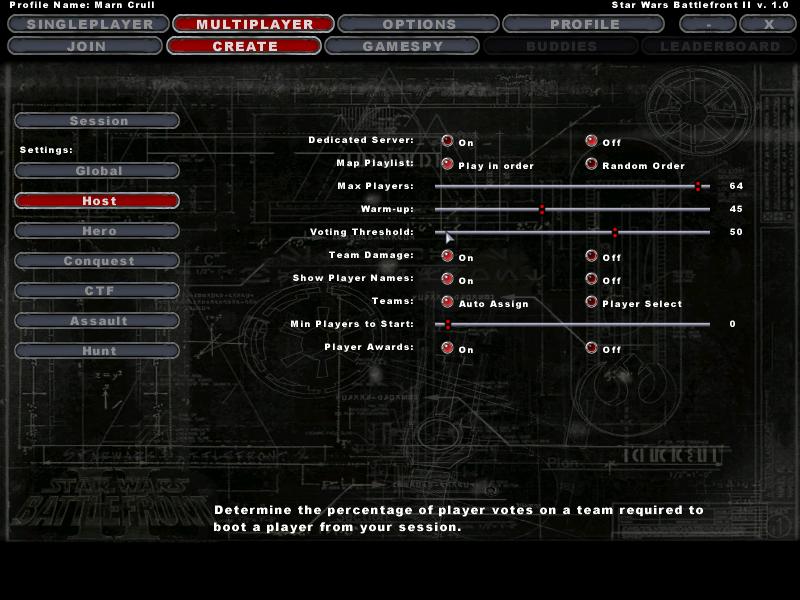
    • Massively Multiplayer (MMP) components, such these from Star Wars Battlefront II

    Tuesday, January 10

    Swicki: Can a Cloud Make Search Clearer?

    A new search tool is in the footer of LCB for you to try out. Swicki is a new twist on search that promises a more contextualized and a customizable community search. It begins with someone, me in our case, creating an initial instance of the search tool naming key topics that might be interesting to the community. In addition, you can designate universal key worlds that every returned page must include. I chose to require "learning" for the LCB search. You can similarly designate key websites to target or to avoid.

    You can set the search to give priority to blogs and/or your website. (I've asked this LCB search to search LCB first and then the web.) After a little bit of configuration work (choosing fonts, search box size, colors, etc), you simply copy some HTML code Swicki gives you and paste it into your site and you are of and running.

    Then as members of the community use the search they can either choose a term that appears in the cloud of terms or enter another term that they are interested in. As the community uses the search engine, it learns the communities preferences and displays new terms in the cloud.

    Swicki is so confident that can deliver a more focused search to you than Google, that on your results page they give you a link to compare the Swicki results with Google results. Check it out. What do you think?

    SimWord of the Day: Hero

    Hero is a very tricky word in the formal learning industries.

    In most computer games, you play the unique hero - the person who has the power to save the day, or at least make all of the decisions.

    In classic mythology, heroes live apart from the rest of society, having special responsibilities and getting special perks.

    In Joseph Cambell's take on things, we can take little heroic actions every day.

    In massively multiplayer online role playing games, we see the emergence of a band of heroes, groups of equals coming together to go on some quest.

    The role of "a hero" is challenging in educational simulations.

    Most of us want to be heroes, although some want it more than others.

    Should HR departments train people to be heroes? Heroes often break rules, something that every centralized department hates. And as Joss Wheaton in the movie "Serenity" wrote, "heroes are people that get other people killed."

    Yet, Len Vickers, the marketing guru behind GE's "we bring good things to life" and Xerox' "The Document Company," told me that the best sales people took advantage of vendor loop holes for the advantage of the customer, heroic in some self-serving way. Every good organization rewards heroes with praise.

    Finally, logistically, programming the user to be a hero in an educational simulation feels funny. Do you give your player the most power to make a difference? If yes, the sim feels false. If no, the sim is unsatisfying.

    I guess the paradox today is that HR has to teach people the rules, and then promote those that break them successfully.

    Monday, January 9

    SimWord of the Day: Real-time

    At the highest level, a simulation is real-time if it does not stop and wait for the user to input before continuing as a turn-based simulation might. Said another way, if the user does not do anything, the simulation takes that as the input.

    Almost all computer games are mostly real-time.

    Some consider real-time simulations to be more realistic, engaging, and educational.
    • They are more realistic because many "real-life" target situations, from flying to negotiating, are real time, and so that dimension is a critical part of it. They also create pressure which mimics the pressure found in situations that aren't inherently speed-based.
    • They are more engaging, in that they require intense awareness, and the constant requirement to deal with surprising situations. They also might prevent people from over-analyzing.
    • They are educational, but also because they make it easier to see fluid patterns play out.
    Of course, even educational simulation real-time zealots (people who would argue for a real-time simulation even if the target use of the content is not real-time) would still argue for paused moments of reflection, such as an after action review.

    It is finally worth noting that real-time is not synonymous with twitch-speed. A good real-time simulation, unlike a twitch-game, could still be of significant educational value if played turned-based.

    Sunday, January 8

    More Relationship Maping

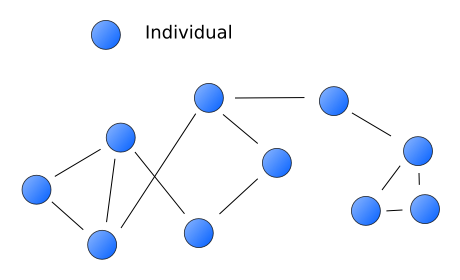
    Clark is right about the importance of being able to understand and map relationships but might not the next set of illustrations to allow us to do that also include something along these lines?


    SimWord of the Day: Lines and relationships

    Nineteenth-century mathematicians discovered to their discomfort that as the conceptual machinery of mathematics became more precise, it became more difficult.
    —David Berlinski, The Advent of the Algorithm

    I suspect that same will be said of our industry.

    One such precision tool is relationships. At the base of any good domain expertise pyramid is a whole mess of relationshps between two or more variables. What is the relationship between compensation and performance? How are budgets spent across the development and launch of a new project?

    Here are some of my favorites generic relationships.
    • The linear relationhips.
    • The bell curve.
    • The s-curve.
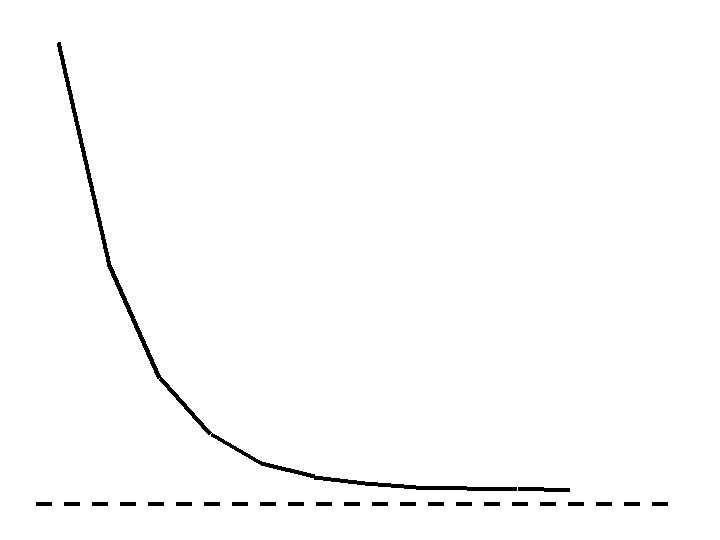
    • The asymptotic relationship.
    • The price/demand relationship.

    Or visually:


    I suspect that increasingly, we will all have to be as comfortable with using these and other relationships to characterize knowledge as we currently are with bullets, headings, and fonts.

    Friday, January 6

    Head spinning...too much Web 2.0...can't see straight....

    For a couple of reasons I have been doing a lot of looking recently at a whole spate (what's more that a spate?) of applications which mainly fall under the current rubric of "Web 2.0". I've done some reading by some seemingly smart folks on the topic and even some of those folks critics...and currently that picture over there is pretty fair representation of what my head feels like.

    I am looking at all of these through the lens of how could any of these impact learning/training and the not-so surprising answer that I keep coming up to is - very little actually - within the bounds of two conditions.

    The first condition (now that I look - this appears to very close related to the second condition as well) being my strong belief that culture will always trump technology. If a corporate or organizational culture is not ready to change or accept change, then no technology is sufficient to break through that. So, changing the organizational culture remains the top priority.

    The second condition states that none of the incredibly cool applications will impact corporate training to any noticeable degree if the market continues to view learning as a product that is designed, developed and built somewhere and then taken to the consumer, like a car. What do cars compete against in the market? Other cars mainly (I hear some of you saying 'mass transit' and if you live outside the U.S. you may have a point but not so much inside the U.S.). Even though if it is mass transit, it is still paying for transportation. 'Learning' products compete against an almost innumerable array of free [informal] options.

    My favorite quote of the year so far? "You don't deploy a commnity." So many of these tools draw their power from community, from an organic coming together of like-minded folks - I think what organizations are missing is the 'organic' and all they are seeing is the 'power.' This gets at the heart of this second condition - the idea that driving this insane burst of creative energy from the Web 2.0 side of the house is the idea that we should build platforms and not applications. Maybe what we should be thinking about is how to become better advocates of changing corporate and organizational cultures to accept the deployment of platforms upon which their members/employees can construct their own learning applications. Oh and yes, we can build and sell those platforms.

    Phew. I'm tired now.

    Corporate pandemics of 2006

    Inspired by a batch of recent frustrating consulting gigs, a battery of medical check-ups and the current buzz about pandemic preparedness, here are my predictions for six emerging corporate pandemics that trainers will have to deal with in 2006:

    1) Ulteriorsclerosis – the clogging of an important initiative by personnel or policies, for spurious reasons that mask more pernicious ulterior motives. Widespread ulteriorsclerosis will lead to the demise of several organizations in 2006. The disease, once it takes hold and starts to spread, can only be cured by surgical OD interventions. It manifests itself in the right projects not being approved, or not moving forward, for apparently good reasons which, with persistent investigation, turn out to be fatuous. Ulteriorsclerosis is typically artificially induced by the idle, the desperate, or the power hungry, and can be career threatening to diagnose.

    2) Nearly Ubiquitous Wireless Mobile Informal Learning Syndrome (NUWMILS) – the propensity to instantly learn only what one needs to learn in order to perform, when and where the performance is required. Also referred to as Schizogooglia, it will evolve in cultures where networked knowledge links of known quality and reliability become so intuitively accessible that it will be like having multiple brains in your head. Sporadic outbreaks have been occurring with increasing frequency, and now seem set to attain pandemic status in 2006. Once it loses its stigma and is accepted as a blessing rather than a curse, NUWMILS will be renamed “ambient learning” and at least three gurus will claim to have invented the term.

    3) Mailanoma – the unrestrained metastasizing of productivity-sapping email, texting, and instant messaging, leading to complete breakdown of one’s ability to communicate. While much of this has been from externally inflicted spam, as 2006 progresses there will be increasing volumes of malignant messaging that are internally generated through quite unnecessary cc-ing, bcc-ing, and e-messaging of people sitting whispering distance apart. As communication is the life blood of organizations, malfunctioning of the system can cause a serious breakdown in performance – and in the ability of training to have an impact.

    4) Infobesity – the deleterious effect of excessive data consumption on the fitness and agility of individual and corporate minds. With the volume of new data being produced doubling every three days (vs. every three decades a few generations ago), Infobesity will become dramatically debilitating, though it will stimulate the growth of technology filtering tools. Those who master infofiltering will jog confidently through the fog, while those who don’t will keep staggering into lampposts. Employees and teams with calcified knowledge filtering modes will become alienated and resentful, unable to compete, and decreasingly productive. Fortunately for them, they make up most of upper and middle management, and still dominate the shareholders of most large companies. So they will hold onto legacy processes and implement new glass ceilings to keep info-savvy juniors from gaining power (often by inducing ulteriorsclerosis in the relevant area). Unfortunately for their companies, the info-savvy are subversive, mutate rapidly, are well networked, and will job hop into smaller, more fluid entities that will collaboratively run competitive rings around the big corporations.

    5) Organizational Incontinence – the involuntary leaking of things you’d rather not have others see. As the networked world brings on premature aging in organizations, they will start to leak at increasingly alarming rates. They will leak knowledge (IP Incontinence) as their walls become porous and their employees network outside of the company to gain the insights they need to get things done. They will leak processes, as much that used to be done in-house becomes outsourced. They will leak secrets, as staff start to blog and podcast without the censoring filter of Corporate Communications. And they will suffer from increasing motivational incontinence as employees finally lose all sense of belonging to a cohesive caring organizational family. This in turn will lead to the leaking of valuable employees. Organizational Incontinence, in all its forms, may require a significant rethink of the role of learning services, and its repositioning as an aid to the enhancement of an individual’s market value.

    6) Learning Impact Myopia – the failure to expect or demand that learning initiatives have lasting effects. Like most other things in corporate life, training activities will be evaluated more and more on what effect they have on each quarter’s financial results, rendering longer term impacts irrelevant, and in turn making the development of long-term programs pointless. When trainers struggle to develop interventions that have lasting impact, they will be told that such esoteric stuff simply does not matter, and will be pressured into providing instant gratification to the bean counters. Learning Impact Myopia and Schizogooglia both seek faster short-term solutions to the expertise problems, but for different reasons. Trainers may have to selectively succumb, while still fighting for some strategic surgical impact. [Paradoxically, Surgical Learning Impact Myopia (SLIM) -- the deliberate implanting or nurturing of e-learning 2.0 where appropriate -- may give SLIM organizations added vigor and longevity].

    Be prepared! The future will be a dangerous place if you relinquish control of your integrity to the organizational pandemics.

    Compliments of the season to all, and may your 2006 be filled with health, wealth, and happiness!

    Godfrey Parkin

    SimWord of the Day: The Seventh Paradox of Educational Simulations

    Simulations are very dense learning experience. Most deployments of simulation based programs look
    • successful if measured forward from what a student learned, but most simulation deployments look like
    • failures if measured backwards from what percentage of material that the students could have learned, they did learn.

    Thursday, January 5

    SimWord of the Day: The Sixth Paradox of Educational Simulations

    Vendors and builders of simulations like to describe them as vaguely and mystically as possible:

    • Learning By Doing.
    • Flight Simulator for Business Skills.
    • Safe Environment to Take Risks.
    • It is Like Actually Being There.

    Yet this hype-driven misdirection blurs product categories in the marketplace, eradicating the critical lines between different types of simulations (branching stories verus interactive spreadsheets vs. game based models vs. virtual labs vs....), making comparison hard and lessons learned to apply the right type of sim for the right situation even harder.

    Mining is Hell

    At some point in our cultural history, someone decided to use mining as an analogy to Hell. Having spent some time 3.5K straight down in a gold mine in South Africa (picture of me in 1987), I can say with first hand experience that the analogy works.
    My heart goes out to the West Virginia miners and their families.