Friday, February 2

February Big Question: What Questions?


The February Big Question goes to the root of what The Big Question is all about. It is a topic that has bothered Tony for a while. In a session on Informal Learning by Jay Cross, Harold Jarche and Judy Brown at ASTD TechKnowledge, you could easily see great questions getting raised by both the presenters and the audience. "How can I help my organization improve the quality and quantity of conversations?" and “How can I create informal learning experiences for new managers in my organization?" These questions offered a fantastic opportunity for discussion and understanding of the subject.

Tony’s revelation was that one of/if not THE biggest questions facing us is that we don't know the right questions to ask in a given situation. Sometimes we’re asking a question when we should be asking a different one.

So, this month, The Big Question is...

What Questions Should We Be Asking?


Please answer this question by posting to your own blog or commenting on this post.
(For further help in how to participate via blog posts, see the side bar.)

Point to Consider:

  • Feel free to list questions from lots of different perspectives and at lots of different levels.
One last note. Don’t worry about answering the questions you suggest. Perhaps we’ll do that in future.

Participating Blogs:
The form for February's Big Question has been closed. If you have a post in response to the February Big Question, please contact the Blogmeister by using the Dear Blogmeister form which can be linked to from the top of the sidebar.

Clive Shepherd
Clive on Learning
The big question for February: what questions should we be asking?
Tony Karrer
eLearning Technology
Clive Sheppard What Questions
Adele Lim
learning & development
Feb Big Question: What Qs should we be asking?
Karyn Romeis
Karyn's blog
February's big question
Matthew Nehrling
mLearning World
The February Big Question- What Question?
Tom Haskins
growing changing learning creating
Asking the right questions
Clark Quinn
Learnlets
Asking Good Questions
Wendy
in-the-middle-of-the-curve
What Should We Be Asking
Karl Kapp
Kapp Notes
Questions, Questions and More Questions
Ray Sims
Sims Learning Connections
What Questions Should We Be Asking?
Mark Oehlert
e-Clippings
The Big Question about Questions
Dave Lee
eelearning
asking questions
Brent Schlenker
Corporate eLearning Development
The February Big Question
Anil Mammen
Discursive Learning
A Question of Questions
TATA INTERACTIVE SYSTEMS
TIS Corporate Blog
What Questions Should We Be Asking?
Valerie Bock
Collaborative Learning
What Questions Should We Be Asking?
Terrence Seamon
Here We Are. Now What?
The Power in Asking Questions
Jay Cross
Internet Time Blog
Big questions about big questions
Geetha Krishnan
Simply Speaking
Questions, questions
Tony Karrer
eLearning Technology
Is the Big Question Half-Full or Half-Empty?
Jacob McNulty
Revolutions
What's in a Question? Our Future
Tony Karrer
eLearning Technology
Action on Informal Learning - Leads to Great Questions
Tony Karrer
eLearning Technology
Continuing Thoughts on Questions



Wednesday, January 24

If we could ask the schools in the U.S. to do just one thing different, what would it be?

Let me ask you all this one question, which I was asked recently by a well-known governor. If we could change just one thing in the U.S. school system, what would it be?

Is there any chance that we can break the Bryan Chapman critique that we as a community of education and training professionals:
  • all agree on our dislike on the current system and
  • disagree on what to do better.

Could we work together with our various degrees of clout and make things better in the school system? Stage one is brainstorming, so let's air all of the ideas.

Friday, January 19

A Tale of Two Program Pilots

I just got results back from two pilots with the goal of evaluating the same, 15 hour training program.

In one pilot, the program sponsor cajoled a bunch of colleagues into doing the program. He oversold the fun aspects of it, and undersold the real work and time requirement required. Literally less than 20% into the program, the coach had to (appropriately) push on the participants for not doing any of the self-paced work, the participants revolted, the pilot failed, and the program sponsor lost credibility with peers.

In another pilot done during the same period, the program sponsor found real people who would really benefit from the program, and most matched the profiles of future students. The sponsor did a pre 360 on all of the participants, did the 15 hour program, and then did a post 360's to evaluate the program. What they found was incredible. The participants who went through the program went from a pre-test of a "3" to a post-test of "4". That was an entire standard deviation increase, and relatively unheard of for such a program. The participants ranked it as one of their most important growth experience in their professional life. The sponsor gained incredible credibility with his managers, and the program is roaring ahead.

I would say that all of our competencies, learning how to pilot may be the most important, and most lacking.

Friday, January 12

Don't hire me! Evaluate your own training budget in three simple steps

I love doing a good training audit as much as anyone. But you can do a lot yourself. When I review training budgets for clients, one tool I use is to break spending into three categories:

1. The money spent to to fulfill obligations.

These are the funds that are spent doing what the training group had committed to doing in the past. These might include ethics and sexual harassment training, new employee training, HIPPA compliance, and so on.

2. The money spent to reduce the cost of fulfilling the current obligation in the future

These are the funds used to automate processes wherever possible, consolidate vendors, or renegotiate, or find cheaper sources.

3. The money spend to deliver new (hopefully strategic) value.

This is the money spent to do something new. These are the new programs, the new infrastructure, and the new tools. Funnily enough, if companies are doing (1) well, these (3) activities are the only things that get noticed.

So many groups are trapped in (1). The best groups are constantly engaged in (2) and then (3). One "aha," and I think I will get plenty of grief here as well for bringing this up, is that often putting resources in making incremental improvements in increasing the end-user satisfaction of (1) training (way different from customer satisfaction in corporate environments), comes out of category (3).

Thursday, January 11

Big Question Follow-up

Some great posts are already out there around the Big Question for January: Quality vs. Speed. You can find them listed in the post. One thing that is definitely clear from the posts so far is that there seems to be a really difference of opinion around:

  • While you may be able to reduce development time via rapid tools, can you speed up analysis and design and still maintain quality?

  • Does iteration work? When?

  • If we didn't have constraints on time/cost, would we really be our own worst enemy?

  • Is quality, speed, cost and learning really like sliders that as you push one up others must go down?

There also are quite a few questions that the responses raise in my mind that I'm still grappling with...

  • What do you do when you are in an organization that only wants low-quality, rapid - even if it only checks the box? In other words, do you fight What the Client Wants? (see also Wendy's comments)

  • When is SME (or end-user) produced content with rapid tools the right answer?

I plan to do another couple of posts on this topic and related topics, but this has been pretty interesting already.

Investing in Informal Learning

According to Training in America by Garnevale, Gainer, and Villet (1990), two out of three workers say that everything they need to know was learned on the job, rather than through the classrooms. Thus the workplace is the most frequently traveled avenue to education and training for most employed persons. The authors further go on to state that estimates of employer investments in workplace training hover around $210 billion annually. Of that, about $30 billion is spent on formal training, while the rest, $180 billion is spent on informal, or on-the-job training.

The estimates that I have seen for informal vs. formal learning in a work environment normally runs about 70 to 80 percent for informal learning. Thus I estimate that on the average, workers learn 75% of their job informally and 25% formally. This means informal/on-the-job learning gets 86% of all learning investments, which leaves 14% for formal learning programs. Note that the authors indicate that formal learning is designed, developed, and delivered training; while informal/on-the-job training may be structured, such as apprenticeship programs, or unstructured, such as coaching or showing another the best way to perform a task.

I see two interesting aspects of this. This is the first time I have a seen training investment cost that tried to show the estimates for both formal and informal learning, however, the authors might have had more resources than others as this study was underwritten by the U.S. Department of Labour and conducted by ASTD. Of course it did include on-the-job training in informal learning, but on the other hand, is this where it should be included?

Secondly, as Jay and others bring the auspice of informal learning to the attention of trainers, it seems to me that trainers will try to formalize even more informal learning. As this shift grows from formalizing the informal, will we see the percentage of investment in formal learning programs grow and the investment of informal learning shrink?

Wednesday, January 10

How to be a Cutting Edge Education Theory Expert using Computer Games

Do you want to be a cutting edge educational expert on computer games? Here are the two, key principles.

Point #1: There is Value in "Doing Something With Feedback"

Argue that computer games are fabulous because players do things, and learn from their mistakes.

"But what if someone argues back," you are thinking, "that people also learn from gardening, changing a light bulb, running a lemonade stand, driving from one place to another, making dinner for friends, and doing just about any hobby, or really, anything."

That's easy. Just bring up scalability, in terms of big numbers (computer games now make more money than box office receipts -or- the average person plays 24.3 hours of computer games a day) or zoom into concepts, taking advantage of big words (they are utilizing advanced task analysis or cognitive anything). These will help.

Point #2: There is Value in "Getting People Together."

Argue that multiplayer environments are incredible because the get people together. And once people get together, they share ideas, they network, they pass concepts to and from each other, they are involved in unstructured learning. Information is fresh, current, real.

Again, I know what you are worried about. People already get together all of the time. They get together in car pools, subways, cafeterias, and water coolers. When people get together, they tend to talk about their families and television shows.

So again, use big numbers (YouTube sold for 1.6 billion dollars -or- one quarter of all Internet users use facebook and myspace) or big words (social networking and points economy).


Paydirt! "Getting People Together" in order to "Do Something with Feedback"

The first two arguments work well by themselves. You can become a well respected thinker just on those two alone.

But if you want to be a real-thought leader, an intellectual giant among ants, put the two together. Now you are in World of Warcraft territory. The only limitation to your success is how big and academic you can make the adjectives. Now you can use phrases like "social cues" or "orchestrating strategy."

You are now ready to usher in a new paradigm of education. You are cutting edge. This will change everything. (And, best of all, if you are too lazy to actually come up with new ideas, just look up "group challenges" or "ropes course" or "little league" or "chess club" or "corporate outing" and cut and paste from there.)


P.S. If you want some proof, use the "volume" logic. It goes something like:

One: generically, games and web sites involve some form of learning and/or at least information.
Two: some games/sites generate a lot of traffic. Let's call one "site x."
Three: Most likely, there are big name corporations that spend advertising dollars to expose themselves to this "site x" traffic and eyeballs. Let's call one "corporation y."
Four: educational theorists just connect the statements and say: "corporate y" gets this new model of learning and education. See, they have a big presence in "site x".
QED

Monday, January 8

Quality vs. Speed

Out of 24 participating posts and nearly 40 comments on those posts, not a single person predicted that they would answer all 12 of The Big Questions in 2007 - how disappointing.

Well your first chance to redeem yourself comes in the form of January’s The Big Question:


What are the trade offs between quality learning programs and rapid e-learning and how do you decide?


Please answer this question by posting to your own blog.


(For further help in how to participate via blog posts, see the side bar.)

Points to consider:

  • Quality learning experiences involve having fun, better interactivity in e-Learning or interacting with fellow learners, possible use of games or simulations, richer blends, but designing and developing higher quality programs cost more and take longer.
  • Rapid e-Learning often involves paring back training to the minimum amount and minimal treatment, quickly building those training elements, and providing the remainder of content as reference. This reduces time and cost and may improve scalability because the skills required for development can be easily spread.
  • Most every learning project involves deciding what to treat in what way. So, what ends up on the design room floor by the time of implementation? What are the potential risks of these decisions? Has there been fat that could be cut without risking quality?

Name
Blog
The Big Question Response
Tom Haskins
growing changing learning creating
The politics of quality
Tony Karrer
eLearning Tech
Big Question for January - Quality vs. Speed
Matthew Nehrling
mLearning-World
The Tao of Design
Wendy
In The Middle of the Curve
Trading Off
Clive Shepherd
Clive on Learning
The big question for January: quality v speed
Howard Cronin
e-Training in the Trenches
Big Question - January 2007
Karyn Romeis
Karyn's Blog
The big question for January: speed v quality
Clark Quinn
Learnlets
January's 'big' Question
Karl Kapp
Kapp Notes
Rapid E-Learning Trade-Offs
Donald Clark
Big Dog, Little Dog
Knowledge & Learning in the News
David Wilson
Learning Reflections
The Big Question - Rapid or Quality
Adele Lim
learning & development
Jan Big Question
Tom Haskins
growing changing learning creating
High performance netwroks solve the problems
Anil Mammen
Discursive Learning
Speed is not the antithesis of quality
Geetha Krishnan
Simply Speaking
Time for Quality
Dave Lee
e e learning
quality vs. speed - we've created a monster!
Shilpa Patwardhan
Closed World
Motivate to Learn
TATA Interactive Systems
TATA Interactive Systems Corporate Blog
Quality Vs. Speed
patrick dunn
occasional rants
The Big Question is how dumb this Big Question is
Tony Karrer
Learning Circuits Blog
Big Question Follow-up
Tony Karrer
eLearning Technology
Are There Trade-Offs?
Michael Hotrum
Choice Learning
learning development: fast, good or cheap?
Brent Schlenker
Corporate eLearning Strategies and Development
January Big Question...a little late
Valerie Bock
Collaborative Learning
High-Quality Rapid eLearning?
KN Master
Knowledge Narratives
Speed vs. Quality - Still Relevant?
Jacob McNulty
Revolutions
January's Big Question: Speed or Quality?

Wednesday, January 3

20% of most groups of students are mentally dropped out

The more I study formal learning programs (I will leave the study of informal learning programs to Jay), the more I hit the same number. Of any class, real or virtual, lecture or simulation, self-paced or chaperoned, academic or corporate, about 20% of the students have mentally dropped out.

This is not the period "fuzzing out" that we all experience. These people are gone. When asked a question, they don't know what is going on. When asked to perform in a simulation, they can't.

Some of these mental dropouts later give the class great marks. Others trash it.

Some of these mental dropouts are fabulous performers in the organization. Others are looking for new jobs. Some are surly; some are charming.

Most sit in the back of the room if they can. Many cluster together during breaks.

Is this rock-solid research on my part? Absolutely not. Am I sounding like Rumsfeld? A little.

I have just been stunned by the absolute constant of this number. And how the training people always look at this number as their own failure. They are reluctant to talk about it. When I bring it up, the training people always try and justify why the 20% dropped out (oh, 10% had previous engagements...). But across situations, across rationales, the number is almost always the same.

What are the implications of this? I have no idea.

Monday, January 1

Big Question Meet the EDGE Question

I thought that in honor of the success of the Big Question series, I would introduce my other favorite question and answer series; the question of the year from the World Question Center. This series is populated by the members of the Edge Foundation:
"The mandate of Edge Foundation is to promote inquiry into and discussion of intellectual,philosophical, artistic, and literary issues, as well as to work for the intellectual and social achievement of society."

You think we're asking big questions, try some of the Edge's past entries like What Now? or What Do You Believe Is True Even Though You Can't Prove It? or my personal favorite What's Your Law?

This year, the entry is What Are You Optimistic About? Why? While all the entries are thought-provoking, I thought some of the ones most relevant to us here on LCB might be:

Early Detection of Learning Disabilities or Difficulties
Understanding What Really Happens To Humans In Groups
A Knowledge Driven Economy Allows Individuals to Lead Millions Out of Poverty In a Single Generation
Humans Will Learn to Learn From Diversity
The End of the Commoditization of Knowledge
A Breakthrough in Understanding Intelligence is around the Corner
The Globalization Of Higher Education
Technology in Education

Saturday, December 30

The Only Training Metric that Matters

There is only one training metric that matters: the person responsible for the training program gets promoted.

Any other metric, be it smilesheets or increased organizational productivity, or stock price, is only ammunition.

Now, clearly we need to tap into pure research. We need to pilot. But there are at least three reasons why this is the critical metric.

1. You can't do any good if you are fired.

2. Your clients, be they sales teams or management, live in a world of results. That is the language they speak, and you are too removed from them if you are not speaking this language.

3. Getting yourself promoted is the ultimate form of accountability. I have known too many people who called themselves "purists" or "in it for the good of other people" or "researchers" or "visionaries" or "business partners" or who like to shake their fists at the gods, saying of everyone else that "they just don't get it" or "they are part of the old model," who really just soft-talked themselves out of sweating out the details, worrying about the repeated, incrementally improved implementations and delivering real value.

Finally, selfishly, I wear two hats, one as consultant, and one as simulation vendor. In either case, I don't want the email from someone who says, "You get it. I get it. Simulations are cool." I want the email from someone says, "I think you can help me become a senior vice president."

Friday, December 29

The Ultimate MMORPG?

(MMORPG = Massively multi-player online role-playing game)

Clark Aldrich got quite a reaction a while back when he posted Second Life is not a Teaching Tool to LCB. While I generally agreed with those who rose in opposition to his declaration, something still just didn't fit for me. Even when his call for evidence of learning in SL with his post Second Life Redux got a lot of responses, something still gnawed at me like a young child who's newest linguistic trick is "but why? but why? but why?"

The nagging sense that there was more to the answer came to me the other day. If you look at formalized teaching as the only means of learning, then Clark is close to right. But if you simply broaden to say the arena Jay Cross advocates with informal learning, it's hard not to see SL as being a place where people, or at least their avatars, can be taught something - i.e. those flaming boulders can really smart.

But it dawned on me, this blog, Second Life, all those podcasts, all the experiments with mash-ups and AJAX and JSON, are all part of an environment where we are working together to create, learn, and share with each other so that we can all move forward. So doesn't that make all of this, including Second Life, part of the ultimate massive multi-player online role-playing game? Better known by it's old name as eLearning?


Tuesday, December 19

POP QUIZ TIME!

Relax, relax. It's definitely open blog and you can look onto your neighbor's screen anytime you want. This month you get two chances to voice your opinion. What I've done is summarized all the answers provided to date by our participating bloggers to the "challenges" question and the "prediction" question.

I grouped similar or related answers together to help narrow down the number of possible answers for you to choose from. Some of the answer catagories were obvious (war for talent/scarce talent/talent mgmt). While others were a bit more of a stretch (Learners will create content teach us and convert reluctant educators aims to unite 7 predictions of learner centrality.)

Don't get too hung up on the details. You have a tough enough task picking out one challenge and one prediction from all of these choices. don't worry, there are no right answers. this is a collaborative quiz. Those who talk about their answers or the overall results in the comments to this post will get extra credit from the blogmeister.

Thursday, December 14

Tidying up around Here

You may have noticed some changes here at Learning Circuits Blog. I just wanted to take few moments to point out the enhancements, in case you missed one or two.

Wider is Better

Based on the fact that 96% of our readership is using screen resolutions of 1000 pixels wide or greater, we took the opportunity to widen LCB from the standard 680 pixels to 1000 pixels. This move allows for more content on the screen, a wider sidebar, and easier integration of graphics.

Feed Me

Our RSS/Atom feeds had been a bit messed up for a while. You should find it much easier to grab the feed in a number of formats now. We had a Bloglet feed as our primary feed, but unfortunately, as a one-man shop, Bloglet is nearly defunct and their services have been on again, off again at best. Feedblitz has stepped in with Bloglet's blessing and set up a migration tool, which we have utilized to transfer nearly 2000 email subscription to LCB over to Feedblitz. If you were one of these subscribers, you should have alread received a couple Feedblitz mailings.

As an alternate to Feedblitz, I've set up feeds (both email and RSS/Atom) with Feedwhip. There is also the Feedburner feed which can be saved to any number of social bookmarking sites using the button provided in the sidebar.

A Matter of Good Forms
As a part of The Big Question, I've been trying out a few of the new database/forms tools. I took a look at all the free tools available and landed on Zoho Creator as the best blend of ease-of-use and powerful functionality. One weekend when Zoho took Creator offline to upgrade their servers, I swapped in a Wufoo entry form. Wufoo's easier to use than Zoho Creator, but it's data analysis capabilities are not as strong and you can't embed a live report into your blog.

I've also used Zoho Creator to create a form for submission of possible future The Big Question
questions and a contact form to drop me a Dear Blogmeister message (thus wiping out the massive email spam attacks that came with having a mailto: address on LCB).

Peekaboo FAQ
The here today, gone tomorrow FAQ is back yet again. No more ads, no more services going belly up, and no more Comcast accidentally wiping out my FTP content. If you have a question that isn't answered in the FAQ, please fill out the Dear Blogmeister form that's conveniently located on the same page as the FAQ.

Take this post and .......
I've added a few of the Feedburner Feedflares at the end of each post. If there's a particular Feed Flare (ie, Save to Spurl) that you'd find beneficial if it were included, please drop me a note and i'll to accomodate your request.

That's it for now. Have a Happy Holidays!

Dave
your humble blogmeister


Sunday, December 10

Convergence Learning

I came upon an interesting term -- Convergence Journalism: from the convergence of technologies that has taken place with digitization, to economic convergence in media ownership, through to the journalistic convergence that is seeing both a combination of media forms into one 'multimedia' form, and a multiplication of delivery systems.

Wondering if the learning profession has such a term, I Googled it and came across this interesting definition from KERIS - the Convergence Learning Model is founded upon cognitive sciences and operates on three impetuses: the psychology of learning, pedagogical change, and technological advancement. From a psychological view, the model addresses intrinsic motivation based on Csikszentmihalyi's flow theory. From a pedagogical view, the model provides a link between formal and informal learning to the benefit of each. Finally, the model is implemented using ubiquitous computing technologies.


Flow

Flows are not just one element of social organization, they are the expression of the processes dominating our economic, social and symbolic life - Manual Castells in The Rise of Network Society.

Csikszentmihalyi describes flow as "being completely involved in an activity for its own sake. The ego falls away. Time flies. Every action, movement, and thought follows inevitably from the previous one, like playing jazz. Your whole being is involved, and you're using your skills to the utmost." Thus the development of learning spaces is far more than developing content, rather it is staging experiences that allows the learners to gain a finely tuned sense of rhythm, involvement, and anticipation known as "flow." And rather than seeing learning as a chore, "learning flow" challenges the learner to want to learn.

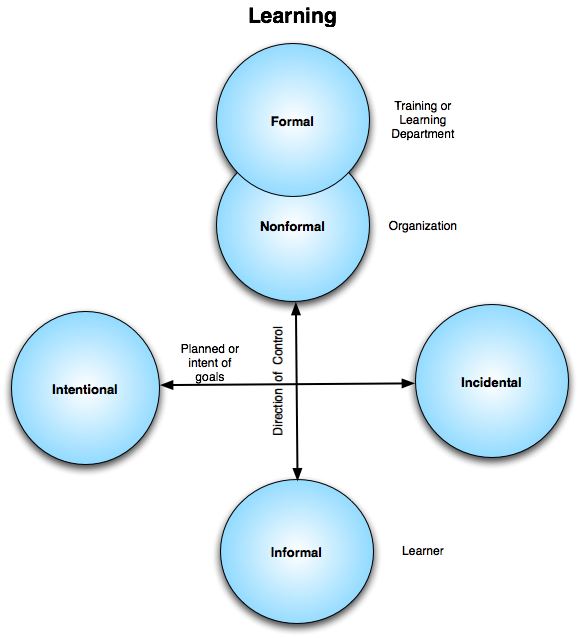
Formal & Informal Learning
"The learning zone" is the convergence of formal and informal learning within a social context where the interests of the enterprise and individual meet. The role of social networks is essential to successful learning in enterprises. - Window into Talent and Learning

Thus, rather than learning being organized around an event, it becomes a network of both planned and spontaneous situations. Some business processes are just too important to be left to chance. For example, manufacturing a product to specifications or safety procedures normally require that some type of formalized learning be given. Yet, it does not require strictly formalized learning methods. Competencies require the mastery of the 5 Cs: Content, Conversation, Connectivity, Collaboration, and Context:

  • While we all enjoy a good speaker, literature, or video that a well prepared lesson can provide, we also need to create and search for our own content in order to provide meaning to the new information.

  • While corporate classrooms have been moving away from lectures and more towards the interactive, it is often only after the learners have left the classroom and have had a chance to digest and reflect on their new knowledge and skills that they are able to engage in meaningful conversations with others to make their learning deeper.

  • People are social creatures, thus many of them look forward to the social aspects that a well prepared class can provide, yet once they leave the classroom, technologies such as the web, blogs, discussion groups, mobile phones, and email allows them to connect not only with the people they met in class, but also with others who share the same interests.

  • This social aspect carries over to working and learning with others in new projects that allows them further gain insight into their recently acquired knowledge and skills.

  • And finally, it is the experiences provided by the other four Cs that give the learners a more well rounded picture or context -- information only becomes relevant when it is related to something the learner is already familiar with.

Technology

Technology is meaningless except in how it can assist you, and then it should disappear and be invisible. It allows you to think of things you couldn't think of, it doesn't think of them itself. - Richard Saul Wurman

When most of us hear the word "technology," we tend to think of hardware, yet it is far more than computers and electronics. It is the application of tools, machines, materials and processes that help to solve problems and extend human capabilities. It has a circular effect on us in that we use technology to learn other technologies; use the newly learned technologies to create new technologies, and then use the newly created technologies to learn other technologies.Thus learning has sometimes been described as the meeting of people and technology. Since technology extends our capabilities, it can help to provide that needed flow that fully engages us in the task we are focusing on.

What to do during the holidays to understand the New Knowledge Order

Between Web 2.0 (including Blogs), Computer Games and Simulations, Digital Cameras, Podcasts, Widgets and other Ubiquitous/Ambient Information, and Cell Phones (just to name a few), it is hard to argue that we are all not in the midst of a New Knowledge Order.

The upcoming winter holidays gives some of us an opportunity to spend hours of low-tension time to experiment. My question to you is, how should that time be spent? What are your suggestions (as specifically as possible), for learning by playing and experimenting?

For one, I would suggest that everyone (who has not already) to download the free iTunes and find a few podcasts to subscribe to and listen to. If you like movies, I would suggest the wonderful Filmspotting podcast. If you like politics, try either Slate's Political Gabfest or Left, Right, and Center. You can burn the podcasts onto a CD for your car. The files are all MP3's, so you can copy them onto non-iPod mp3 players, or, of course, synch them with your iPod. Finally, if you are crazily motivated, download the free, open-source Audacity software and try recording your own voice. Many organizations could (and do) easily have a weekly podcast to align and inform groups of employees, customers, and suppliers.

What else?

Friday, December 8

How would you want your pilot, your doctor, and your lawyer to learn?

You and your family are boarding an airplane, and are about to fly across country. How would you want that pilot to have learned how to fly? P.S. It is stormy.

Your daughter is going in for an operation. How would you want that doctor to have learned how to operate?

You are the defendent a big intellectual property lawsuit. How do you want your lawyer to have learned her craft?

Now, is it fair or unfair to talk about project management, leadership, relationship management, and innovation (or other big skills) using those same standards? Is it as important for your boss, or your CEO, or your employee to have the same level of mastery? Is it even possible?

Thursday, December 7

Federation of American Scientists Bland Report on Harnessing the power of video games for learning

The Federation of American Scientists wrote a paper on Harnessing the power of video games for learning. It is available here: http://fas.org/gamesummit/

Predictably, it is filled with stirring quotes of intellectual criticisms of the current system, detailed modeling of the problems, and vague inspirational quotes of the future opportunity, all by comfortable people. Blah, blah, blah.

My first reaction is, does anyone have any sense of irony that this document has no sense of humor, interactivity, or fun? The form of this document argues for traditional material. I am not saying this document should be a graphic novel, but throw me a friggin' bone here.

I also think of my friend and colleague Graham Courtney who has deployed simulations both nationally and internationally, and to groups from academics to corporate to military. If I were interested in a pep-rally for simulations, I wouldn't let him anywhere near the room, but if I was interested in advancing the art, and the lessons learned from first generation deployments, I wouldn't think of a conversation without him.

But finally comes the real question: how do you actually, really, as-if-your-life-depended-on-it, make change?

a) Where is the pain? Who is bleeding? Who is the poster child of why the current educational monopoly is unacceptable?

The Quality movement, a great milestone of formal learning, happened because of economic pain. But if corporations and competitiveness are the issue, as some speakers seem to think, then why aren't more corporations using games and simulations, as they did with Quality?

What is the emotional resonance, such as the glaciers eroding in An Inconvenient Truth, for this?

b) Wouldn't it be great if the Federation of American Scientists adopted one simulation that they thought had the best shot of role-modeling this new model, and put their resources behind it. Instead of funding reports and conferences and grabbing some sound bites of smart people, what if they measured the before, implemented it in 10 different environments for three years, and then got an after? What if they invested in taking the simulation from version X to version X+1? (This last point is critical - educational simulation require new genres; new genres require a few generations to get right.)

c) What if instead of having traditional lectures, the theme and the structure was: let's produce something to convince people to use games and simulations!

There is safety in writing reports and having conferences. There is comfort in evaluating. There is comfort in asking someone else to change while you do not. But until someone says, "failure is not an option" then failure is inevitable.

P.S. Having said all of that, thanks, report, for the Virtual Leader plug!

Wednesday, December 6

Imagine a course that "just" got students to get the quiet people talking

Imagine a course that "just" got employees to get the quiet people talking at the right time.

(And I mean really applying the skill on a near daily business. Imagine that an employee is increasingly uncomfortable in a conversation until everyone has chimed in.)

I would imagine that students would hate the program. ("Oh, it's so obvious. I already know I should do it, even if I don't." "I can't believe I spent a few hours learning this..." )

Management would have a hard time selling it, measuring it, or funding it. (Straetgic Goal #1: Getting People to Do Something that We All Already Know How to Do, and that can be summed up in a tag line in an email).

Yet I would imagine that the results from the application of the content would improve employee satisfaction ("My boss heard my great idea today"), innovation ("Let's try things differently"), and have a tremendous ROI.

I believe the real use of simple skills at the right time is so much more valuable than the intellectual acknowledgement of complicated processes, yet is almost impossible, due to our structures, egos, and value system, to actually implement.

Monday, December 4

Past Experiences. Present Challenges. Future Predictions.

It's the beginning of another month!
Time for another The Big Question.
November's Question got passions raging and great conversation with real substance whose embers are still glowing as more comments still are flowing in. While we had fewer participating posts this month (21 registered and 10+ thus far found that didn't register with us), the level and depth of the conversations were much more involved and intense.
We heard Mark Oehlert's whining about the first two The Big Questions being tough, so here's a softball, or should I say SNOWBALL, for you.


The Big Question for December is:


What will you remember most about 2006?
What are the biggest challenges for you/us as head into 2007?
What are your predictions for 2007?

Please post your responses to these 3 questions on your blog.


You can post about you and your life as a workplace learning professional or you may prefer to post about our field, current events that impact learning, or any other interpretation of these questions that makes sense for you. Reflection on the past, acceptance of where we are today, and putting our hopes for the future out there are very much a part of this time of year for many of us who grew up in Western traditions. Tony and I are hoping these three questions will be come an LCB tradition over the coming years.


The Big Question Process

You can find more details over in the sidebar, but simply answer these questions by posting your response on your own blog. When you have it ready, come back here to Learning Circuits Blog and fill out the form below regarding your post. We'd appreciate it if you would give a link to this post from your post. Adding The Big Question logo to your post would be a perfect early Christmas present for Tony and I. Once you've entered your post in the form, check out some of the other posts and get involved. Be sure to comment on other participants blogs. or if you should feel a stronger need to write post another post to your own blog and repeat the process again.

To those of you who will be celebrating, have a safe and happy holidays! Enjoy the conversations! - Tony and Dave


Tony Karrer eLearning Technology LCB Question for December - Past Year, Present Challenges, Future Predictions 04-Dec-2006 15:19:07 Dave Lee eelearning past experiences.....More to come... 05-Dec-2006 00:00:00 Karl Kapp Kapp Notes Thoughts about 2006 and Predictions for 2007 05-Dec-2006 19:18:42 Geetha Krishnan Simply Speaking LCB Question for December: 2006 - 2007 05-Dec-2006 22:49:03 Dave Lee e e learning let's continue...present challenges. future predictions 06-Dec-2006 00:00:00 Aradhana Ravindra My Learning Blog What will I remember most about 2006? 06-Dec-2006 07:22:10 Jay Cross Internet Time Here comes tomorrow... 06-Dec-2006 18:58:34 Clive Shepherd Clive on Learning The big question 07-Dec-2006 03:53:27 Brent Schlenker Corporate eLearning Development December's BIG QUESION! Part I 07-Dec-2006 20:16:26 Clark Quinn Learnlets December's BIG Question(s) 08-Dec-2006 13:30:58 Tom Haskins growing changing learning creating Version 3 in 2007 09-Dec-2006 09:28:31 Steve Kaufmann thelinguist.com The Big Question 11-Dec-2006 10:45:25 Wendy in-the-middle-of-the-curve Big Question - Dec 2007 11-Dec-2006 15:17:56 Paul Fender Paul Speaks The Big Question 11-Dec-2006 16:33:46 Anil Mammen Discursive Learning Reflections, Challenges, Predictions 13-Dec-2006 10:48:28 Geeta Bose Learnability Matters The year that was! And, the year ahead… 14-Dec-2006 04:23:29 Mark Oehlert e-Clippings The LCB BIG Question (December 2006) 14-Dec-2006 06:52:03 Jim Blehsaw Managing the Professional Services Firm Past Experiences. Present Challenges. Future Predictions. 16-Dec-2006 17:42:32 Brent Schlenker Corporate eLearning Development December's Big Question Part 3 18-Dec-2006 00:00:00 Brent Schlenker Corporate eLearning Development December's Big Question Part 2 18-Dec-2006 17:29:10 TATA Interactive Systems TIS Corporate Blog LCB Question of the month: December 2006 18-Dec-2006 23:20:00 Stephanie Sandifer Change Agency Looking Back on 2006 and Ahead to 2007 20-Dec-2006 00:00:00

Sunday, December 3

Is it self-defeating to write a book advocating Informal Learning over Formal?

I am happily reading Jay Cross' new book, Informal Learning. As one would expect, Jay writes well and I can easily recommend the book to anyone interested in organizational learning.

While I will chew on this book more intelligently in weeks to come, I am struck by a basic paradox. Can one criticize formal learning models in a book? Isn't a book the epitome of what one is suggesting is the wrong model?

I write this in part because when I attend any of Jay's events, he is the anti-presenter and runs anti-workshop workshops.

I write this also because I have the same issue in writing about simulations.

The answer to the paradox is non-trivial, and fairly important for our industry. In my mind, even though a formal learning experience is not the complete answer, it can be a really productive first step. Reading Jay's Informal Learning is a great first step towards the work of developing a better learning culture. Hopefully reading one of my books is a great first step towards the same goal, just along a parallel path.

In fact, the justification for all formal learning experiences has to be no more and no less than being great first steps. Honestly accepting this truism, in fact embracing it, at all levels of the design, funding, and measuring stages, seems necessary for success.

Wednesday, November 29

What are your strategic goals in 2007

Even more so than saving my Wikipedia entry, I would like to ask something more of you.

What are your strategic goals for 2007? As part of that, what are your learning goals for 2007? And finally, how much time do you plan to spend in either classrooms, online courses, or conferences?

Monday, November 27

What simulations are good at capturing that books are not

I wrote a two-page piece for Brown University's Conduit magazine, on page 8 and continued to 15, downloadable for free here: http://www.cs.brown.edu/publications/conduit/conduit_v15n2.pdf

Here's a quote:

"The next breakthrough will be when simulation and game design is not taught as a vertical skill, like Russian History, Clinical Psychology, or Biblical Archeology, but a horizontal skill, like researching, analysis, writing, and public speaking.

The philosophies of simulation design permit different types of knowledge-capture to augment linear approaches such as writing, taking pictures, and making films. And the full assimilation of post-linear content will change every aspect of universities, from research agendas, to which will be the most influential, to the critical issues of what is taught, how, and why.

There are at least four major constructs – situational awareness, understanding of actions, awareness of patterns over time, and conceptual dead reckoning – that are as natural to simulations as internal monologues and narratives are to books."

Friday, November 24

Two Chasms, Training and Life, and the Invisible System

Here are two sides of the same coin.

1) The Training Chasm is "how do really change people's behavior in a formal learning program?"

2) The Life Chasm is "how do some people accomplish so much more than other's, even when they don't work harder, and really only make slightly different uses of the same basic tools and options?"

I think about both of those when I struggle to discuss the most critical part of a simulation.

There is the interface. There are the results. And then there is something in between - an invisible system. By mastering this invisible system, your actions in the interface lead to success, often through making unconscious trade-offs. By ignoring or fighting this system, you actions, ostensibly similar to the successful user, lead to failure.

Meanwhile, a lot of training talks about models, doing the right things in the order. They might even talk about how to theoretically attach actions to the model. But without practicing using this system, the concepts just as flat as with a tennis student who learns in a classroom, and then is forced to play without internalizing through action.

Wednesday, November 22

Second Life Redux

I have been getting some grief around the web for my post suggesting that SL is not a training tool. May I beg the community for some help?

Please respond to this post with use cases, examples either real or theoretical, of people learning in Second Life.

Is Level 1/Smilesheets BAD for training?

It is commonly referred to as Kirkpatrick Level 1. Did the students enjoy the program?

1) Quality advocates say that such feedback is important. Buzz marketers would say that the students are your best advocates, so you want them to be happy. It keeps the instructor on their toes.

2) There are plenty of people including Kirkpatrick who say that the information is fairly worthless.

3) Also, I have seen many situations where training groups use it because it is the easiest metric. It lets them off the hook from doing other evaluations.

But I heard an argument yesterday from a 30 year veteran that had me thinking beyond the 2) and 3).

4) Does it put the students in the wrong mentality? Does it, as the instructor described yesterday, put the students in a mindset of learning back and saying, "OK, show my what you got? The lessons are your responsibility to teach, not mine to learn? Entertain me! Make it fun?" Does it position too much training as entertainment not training as responsibility to shareholders?

What do you think?

Monday, November 20

Second Life is not a teaching tool

Every week or so I hear about a company looking to Second Life as a teaching environment.

First, I have to say that Second Life is a great Web 2.0/massively multiplayer environment. I respect the ability of people to make money in Second Life. I respect the ability of people to "hang" in Second Life. I think it is great that companies are prototyping visual and structural designs in Second Life. I suggest everyone listen to the Business Week podcast.

Having said all of that, Second Life, as is, is not a teaching tool. It is content free. It is closer to a virtual classroom tool, or even a real-world meeting room or water cooler (without the actual water). Any content has to either bubble up from spontaneous conversations (great when they happen, but not predictable or scalable enough to provide an intellectual payoff), or be "brought in."

From a teaching perspective, it is like grabbing a bunch of employees, putting them in the middle of Times Square, each with a laptop and Internet connection, and maybe a box of Lego, a pad of paper, and some crayons. Will magic sometimes happen? Absolutely, as Jay Cross will point out. Will it be a program that is continued and expanded over the years (my own primary metric of success), either bottoms up or tops down? No.

And mostly, I worry that educational simulations will be lumped together with Second Life. When the "Second Life as Teaching Environment" fails due to randomness of value and experience, people will say, "Ah, avatars! Not so good after all."

The reason for my Simword series here is to highlight that the opportunity for educational simulations, and even perhaps subsequent versions of Second Life, to help people rethink
  • their own interface with the world,
  • their own situational awareness,
  • where they are versus where they want to be,
  • and nurture a greater awareness of patterns.

Only by thinking in this new way do we realize why our ability to teach the most important skills, like leadership, relationship management, stewardship, and innovation has been unnecessarily hobbled by an invisible context of linear content.

Having said all of that, maybe the best of all models will be a structured educational simulation front end experience to drive more focused behavior in the virtual worlds. Now that would be blended learning!

P.S. Speaking of Web 2.0, someone showed me Virtual Leader on YouTube! I don't know who put it up, but freaky!

Sunday, November 19

Typical Sim Conversation

Training Person: I can't do simulations. They are too expensive.

Me: Not necessarily. There are many simple models.

Training Person: Could you show me some?

Me: Sure. Here they are.

Training Person: And are these more effective?

Me: Yes. They have very impressive long term productivity benefits.

Training Person: Those are great. But how about multi-player? Do you have any examples of multi-player?

Me: OK. Here they are.

Training Person: Those are cool. But you have any with better scoring and coaching built in as well?

Me: Sure. Here are a few other examples.

Training Person: Animation is really important to me. Do you have any examples of sims also with really smooth animation.

Me: Yup, I have a few right here.

Training Person: The interface still seems a bit rough. Can I see one with a seamless interface on top of everything else?

Me: Sure - how about this?

Training Person: Our corporate colors are blue and red? Is it possible to customize it?

Me: Yes.

Training Person: Wow, that is so fantastic. That really blow me away.

Me: It is impressive.

Training Person: It's too bad, really.

Me: What is?

Training Person: I can't do simulations. They are too expensive.

Thursday, November 16

Learning from Fox News

Quick question:

If you had a training program that took participants 15 hours to do (let's say a mixture of synchronous and asynchronous), and
  • half of the participants increased their productivity by, say 20%, in a way that endured over months and even years,
  • but the other half hated the experience, and thought it was a waste of time,
...would you champion it?

My sense is that even though the ROI of such a program would be through the roof, most training people are so uncomfortable with the negative press that they would not want it in their portfolio.

Am I wrong? What are your thoughts?


P.S.

Here's a podcast on simulations that I did a few days ago that I hope some of you might find interesting called Immerse Yourself - Increasing Learning through Simulation... Gaming Style.

P.P.S.

I have been gathering more simwords - descriptors inspired by computer games and simulations that describe the knowledge and wisdom that book, magazines, and lectures have left behind. Let me know if you want them here.

Monday, November 13

Internet access alone raises test scores

Post by Donald Clark points to a study that says: Donald Clark Plan B: Internet access alone raises test scores.

The findings were consistent across both genders – the more time the children spent on the web the higher their academic achievement as measured by standard test scores.

Monday, November 6

November's The Big Question
Are our models (ISD, ADDIE, HPT, etc.) relevant in the future?


October’s The Big Question was great fun and a great success. We had 38 posts regarding the topic “Should all Learning Professionals be Blogging?” There were over 70 comments made to the posts and we had 60 votes in our mini survey.

November's The Big Question is:


Are ISD / ADDIE / HPT relevant in a world of rapid elearning, faster time-to-performance, and informal learning?

The procedure is the same as last month. For details, please see the sidebar.

To follow The Big Question, click on any of the links to participating posts below. Please feel free to comment on this post or any of the others. The aggregated list of all the comments to participating posts can be seen by hitting the MySyndicaat button below.

Enjoy the Conversation!


Tony Karrer
eLearning Technology
Significant Work Needed to Help Instructional Designers
Matthew Nehrling
mLearning World
Choose the Right Door
Tom Haskins
growing changing learning creating
Vetting our use of ID models
Anil Mammen
Tata Interactive Systems
The future of instructional models
Clive Shepherd
Clive on Learning
Is instructional systems design still relevant?
Jay Cross
Internet Time Blog
Jay says, "Sometimes"
Karl Kapp
Kapp Notes
Yes, We Should Keep ADDIE, HPT and ISD Models
Phil Charron
Learning Simulations
ISD, ADDIE, HPT relevant?
Clark Quinn
Learnlets
Not your father’s ISD/ADDIE/HPT
Dennis Coxe
Sailing by the Sound
Is ISD / ADDIE / HPT Relevant?
Dave Lee
eelearning
are we forgetting the forklifts?
Anol Bhattacharya
SoulSoup
Big Question: ISD / ADDIE / HPT: Still relevant?
Karyn Romeis
Karyn's blog
The future of learning design models
Jacob McNulty
Revolutions
What Fate Awaits the Models (ISD, ADDIE, HPT) of Traditional Training?
Geetha Krishnan
Simply Speaking
Not ADDIEing up?
Russ Crumley
Make the Moment
Absolutely Yes
Harold Jarche
Harold Jarche
Wither ISD, ADDIE & HPT?
Wendy Wickham
In the Middle of the Curve
ISD, ADDIE, HPT
Clark Aldrich
Learning Circuits Blog
Web 2.0 and the changing face of editorial content
Dave Lee
eelearning
addie? isd? hpt? - adapt or die!
Tony Karrer
eLearning Technology
The Big Question for November - Future of ISD / ADDIE / HPT?

Web 2.0 and the changing face of editorial content

The pure premise of Web 2.0 is
  • let's get rid of editors;
  • users submit the content, including primary entries, feedback, ratings, and even clicks.
  • recency is absolutely necessary to the value of content;
  • a critical mass volume is necessary in the tens of thousands, if not much higher
  • the value of content is best determined by the wisdom of the masses through user rating, user volume.
  • meaningful 1:1 relationships can come from participation in communities

What does that change, if anything, the training model?

Friday, November 3

eLearning Technology: How Do People Interact with Blogs?

This is a slightly different topic but relates to The Big Question for October: Should All Learning Professionals be Blogging? Some interesting comments are being left about How Do People Interact with Blogs?

Thursday, November 2

LCB Busts a Move

Last week I surfed on over to Technorati to do a quick check on Learning Circuit Blog's ranking. We've generally been in the 40,000 to 60,000 range with some a great degree of consistency. Well you can imagine the double take I did when I saw the listing you see on the left here.

25,173! That's way cool. Obviously, The Big Question had the impact we had hoped it would have. 28 of you posted a response to your own blog and came back here and told us about it. 5 of you participated in The Big Follow-up Question. On top of that just nosing around Tony and I uncovered several more posts and references to The Big Question that had not been reported back to LCB. That's at least 38 people who took part. Of particular note was that 11 of the 38 participants were folks who had never posted a comment to LCB before. While they may have been lurking previously, this was a new level of participation for them.

We also had 6o responses to the mini quiz. See the final results in the sidebar.

The Big Question definitely says something about the power of networks. Just what is something I've decided to take some time and figure out. I've collected much of the participation and reaction to The Big Question. But I could use the help of those who participated by posting a response to your blog. Did you see a change in your Technorati or Alexa ranking? (or any of the other ranking services is fine.) Do you have actual numbers say from the end of September and from mid- to late October. If you do and wouldn't mind my adding them to my data, please drop me an e-mail at dcleesfo (at) gmail (dot) com. I'd like to see if there was a consistent change or was the change limited to a few people's blogs. I'm planning on doing this analysis for at least two more months, if not longer. So if you either didn't participate by posting a response to your own blog or or you didn't check your rankings before and after, but you'd like to moving forward, check your technorati, alexa and/or other rankings this weekend and either jot it down or send it to me. Then make a note to check again around the 20th of November and send the information on to me.

I'll share my findings with the LCB community whenever it seems appropriate. It is also my intent to report data in the aggregate. I'll only use screen shots or specifics about your blog in public reports with your knowledge and consent.

Get ready. The next The Big Question launches on Monday!

Wednesday, November 1

If you aren't piloting, you aren't doing your job, and you probably won't keep your job

I have seen hundreds of situations in the last 36 months where a training group had a training experience they said they wanted to consider for implementation.

  • Around 25% did not evaluate the program at all.
  • Around 25% evaluated the program by skimming it.
  • Around 20% evaluated the program by asking a few friends to skim it.
  • Around 20% evaluated the program by putting in a small group and asking the participants if they liked it.
  • Finally, around 10% evaluated the program by putting a group through it and measuring the effectiveness.
As a bit of a post script, when re-engaging training professionals a year later, there seem to be a significant correlation between those who didn't pilot well and those that did not have a job. Those most afraid of bothering people with a pilot became those most vulnerable.

Wednesday, October 25

A Short Experiment: Six Word Lesson Plans

I don't know how many of you have seen it, but over at WIRED, they did an article in which they asked a series of writers to follow in the footsteps of Ernest Hemingway and write an entire story in just six words. Hemingway wrote "For sale: baby shoes, never used" and declared it his finest work.

I have always been a fan of the Webby Awards and their restriction of only 5 words for acceptance speeches. You can see the great results here. I have also just listened to the podcast from IT Conversations featuring Kathan Brown talking , in part, about how constraints push creativity into new places. Along those lines and with a big tip o' the hat the the genius behind the creation of the Big Question - I have my only little contest going.

Let's see who can write the best lesson plan of learning objective in only six words. I have also posted this challenge on my humble blog and would love to see the results go either place (I promise to share all results in both places).

Let's have some fun and see what ideas constraints might bring us!

UPDATE

Harold Jarche picks up the gauntlet first - here
Peter Isackson adds one with an artistic feel
Geetha Krishnan weighs in with an over-arching set
Dave Lee jumps into the mix with this great entry
Lee Kraus has one here that really resonates
My buddy Brent Schlenker has the Apple-induced six worder here
Jay Cross make his move and brings some other 'possible' entries with him like one from Roger Schank. p.s. Buy The Book.
Stephen Downes joins the fray and follows the narrative idea from the original WIRED story nicely.

Monday, October 16

DevLearn Handouts and A Success Story: Elearning and Instructional Design Musings

The sessions at DevLearn went really well. You can find handouts from DevLearn sessions and you can find my session handouts at:

What’s Now and What’s Next in e-Learning: Technologies and Practices

Not sure if you'll need any special permissions to get these. If you do, let me know and I'll post them somewhere else.

Now, let me say that many presentations I give, I know that when Monday rolls around after the conference, there won't be any real action. But today, I've received several emails that indicate real action is being taken and even one person sent me a link to their new blog that they decided to create as their next step out of my presentation. Here's the blog:

Elearning and Instructional Design Musings

Of course, now I have big expectations. (Actually, a pretty good write-up of thoughts around DevLearn can be found.)

Kudos to all of you taking action!

Tuesday, October 10

The Big Follow-up Question

What a great conversation our Big Question generated last week. As Tony has summarized, it seems most everyone agrees that blogs are great tool for acheiving some vital professional development characteristics that every learning professional should have:

  • being self-reflective,
  • being collaborative,
  • being rigorous in supporting our positions,
  • open to feedback,
  • understanding our point of view and learning to share it,
  • working knowledge of new technologies,
are a few we've identified. But where does that leave us? Of course, the begged question here is -


So, What Can We Do About It?


If you think it's important that everyone be blogging, how do we get there? If you agree the goals that I've just listed are important, but blogs aren't the answer. What is? Blog about how you would take steps to improve the quality of learning experiences using blogs - or other technologies.

The form for submitting posts regarding the big follow-up question has been closed. However, if you have a post in response and would like to have it added to the list below, please contact dave lee at blogmeister (at) mac (dot) com

Sunday, October 8

Community Net Worth

In my assumed role as devil's advocate, I'll be bold and make another observation about the negatives of blogging. Using the very example of this blog, doesn't the "everybody blogging" (or everybody wikiing) principle inevitably result in what I'm tempted to call "learning labyrinths" in which focus can only be provided by individual participants or learners? What I mean is that there's little hope for community focus, which in turn means that even tentative conclusions about what is discovered, learned, validated, etc. is either the result of a peremptory use of authority (wherever it may be situated) or the vaguely perceived subjective impression of which way the wind is blowing for the majority.

That said, at least for this group, learning labyrinths appear to be fun. They could also become a productive tool if we had both a strategy for managing such complex and unpredicatable entities as well as the means and know-how to carry the strategy out. But it's a lot of work (as well as virtual juggling), as Dave's efforts and successive adjustments demonstrate. As at least one element of progress towards a strategic goal I would suggest the need to plan and successfully execute a refocusing phase at some point. But to do so requires taking on major responsibility as a guide or guru, which raises the question of roles and the exercise and abuse of power in "teaching" relationships.

My one "positive" suggestion is that, as in marketing, the place to start is not with the product and its features but the marketplace and its structure. We're engaging in something that concerns a broadly defined community (the "learning" profession) and proceeds through the spontaneous generation of smaller communities of discourse. That much, at least, seems clear from this experiment. One way of finding out about one's marketplace is, of course, to launch the product and test the reaction; but it's usually considered wiser to examine the intended target audience first to see what it's capable of taking on board.

Now that the first wave of bloggers and blog-readers have read the initial results both in the form of serious utterances, straw polls and comic reformulations (thanks, Tony for that refreshing exercise), whither go we? Do we know more about our marketplace or do we simply know more about the individuals who have so far participated?

Thursday, October 5

Throwing a Big Community Net

I have a few new aspects of "The Big Question" to announce. Both are designed to bring everyone in the greater LCB community a bit closer to each other and to enhance the conversation.

Capturing the Big Conversation

Through the magic provided by Cocomment and MySyndicaat we now have a chronological listing of all the comments made to all of the blog postings regarding The Big Question. To let you in on the secret behind this list here's what I did:
  1. Captured the comments conversation for each post with the cocomment widget (whether there was a comment made to the post yet or not)
  2. From the cocomments "your conversations" page I then found the RSS feed for each post and it's comments(this is generated once there is at least one comment on the post)
  3. I then fed these RSS feeds in to a MySyndicaat feedbot.
  4. (Then I leaned on MySyndicaat's support service because I could only generate the first comment for each post)
  5. Giovanni from MySyndicaat got me the last mile by fixing a setting in my feedbot and Voila! We have the page you can link to by clicking on this button where ever you see it.

A Poll For Our Lurkers
Following good community design, we've posted a flash poll in the sidebar to give anyone and everyone a change to participate in the discussion. The first poll is simply a repeat of The Big Question - Should Every Learning Professional be Blogging? Whether you've posted to your blog, commented on a post, or have just been sitting back enjoying the discussion, go voice your opinion in our poll.

Now back to the conversations!

Wednesday, October 4

The Big Question for October:
Should All Learning Professionals Be Blogging?

The Big Question is a new monthly feature on Learning Circuits Blog. We want everyone in the LCB community to join in - from the comfort of your own blog. Each month we will pose a question we think is of interest to the learning community.For info on how it will work, please see the Sidebar.


The Big Question for October is:

Should All Learning Professionals be Blogging?
Posts Discussing This So Far (26):
  1. Dave Lee - eelearning - did your great-great-great-great grandfather write a novel?
  2. Tony Karrer – eLearning Technology - LCB's Big Question - Should All Learning Professionals be Blogging?
  3. Brent Schlenker - Corporate eLearning Development - Should All Learning Professionals be Blogging?
  4. Jim Belshaw - Managing the Professional Services Firm - Should All Learning Professionals be Blogging - Practical Issues
  5. Rodolpho Arruda - Noverim Me, Noverim Te - Pessoas que trabalham com educação deveriam ter seu blog? (Don't worry, Rodolpho posted in English for us monolingual US people.)
  6. Stephen Downes - Half an Hour - Should All Learning Professionals be Blogging?
  7. Harold Jarche - The Big Question
  8. Bill Bruck - Blogging and the Nature of Dialog
  9. Matthew N. mLearning World Learning Circuits Asks- Should All Learning Professionals Be Blogging?
  10. Mark Oehlert eClippings Learning Circuits Asks- Should All Learning Professionals Be Blogging?
  11. Barry Sampson Learn Me Happy The Learning Circuits Blog: The Big Question for October: Should All Learning Professionals Be Blogging?
  12. HowCron e-Training in the Trenches Should All Learning Professionals be Blogging?
  13. Geetha Krishnan Simply Speaking Should All Learning Professionals Be Blogging?
  14. Jane Interactive-HE in FE Should All Learning Professionals Be Blogging?
  15. Karl Kapp Kapp Notes The Learning Circuits Blog: The Big Question for October: Should All Learning Professionals Be Blogging?
  16. Rovy Bronson Situativity Should We All Blog?
  17. Nancy White - Full Circle Online Interaction Blog: The Big Question for October: Should All Learning Professionals Be Blogging?
  18. Bronwyn Clarke - Should All Learning Professionals Be Blogging?
  19. Tony Karrer - eLearning Technology: Top Ten Reasons To Blog and Top Ten Not to Blog
  20. Dave Wilson Learning Reflections The Learning Circuits Big Question
  21. Clive Shepherd Clive on Learning Should all learning professionals be blogging?
  22. Tony Karrer eLearning Technology Blogs vs. Discussion Groups or Mis-Understanding Blog Reading and Blog Communities
  23. Dave Lee eelearning blogs are awesome
  24. Clark Quinn LCB Big Question of the Month
  25. Peter Isackson Learning Circuits Blog Community Net Worth
  26. Mohamed Amine Chatti Mohamed Amine Chatti´s ongoing research on Technology Enhanced Learning Should All Learning Professionals Be Blogging?
  27. David Wilkins Performance-based Learning The Big Question -- Should All Learning Professionals be Blogging?
  28. Terence Armentano, M.Ed., The eLearning Spotlight and Resources Should all Learning Professionals be Blogging?

Check out all 54 comments responding to these posts. Just click on this button whenever you see it!