One aspect of Virtual Leader that I have liked is that it forces players to differentiate between criticizing ideas and criticizing the people who sponsor them.
And yet, the exact mixture of the two provides a lot of additional information as to how raw, even how religious, the conversation is getting.
A post I made on schools and business hating each other definitely hit a bit of a nerve with some people outside our community, posting in.
But no topic raises such primal emotions as talking about post-literacy. The very idea that books are "just" a technology, three steps forward and one step back (my own working definition of any technology), strikes some people as blasphemous. It comes off as anti-book, as if being pro-automobile is the same as being anti-walking. One friend asked me not to use the phrase around her.
We are going to have to begin talking about post-literacy. The irony is that as we explore the topic, our love for reading and writing will become more heightened, not less.
Friday, August 12

Thursday, August 11
Flow
 Dutch composer Simeon ten Holt wrote Canto Ostinato (mp3 file) for various instruments and flexible duration. Ten Holt uses repetition and minimalist permutations to create an original, evolving work with ever-shifting moments. These parts are woven together into an overlapping and flowing whole.
One popular arrangement is to have three or four pianos facing each other in the center of a room, and normally, unlike conventional performances, the audience is allowed to move and surround the performers as they play.

Canto Ostinato has 106 figures or parts and the players themselves, decide on the stage, how many times they repeat each section, etc. Ten Holt has said, "that what happens on-stage is like you're looking at an object from different angles, and the object is changed by the input people put into it. If you look at an object from above or below, it's still the same object, but the colours are different, the shapes are different, and that's what happens on-stage. So the players' input is very important."
Canto Ostinato has become a metaphor for a new approach to design (Thackara, 2005). The composer, score, musicians, stage, and audience all interact in subtle, yet complex ways. Neither the musicians or the audience knows exactly what will happen next as the arrangement is quite flexible. But they are not flying blindly as there are principles and to a point, a score. Thus, the situation itself, in a sense, becomes designed.
Flows are not just one element of social organization, they are the expression of the processes dominating our economic, social and symbolic life - Manual Castells in The Rise of Network Society.
Notice how this relates to performance management. There is a space of flows in each performance situation -- techniques, technologies, information, sounds, symbols, people, and the performance itself. Yet, like the Canto Ostinato, while there is a score (goal or blueprint); life unfolds anew, thus, each situation basically designs itself.
Fredick Taylor's Scientific Management tried to freeze the performance and then totally script it. While Taylor's method focused primarily on the process itself, flow is more about helping people to develop so that they can perform. The manager becomes more like Ten Holt in that he or she givers her players a score to follow and conducts them, while at the same time giving them the freedom so that the situation is allowed to design itself, rather than just becoming a carbon copy. Thus, rather than just simply following a script, interaction becomes a major part of the performance.
Reference
1. Arrangement (mp3 file) by Jeroen Van Veen
Evaluation of Formal Learning Programs is a marketing activity
One should not evaluate a formal learning program to justify that the money and time were well spent. One should evaluate a formal learning program to get resources for the next program.
If there is a "level 6" evaluation of a training program, it is, "did it lead to growth of the training program/growth of the training group/promotion of the sponsor?" If not, all other metrics are irrelevant.
Of course lessons learned should make the next program (the X+1 program) better. But the driver of those improvements is to get an even better evaluation of X+1 than of X, so that selling the X+2 program is easier.
There are those who view marketing as selective truth telling at best and lying at worst. That is too bad, because ultimately marketing is evolving the premise for a sustainable vendor relationship. It involves as much listening as talking.
Credibility is hugely important, therefore. Honesty is a sine que non of any sustainable brand. But the culture of the group has to be growth through success, not just introspection. Evaluations should be done looking forward and outward, not backwards and inward.
How effective is your learning evaluation?
The evaluation of training is too important to be left to trainers.
At the individual intervention level, at the strategic enterprise level, and at all points inbetween, the quality assurance processes applied to formal learning initiatives in most organizations are, in my experience, rudimentary at best.
Training departments are usually stretched thin, and don’t have the time or resources to do a “proper” quality assurance job at either the course level or at the aggregate departmental level. Implementing a regimen that elevates the strategic importance of evaluation (across all levels) and places it on a more professional level will do two vital things. It will improve significantly the effectiveness and efficiency of all learning activities; and it will save a tremendous amount of unnecessary, un-useful, or redundant work.
My fear is that with the advent of LMS-based evaluation and record-keeping, the information we have about the quality of our learning activities is becoming more narrowly focused, and its usefulness is becoming further diluted. Just as LMS functionality tends to constrain the nature of our design of instruction, it constrains the nature of our inquiry into its impact.
I’d like to see more training departments creating evaluation units and staffing them with a trained expert or two who can help get past the simplistic "smile-sheet & ROI" approach and start building systems that put the important issues on the dashboards of individual trainers, instructional designers, and senior learning managers.
Tuesday, August 9
Short Essay Question (worth 20 points)
In a fictitious Fortune 1000 organization, there is a 20-person group dedicated to managing real estate assets. Seven of the people were chosen to take a two-day, off-site course on negotiating, which all but one attended.
Questions:
- How do you think the members of the team felt who went to the training?
- How do you think the members of the team felt who did not?
- What does this say about the perception of training?
- Is this situation a good one or bad one for the organization?
- Could/does this situation happen in your organization?
You have five minutes to respond.
Monday, August 8
24 Questions about computer games and education
- Are computer games inherently counter-cultural?
- Are some computer games bad for children?
- Do computer games herald a revolution in education?
- For a given curricula, where would one ideally use books? Where would one ideally use computer games/educational simulations? Given educational objectives, how do you support them with computer games/educational simulations?
- How can computer games/educational simulations augment existing curricula; inspire new curricula? Do computer games/educational simulations increase the types of content that can be learned formally?
- How can modding be used to better use existing computer games in formal learning programs?
- How can teachers/professors/trainers use existing computer games (as is) in formal learning programs?
- How can you create a marketplace for educational simulations?
- How do you create a computer game for education?
- How do you measure the effectiveness of computer games/educational simulations?
- How do you use a computer game structure to capture and model expert behavior? What then has to happen to make it an educational simulation?
- How does someone who grew up playing computer games learn differently than someone who did not?
- How much should an educational simulation cost? To build? To buy?
- Should educational simulations be fun, the way that a computer game is fun?
- What are educationally relevant artifacts from computer games/educational simulations?
- What does one learn from a computer game? What does someone learn from Civilization III? Grand Theft Auto? What are the new frameworks/vocabularies needed to talk about this new content?
- What is the impact of looking at computer game genres, as opposed to computer games? Do we need new genres for education, or are existing computer game genres sufficient?
- What is the relationship between production values and effectiveness?
- What should a professor do about computer games? What are early steps? What are later steps?
- What toolkits exist for an e-learning developer to quickly and cost-effectively make an educational game?
- When should an educational simulation be single-player/multiplayer/massively multi-player?
- Which computer games today are appropriate for formal learning programs?
- Which computer games today are worthwhile from an instructional/liberal arts perspective?
- Will educational simulations be to computer games what documentaries are to movies?
Brainstorm: The New Curriculum for E-Learning Developers
I have a question for this community. If you were a university offering an advanced degree in Instructional Technology, what are the tools (not philosophies) you would strongly urge your students to learn?
Saturday, August 6
Digital Tools / Paper Mindsets
Someone, perhaps unwisely, gave me keys to this blog and asked me to write. We'll see how long it lasts...
For this first post are some long held observations on the use of communications technology. We know and see people spending a majority of their workday, or just walking around town, plus what they do at home, in front of the computer, the cell phone, the blackberry-- immersed in digital tools. However, it sure seems we still think in a paper mindset. Think about our terminology. We read web pages. We insert bookmarks to remember pages. Heck, I am surprised we do not refer to web sites as web books.
Mainly I am thinking of email, both boon and bane of our workday. Sharing information by email in our organization is the expected norm-- and the scourge of spam is bad enough in terms of time and productivity wasters, but also when it is used be well intended people in an inefficient way.
The ones that make me scratch my head are messages that arrive with subject lines like "Tuesday Planning Meeting Agenda" and upon opening the message is no agenda, no message, just an attached Word document. This makes the agenda, essentially text only content, yet one more click, and one more application launch away. And what does one really do with a nicely formatted list of basic bullet points? Print it? When I send agendas, they are right there in the body of the email, readily scanned, right there ins the message.
One of our groups, actually a technology group, has done this for years. But they've recently stepped up the level. They've created a portal for online community building. Oi! So the meeting notice is like, this, "Upcoming meeting. Click here for agenda." I click there. It's certainly a portal like pile of boxes and links. I find the one labeled meetings. I click the link for this month. It's another web page. I click a link that is labeled "agenda". What do I get?
It's the same old Word document. So now the agenda is about 3 clicks and an application launch away. It's what happens when we are stuck in document - paper - print mindsets. It is all about the "page" and not the content.
This was a puny example of a syndrome I have elsewhere labeled email attachment disorder. Beyond Google's gmail, general e-mail is about the worst and most inefficient system for organizing information. Much of the information shared in our system has no permanence beyond what is stuffed into an email. But there is no long term organizational memory or archiving of email, it is rarely widely searchable, and for large media files, it is sent to many more people than will actually view it. It is a paper mindset, stick a copy in everyone's mailbox.
For as long as I've been responsible for our office's online content, I've had to urge, remind, nag to always plan up front that everything we do have some sort of electronic presence, record, etc, especially for those that are unable to participate in our activities. Groups I am responsible for put their agenda up as a URL and filled in later by meeting notes. Our Ocotillo Online Learning Group has held monthly meetings back to 2000, which I know because all meeting notes have been archived, making them potentially searchable and internally linked to relevant content. This is what happens when you think about information in a web mindset, freed from the constraints of single throw away documents.
How about the N-factorial e-mail messages needed for N number of people to plan a meeting? For a different tactic, see Lee LeFever's Common Craft article on Wiki and the Perfect Camping Trip. Now that is using digital tools in a non-paper frame of mind. And it's been done in real life.
This web thinking is playing into our new plans to cease the print publication of a long running journal, which costs our unit thousands of dollars per year plus intense time spent in editing (getting the one off print version perfect), in lieu of a web publication that will, we hope, expand the range and types of content we can publish, plus add features not available in print.
We are trying to break of the proverbial box, which is after all... a paper product.
So what's it like in your organization? How does it organization and archive its processes? e.g. is there organizational memory? Are digital communication tools used to push around electronic bits of paper? Or does it really leverage the power of the digital terrain? Are they thinking digitally?
Friday, August 5
Tools of E-Learning Hacks
This is an odd industry, sometimes a very cruel industry. What amazed me when I first entered it, and what still amazes me today, was the amount of hacks that people generally accepted as experts. There was/is this bizarre premium on volume and intensity over actually well thought-out and/or well-researched and/or deeply intuitive statements.
The framework/snake-oil of many of these hacks is: say something that superficially sounds smart or interesting, but that can't be taken any deeper.
- Any statement that starts something like: The X Myths about e-Learning, Training, Learning, or whatever is always suspect. Most of so-called myths have very little supporters, or are bizarrely vague in and of themselves. i.e. Myth #1: E-Training equals E-Learning, or Myth #2: People only learn in formal training situations.
- Another hack device, one that I have mentioned here before, is invoking every hot new technology. Training/Learning should be more like TiVo, or iPods, or Computer Games, Segways, or Viagra, or GPSs, or whatever. Don't get me wrong: if you are Kurt Squire and just finished your dissertation of actually using the computer game Civilization III in the classroom, I want to hear all about it. But if you just watched your kids playing a racing game on an Xbox, and want to make a sweeeping statement, you don't win visionary points from me.
Anyway, enough of that. I would like to show you how smart I am and tell you why Harvard Business School is doomed. And all of this fancy new technology is a waste as well.
Think about it. Why spend two years of your life, and all of that work and money, to get an advanced degree? The point is to control your life, right? All you really need is an email with tomorrow's winning lottery number. The infrastrucutre is so simple: an email address, which everyone has, and even a very old computer. Text only. You could even get it on your cell phone or pager (that would be m-learning). Or someone could call you and leave a message on the phone and answering machine you already have! And be honest: you may not spend three hours doing all of your homework, but you would definately spend three hours to get to the right store to buy a lottery ticket, right? You would be set for life!
That's the future. Yup, Harvard and all of those other places that just don't get it are doomed.
What is your favorite hack device?
Thursday, August 4
Pop Ups and Spam
Just a quick operational note to everyone.
Apologies to anyone who was subjected to a barrage of pop up advertisements. I have shut down the "Invite or Seduce?" flash poll (the trend was pretty obvious anyway!) because it was this Bravenet tool that was the culprit. Because LCB is entirely volunteer and operates with no financial support we seek out free resources. Unfortunately, most of these come at a price of advertising being pushed through your website. I will continue to work to keep this to as unobstrusive a presense as possible. If you are aware of any free web-based tools which are also advertising free, please let me know.
In addition, if you run across any spam comments, please drop me a quick note by hitting the "email the Blogmeister" link in the sidebar. I found 14 spam comments this morning throughout LCB. Fortunately they were fairly benign in content, but I may have missed 1 or 2. Scouring through the comments in Blogger is not easy.
Thanks everyone! Now I can get back to reading all the great discussions you all have been posting in the last few days! WOW! Keep it up!
Dave
Your humble blogmeister.
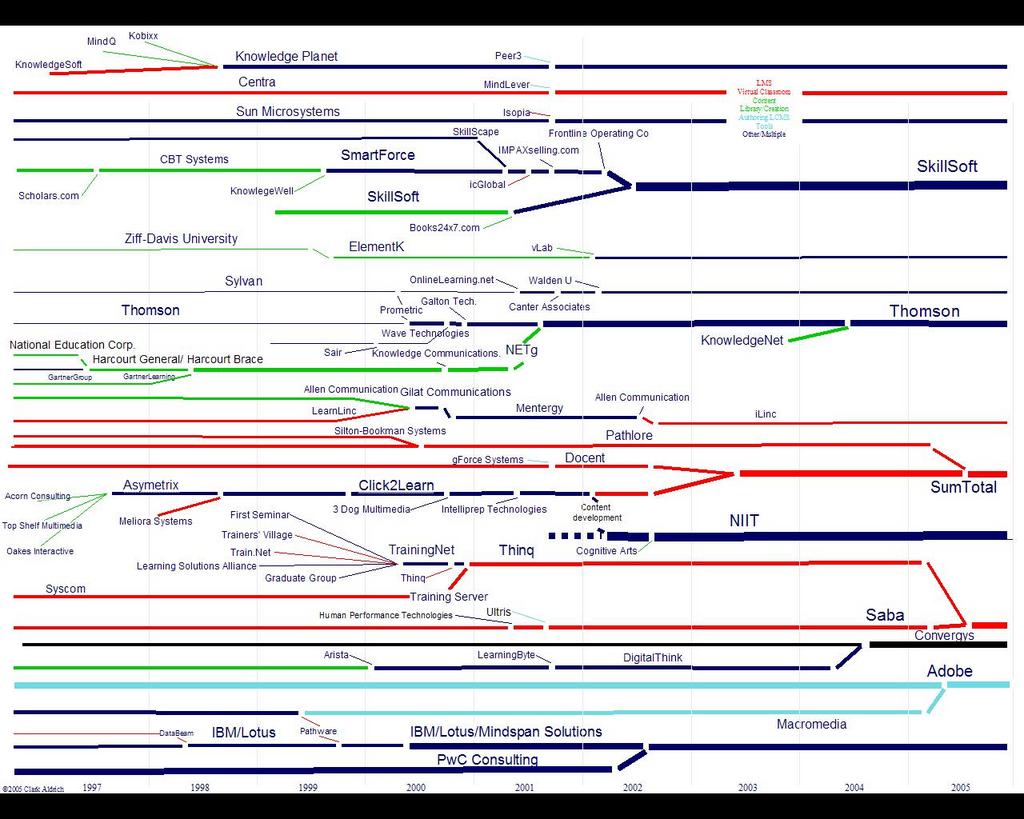
Brainstorm: What have been the major e-learning mergers of the last five years?
I have a question for everyone reading this blog. What do you think have been the major e-learning mergers over the last five years? List them by year if you have that information off the top of your head, but the actual merger is more important.
Wednesday, August 3
Merger mania in and around eLearning
First, on Monday, WebEx buys intranets.com for $45M in cash (details) then today SumTotal buys Pathlore for $29M in cash (details) and $19M in stock. And then I hear that back on July 27 Premiere Global Services announced that it was buying Netspoke for $23.2M in cash (details).
So a virtual meeting company buys a collaboration company.
A LMS company buys another LMS company.
And a communication services company buys a collaboration company.
Looks like the convergence that Elliott Masie has been talking about taking place is finally happening. Anyone familiar with my posts and company knows that I am a big believer in the power of collaboration (and ideally done to such a level of integration that it results in mentoring not just with 'experts' but also with your peers) so it is heartening to see that finally we are moving past 'simplistic' collaboration (i.e. like stand-alone web meetings) in learning with WebEx+intranets.com and PGS+Netspoke while the fragmented LMS sub-industry is getting so much needed consolidation with SumTotal+Pathlore (and remember that SumTotal is the March 2004 merger of Docent and Click2learn).
All of this comes of the heels of SkillSoft releasing SkillSoft Dialogue, their version of a virtual classroom and NETg buying KnowledgeNet last year for their virtual classroom technology/LMS resulting in their Knowledge Now suite.
Are we finally getting to the point where educational content is merging with collaboration technologies which is merging with learner management infrastructure?
Collaboration is important as it allows learning to become a continuous process and acts as a quality feedback loop while helping to generate new content out of the resulting interactions, all of which sits on top of the learning management system. It has been long neglected in the eLearning industry due to it's complexity (trust me I founded scholars.com and struggled with the scalability of it's mentoring model long after SmartForce bought it) for it has been far easier to manage content objects than collaboration objects. I always said while at SkillSoft/SmartForce/CBT Systems that the value of SkillSoft is not the 5000+ hours of training but the fact that you could potentially tap into the collective knowledge of their 3 million users. Of course the Internet bubble burst and they went back to the tried-and-true model of producing generic content.
Anyway ... sorry for the rant but I have been concerned about the health of the eLearning industry over the last 2 years and I am glad to see this much needed consolidation taking place. Hopefully it will result in some truly innovative stuff versus people scrambling to get into liferafts. Think social networking analysis, workflow learning, collective intelligence, presence awareness, expert locating, communities of knowledge (made up of smaller communities of practice) ...
Or as BusinessWeek recently put it - The Power of Us. If you haven't read their cover story on how mass collaboration is shaking up business you should as they talk about how large scale collaboration has changed the delivery of services like auctions (eBay) and product like books (amazon.com) which makes you think about how mass collaboration could change the sharing of knowledge which until recently has been done on a small scale, typically geographically driven, basis or through static content.
PS - for those that care it is interesting to note that the 2 collaboration acquisitions were basically done at 2x trailing 2004 revenues (Netspoke) and 3x projected 2005 revenue (intranets.com) while the LMS acquisition was done at 2x trailing 2004 revenues (Pathlore). These multiples are indicative that there is a resurgence of interest and hence increased value.
Schools hate businesses, businesses hate schools
As a gross generalization, schools hate business and businesses hate schools.
Let me defend that:
Schools hate business
1. Many academics view any skills that empowers an individual outside of academics as either "vocational" or "turning students into drones of capitalistic societies." (Yet they have no problem rewarding skills that turn students into drones of academic environments.)
I mention teaching subjects like "project management"and"solutions sales" to teachers and they recoil.
2. Professors are even encouraged to downplay their consulting to corporations. Even in b-school environment, what consulting is done, according the school mythology, is prostitution, a pursuit of lucre at the expense of integrity, unless it is done at the board level of a Fortune 500 company.
3. A lot of academics smile when the stock market dives, vindication of both their world view and their own personal career choice.
Businesses hate schools
1. Businesses rail against classrooms, even their own training classes. Corporate people love to complain about training classes. "Classes don't work!" "Training doesn't teach anything." "No one ever learned anything of important in a classroom." Many training books and training professionals love quoting high profile individuals (such as CEO's or brand-name consultants) hacking at classrooms, thinking "beyond the classroom." If you listened to all of them talk, you would assume that employees are spending half of the lives trapped in basement lectures. Most people spend less time in classes than they spend waiting in line at their organization's cafeteria. It reminds me a bit of the supporters of the a flag burning amendment. I wish people wouldn't burn the American flag as much as anyone, but as far as I can tell, there is just not an epidemic of flag burning. And there sure is no epidemic of too much classroom training. The railing is really just posturing.
2. Business people love talking about academic reform. But when a company is performing sub-par, business people don't talk about Xerox reform or corporate reform. They talk about change management, growth, and re-invention. They talk about "taking a short-term profit hit" to "restructure."
3. Even amonst the corporations that do the most training, I have never seen a business sponsor an internal remedial history class, or art class, or literature class, or any kind of liberal arts experience. They say they respect it on a resume, but if you don't arrive with it, they are sure not going to give it to you.
4. And businesses fight hard for tax breaks, which come out of school pockets.
All with a big smile
But both sides hide their animosity reasonably well. The development side of schools want donations from businesses. They talk to parents about preparing students for the future. Businesses want to appear helpful and benevolent and part of the community.
It is only after the love-fest meetings and PR events do the real feelings emerge.
And I believe the friction, the misalignment, this cold war between these two hurts students, hurts our GDP and standard of living, hurts schools, and hurts business.
The Hope of T+D
In our profession, literally of the people reading this blog, lies either the opportunity to bring these two worlds together, or to create a bigger wedge to push them apart. It is an opportunity (and yes, responsibility) that I hope we all consider as we present our ideas, shape our strategies, postore, define ourselves, and invest in and execute our plans.
Tuesday, August 2
Innovate's special issue on the role of video game technology in educational settings
Innovate's special issue on the role of video game technology in educational settings is now available.
It features such power-thinkers as Gee and Squire.
I had an opportunity to present a take on what I believe is absolutely necessary for the next step in schools: the 20 simulation genre solution (this is in the second half of the interview), as well as explore throughout the truism "what is taught is governed by what can be taught" and the crippling bias of linear media.
Love it? Hate it? Get it? Let me know.
Monday, August 1
Why it is hard to trust analysts
I was recently asked to write an endorsement blurb for the back of a book by an author who had made the the same request of at least 19 other industry "experts."
I am assuming no more than five would make it to the back of the book. So if I cared about actually being quoted, I would have to write something amazingly positive. "Sell your children if you have to buy this book and make it your new reason for living. Quote it to friends. Post aphorisms from it on your walls. THIS BOOK WILL CHANGE YOUR LIFE ."
This reminded me of when I was at Gartner.
First, reporters would call me and several other respected e-learning analysts. The wanted a projected market-size in billions, and frankly would quote the biggest number. So if you wanted your name to appear in the Wall Street Journal or on ABC news, shoot high.
Second, if you have a beat within any "neutral" media organization, be it for a publication, a broadcast, or as an analyst, you have to compete for resources within your organization. So again, it benefited you to be as inflationary as possible. (And don't get me started about Wall Street!)
I hope the book will be a big success and I am sure I will recommend it personally to clients. But I turned down the author (I turn down over half the books that people ask me to do).
Having said that, I have no doubt the person will get at least five of people to say, "You must buy it now. YOU WILL LOOK BACK AT THE TIME BEFORE YOU READ IT AS A CRUEL CHARACTURE OF LIFE," or something like that.
Creating an environment where the best of the best builders thrive
I have often sung the praise of IT Conversations, which has so many great presentations, and a few duds.
One presentation I both loved and would consider required listening is Paul Graham's presentation on Great Hackers. I had thought, by the title, this would be a piece profiling evil programmers. Instead, it talks about why and how companies attract and keep the best of the best.
One of the key points for me was the need and ability to focus for extended periods of time without being interupted. This speaks against cubicles specifically. But also, it gets to the issues that great producers of IP have to put themselves in the right mood, and that the threat of constant interuption can prevent one from putting oneself in that state of productivity, as well as the reality.
I would greatly value other people's reactions to the presentation.
Friday, July 29
Why Internal Training Departments can't keep Type-A personalities
I believe training should be one of the most important parts of an organization. Yet training is often (not always) one of the least important (if that is just perception, or reality as well, depends on the organization,). One thing I have tried to understand is why this discrepancy.
One observation I previously posted was that training promotions often lead to career ghettos.
But something that I would like to explore here is the reactiveness of training. Training almost always sweeps up after the parade.
- There is a big crisis, it is studied, it is researched, task forces look at root causes, and THEN training is presented as an answer and implemented.
- A new application is developed, piloted, tested, and THEN training is developed
- Sales people pioneer this great new technique, it is identified, vetted, and THEN training is brought in to scale it up.
This constant lag drives Type-A's batty. Almost all leave the department. Some flee to vendors, but then they still have to deal with the Type-B's who are left in the training department.
It is hard to know how to circumvent this, or even if it should be circumvented. But in understanding the role and profession, it is hard to ignore it much longer.
The "can you learn from computer games" gotcha!
David's comments got me thinking.
There is an emerging argument with which I disagree that goes something like:
"Some of you are saying that computer games teach.
If you say computer games teach, aren't computer games teaching violence?"
My argument back is saying:
Consider:
There is an emerging argument with which I disagree that goes something like:
"Some of you are saying that computer games teach.
If you say computer games teach, aren't computer games teaching violence?"
My argument back is saying:
- Chess teaches you some general strategy.
- Chess does not teach you how to kill kings.
Consider:
Every day, in every class, students learn interface/cyclical skills. Again, these are the highly precise skills they learn through constant repetition. Here are some examples of the types of cyclical content that our K-12 experiences have taught, and we refine in corporate classes:
- How to be called by the teacher when you know the answer;
- How not to be called by the teacher when you do not know the answer;
- How to be the first to answer all of the easy questions;
- How and when to ask for extra help to feign interest;
- When to make eye contact when listening to a teacher;
- How to draw in notebook when pretending to take notes;
- How to obtain very good snacks/lunch; and
- How and when to observe classmates without getting caught.
- The first lesson I teach is: “Stay in the class where you belong.”
- The second lesson I teach is for students to turn on and off like a light switch with every new topic.
- The third lesson I teach students is to surrender their will to a predestined chain of command.
- The fourth lesson I teach is that only I determine what curriculum the students will study.
- In lesson five I teach that a student's self-respect should depend on an observer’s measure of his or her worth.
- In lesson six I teach is that every student is being watched.
Saturday, July 23
On Being Digital
So first I read about age being a factor in Tom Hoffman's post, Outta My Way Geezer!

Then I see this cool movie by Stephen that he refers to in his post about Moviemaker.
So, here's my movie about the subject of being digital.

So using Moviemaker or another tool that shows you are a digital native, what do you think?
Happy Movie Making,
Donald Clark
Then I see this cool movie by Stephen that he refers to in his post about Moviemaker.
So, here's my movie about the subject of being digital.
So using Moviemaker or another tool that shows you are a digital native, what do you think?
Happy Movie Making,
Donald Clark
Subscribe to:
Posts (Atom)

 Posts


