Tuesday, November 29

Summary of Original Snake Oil Comments


Initially, the thought of summarizing the 60 comments that came in reaction to Sam Adkins’ Snake Oil post was daunting. But the reality turned out to be a joy. As I worked my way through the 39 pages of comment for the 3rd time over the weekend, I felt some how privileged to be taking the time to listen to such passionate, well reasoned arguments. A comment by Peter Isackson seems, at least at first, to be delighted with the diverse dialogue:


Sherlock says you are what you sell. Godfrey says you are what you design. And Dave says you are what you get lost in. I think Godfrey would agree with the even more existential proposition that you are what you learn and that, as a training professional, it’s also possible to sell what you learn (once you have learned it).

Peter also happened to hit upon four of the major themes ran throughout the comments.


WHAT’S WRONG WITH SNAKE OIL?

First Sherlock (one of those masked bloggers who give the Blogosphere some of it’s character) chimed in with a post in what I’m calling “What’s wrong with snake oil” theme. He takes a pragmatic, but somewhat cynical position by saying, “I've long since stopped thinking in terms of learning - these days I see myself as a solution provider. I sell things that appeal to training managers, regardless of whether or not they ACTUALLY work!!!” I almost like his, ‘hey I’m just a guy trying to get by” tone. Almost.

Frank Hughes too has a cynical read on the situation but takes it much more negative tone that was more inline with Sam’s thinking. Frank said,” Most trainers/teachers want to be a star, standing in front of a class, no matter how effective it is. Most managers want to "track" their employees learning, and the only way to do that is with formal classroom and elearning courses. Most employees like classroom classes not because they learn, but because they are social occasions that get them away from their desk.” Ouch!

Then there were a few folks that fell in line with Beth Friedman who said that of course we’re selling snake oil. It’s early in the game for elearning. It’s still new to us.

Graeme Dobson summed up yet another group who said:

My experience shows the old 80:20 rule applies - that is only 20% of performance problems are fixable or should be addressed by a training solution.
So you see it doesn't really matter how good (or bad) a training method is - if you apply it to those 80% of performance problems where training is the wrong solution IT WON"T WORK!

DON’T BLAME THE TECHNOLOGY, IT’S THE DESIGNERS!

Godfrey Parkin chimed in with, “My point is that “training” is not at fault, but the design and implementation of it is clearly (on aggregate) inadequate.” Lisa Galarneau agrees, “Sure a lot of what professes to be training is terrible, but he end result is simply reflective of the approach.”

Jack Pierce rallies to the defense of the designers by pointing out a program he’s involved with that had trained almost 40,000 learners in two years with 95% reporting greater sales, better product understanding. “What’s the secret?” he asks. I’d say an understanding of the user, combined with an understanding of the technology, and hard work.”

Vicky Fisher (processes) and Jennifer Turner (salaries) blame cuts to design budgets as to blame.

Howard Davis says that he holds hope for eLearning and Blended Learning, but not the way they are being used. “The irony of course is that even with our latest tech tools we’re still stuck in using ineffective teaching and training models.” Marcuss Oslander agrees, “A delivery mechanism is only as good as the material it intends to deliver. We need to lighten up—to stretch the technology—to make learning fun!”

Although, I think my Blogmeister’s Choice award for best metaphor goes to Keith with this one, “Would you use a Ferrari to go to the store?? Maybe, but would you use the Ferrari to take all the neigbourhood kids to soccer. I guess not. It remains a question of the right tool for the job.”

WHAT SHOULD WE BE SELLING, THEN?

Godfrey Parkin points out that first generation products seldom live up to the expectations set for them. He continues by saying, “The internetworked world gives us an opportunity to rewire the corporate mind, and to change from within the way an organization thinks and behaves. To me, that is the real promise of e-learning. And I think we will all survive the snake-oil phase of our evolution.”

“Only when the corporate training world gets back to the basics and understands that each student has a unique learning style and that only a training approach that recognizes that fact will succeed, will we, the instructional designers and trainers, also succeed,” was the challenge C. Michael Hecht set down for us.

Chris Brannigan says there’re a cause waiting for a leader and tries to recruit Sam! “Thus we come back to us - what can we, the 'believers' (in some cases) or 'committed citizens' do to break the complacency? Do we want to? I think that a lot (enough) of practitioners would. Articles like yours may herald the start.

VENDOR FUNCTIONALITY IS THE PROBLEM

Right after the quote from Peter Isackson that I used to open this post he adds,

The irony of our business – and the terrible paradox Sam has highlighted -- is that efficiency rather than performance dictates its inexorable law: it’s better to invest in designing and selling than in learning about what customers really need. Profitability dictates that we should spend our time and money on marketing what we’ve already designed (or decided to design) than to discover what we should be designing…. So before we can “learn” anything that will go towards meeting the “need” for learning, we find ourselves in the position of “teaching” the buyers to believe in our goods, from which we’ve learned nothing (apart from how best to market them).

Vicky Fisher seemed to like that answer, “I wholeheartedly agree with Peter. There are learning products out there that suck, and there are (some) learning products out there that work.”

And David Fisher piles on, “The economics and vested interests of classroom training make it difficult for training suppliers to reengineer their offering to really be blended. Adding in non-integrated e-content cannot compensate for this. In this form, it will inevitably fail.”

The last nail in the coffin comes from Alan Stewart, “Why are we taking the heat for the failure of providers to give our organizations/clients the learning solutions they really need. If you're not sure what the need is then aim for a solution that delivers 'Just-in-Time', 'Just-Enough' and 'Just-for-Me' learning and you won't go far wrong. Like any market, training/e-learning etc. providers are demand-driven so perhaps its time we started to be more demanding.

Now don’t you feel better? Those big bad vendors can’t hurt us any more!

DEFINITIONS: Can We Agee about what We’re Talking About

Finally, the last of the most common theme we’ve chosen to tease out of the original debate is an age old one in argumentation – definitions. Some commenter accuse Sam of having too narrow of a focus when talking about training or elearning. Other terms that were discussed as having been ill defined included: blended learning, training, what should be evaluated, e-content vs. e-learning, mentoring, etc.

These five categories composed a great portion of the discussion two years ago so we thought they’d be great topics to renew a discussion around. Tomorrow we will introduce the Learning Circuits Blog’s Beyond the Blog Discussion Wiki in which Don Clark, David Grebow, Godfrey Parkin, Mark Oehlert, and myself will moderate discussion around each of these topics for however long you which to discuss them.

So check out the new wing of LCB tomorrow!

Friday, November 18

Summary of Original Snake Oil Post


“We are the Problem: We’re Selling Snake Oil” came at time of great tumult in the workplace learning world. The dot.com bubble had popped and promising companies were disappearing, dramatically being downsized, or being acquired by larger competitors. At the same LMS/LCMS’s were being adopted by company after company as the backbone of renewed investments in learning. More frequently, the top-ranked learning official was being given a seat at the corporate strategy table. But the now expected performance metrics to demonstrate the value of training were hard or impossible to develop. When metrics were attainable, they weren’t always supportive of the learning function’s plans.

It was into this environment that Sam Adkins post on the evening of November 16, 2003 was published. Sam’s post was actually a collaboration between several people - a calculated attempt to stir up a sleepy profession which was struggling with some of the realities mentioned above. The post raised concern about the emerging trends in workplace learning. Sam’s intent was to publish a second post that woud provide suggestions and predictions of what the future held for our profession. Due to the overwhelming reaction to the first post, the second post was never written.

The original post can be found either by
  • using this link Snake Oil Post.

    OR

  • going to the LCB Archives in the side bar on the right of the LCB home
    page. In the 2003 dropdown menu click on November.

What follows is a summary of the original post as it appeared two years ago.
Sam began with 4 simple, but powerful statements:

· Training does not work.
· eLearning does not work.
· Blending Learning does not work.
· Knowledge Management does not work.

We are the source of the problem because we are selling snake oil. It doesn’t work but there is still plenty of money in it.

The sole measure of training’s effectiveness in the corporate setting, according to Adkins, “is rated on whether you save or make money (or both) for the company. Your value as ‘intellectual capital’ rests exclusively on that.”

In the remainder of the post he gives is evidence in each of the four areas identified as not working above. Here we present very brief summaries of his arguments. For detail, please see the original post.


Training – 80-90% of training fails to make it through to on the job application. This is compounded with Bloom’s data that demonstrated that students who receive one-on-one instruction perform two standard deviations better than students in traditional classrooms. Training is both inefficient and ineffective.

eLearning – Dropout rates = 70-80% and we continue to ignore this. Adkins posits several reasons for these high dropout rates:
It is learning product that is incompatible with the workplace
it is generally meant as “do-it-in-your-own-time”, not on the job
While the vending machines (LMS/LCMS) work perfectly, they are vending snake oil.
Adkins identifies six learning form factors that comprise the eLearning market:
Text Based was seeing success when using XML to fuse this content directly into the workflow.
eBook accelerating at 6 to 8 times the rate of traditional print texts.
Contextual Collaboration (IM, chat, webconferencing, expertise mining or presence awareness) 40-50% of knowledge needed is on the heads of other workers.
Simulation – Gartner estimated by 2006 over 70% of elearning would be simulation. Adkins asks why call it elearning when it’s really simulations.
Wireless - handhelds had initial success in streamlining business processes causing efficiency gains and eliminating error rates.
Workflow Learning - business process management systems were selling like hotcakes while courseware products were suffering from lower demand and cheaper outsourcing offering.

Blended Learning - is only snake oil rebottled in to different containers. But it’s still snake oil.

Knowledge Management – Knowledge cannot be housed in hardware or software and then moved about. What was being put forward as knowledge management are migrating to expertise management, social networking, advanced data visualization and enterprise content management.

Adkins concluded with a statement saying that the technology vendors were not doomed to, if they move to the new tools like Simulations and workflow learning.

Next in Beyond the Blog: The Reaction

Thursday, November 17

Snake Oil - Revisited | Beyond the Blog

Two years ago today, a post to a quite little blog rocked the training and development world. The quiet little blog was Learning Circuits Blog and the post was by Sam Adkins. In his post entitled “We are the Problem: We’re Selling Snake Oil, Sam outlined how much of what eLearning had set out to accomplish and had claimed to have accomplished was all “snake oil.”

His post angered and scared many. But it also intrigued and emboldened many others who saw a need for our profession to change. Emails were sent to colleagues saying ‘you’ve got to go read this article.’ Passions ignited to protect training/learning professionals or to tear them down. Blame was spread around to everyone – it was the vendors/designers/theorists/customers/our/the technology’s fault – depending on who was commenting.

When it was all said and done, there were 60 comments in reaction to Sam’s “Snake Oil” post. To put this in perspective, the other 283 posts to Learning Circuits Blog between May 2002 and the end of October 2005 have averaged 3.19 comments per post. The list of commentors includes many of the thought leaders in our industry – Jay Cross, David Grebow, C. Michael Hecht, Tom Abele, Godfrey Parkin, Fred Nickols, Jerry Ash, Diana Royce Smith, etc.

What did he say? What was the reaction? Has it had any impact in the past two years? How does Sam feel now? These are all questions we will be answering in Learning Circuits Blog’s first Beyond the Blog.

In a comment on November 19, 2005; Andrew Williams wrote, “hopefully we will all look back on this provocation/post in a couple of years and view this as an inflection point in the industry.” All too often, we don’t come back to reflect on key moments. But that’s exactly what we will do in the next couple of weeks with your help.

Here’s what you can expect from Beyond the Blog over the next week:

  • Today - This general introduction to the Snake Oil Revisited Beyond the Blog
  • 11/18 (Fri) – Revisit Sam’s post
  • 11/28 (Mon) – Revisit the comments and the themes that arose through them
  • 11/29 (Tues) – Are we still selling snake oil? Over the past two years have things improved? worsened?
  • 11/30 (Weds) – Launch of thematic discussion wikis focusing on the themes

Each of the discussion wikis will be moderated by a member of the LCB Blog Squad.

From that point on, Beyond the Blog: Snake Oil Revisited will live as long as the discussions continue to develop. We’ll give you opportunities to vote in mini polls, create mini panel sessions, present content – text, graphic or podcasts to enhance the debates – whatever is doable and makes the debate more robust. We’ll be tracking all the activity in the summary box in the sidebar of LCB. And if you see the value in this debate and want your friends and colleagues to know about it, we will even have a Beyond the Blog: Snake Oil Revisited logo that you can cut and paste onto your own website.

It is our hope that you will feel free to jump into what should be a collection of spirited discussions about what we have been, what were today and what we will or won’t be as a profession in the future. It’s our hunch that by the time that glittery ball drops in Times Square in six weeks or so, we all will have learned something about ourselves, our colleagues, and perhaps what the new year holds for us.

Tuesday, November 15

Beyond the Blog


One of the unfortunate effects of the traditional Post-Comments format of a blog is that topics tend to be focused upon only as long as they stay in the #1 position on the blog’s front page. This is tough enough for some individually written blogs to manage. But it is a far greater issue with a team blog like Learning Circuits Blog. The result is a very fragmented seemingly haphazard coverage of topics.

Tomorrow we will launch our first effort to break away from the Post-Comments format with a feature entitled “Beyond the Blog.” Beyond the Blog will appears several times a year focusing on different major topics of current interest to the learning community. This feature will break from the Post-Comment format in a effort to create a more sustained set of discussions and activities. Furthermore, each Beyond the Blog event will follow a format appropriate to the content and context of the conversation. We’ll provide different ways for you to interact with the Blog Squad and each other.

We hope you will find the first of our Beyond the Blog features stimulating, edifying, and ultimately motivational to re-think the way you learn and the ways you ask your clients to learn.

If you do, then we will have begun to fulfill our mission to use collaborative environments, like blogs, to help you learn like you’ve never learned before.

Saturday, November 5

Corporate informal learning culture

Dave Grebow sees a danger in meddling with the processes of informal learning, and I have to agree. But I contend that it’s also possible to be pro-active without meddling. The aim in all cases is to respect informality but because the efficacy of the means employed doesn’t depend on elaborate control systems, those means should be theoretically less difficult to implement. The real and very formal challenge is to “teach” decision-makers what to do because everything revolves around a gradual but radical transformation of corporate culture.

If we're going to "teach" (whether through training or publishing), we need some ideas. I have a few of my own and have borrowed others from various places. To kick off the brainstorming, here are a some suggestions (remembering that no one idea will get us very far; to succeed you need to commit to the full monty):

  • Begin modifying the physical (and virtual) working environment with the idea of moving away from a functional individual productivity model to a social model (this is sometimes done for other reasons and the two objectives can be made to merge).
  • Encourage collaboration through the widest variety of means.
  • Don’t conduct any formal training without envisaging some form of mentoring, including peer mentoring.
  • For the mentoring provide a permanent collaborative learning environment that can be used for purely personal purposes as well as official or unofficial collaboration (storage of documents, data, links with other communication tools such as audio or video conferencing).
  • Do some formal training, especially at the managerial level, on the complementarity of formal and informal goals.
  • Define what I would call “evolutionary learning themes” that can be informally monitored over time by line managers, but without fixing pre-determined objectives (and devise ways of accounting for their evolution). No reporting… other than collaborative!
  • Start talking about long-term learning projects without any specific constraints attached to them.
  • Refer all formal training events or activities to long-term projects (a variation of the e-portfolio concept).
  • Appoint not a “CLO” (as intimidating as a CEO or CFO), but rather a Learning Culture Coordinator (and Communicator).
  • Start thinking about performance support systems.

Finally, don’t go looking for vendors of the latest ILMS (Informal Learning Management Systems)! You can bet they'll be lining up for sales appointments as soon as they see decision-makers committed to the concept. They'll be far worse than the "formal learning developers" Dave has warned us about.

Friday, November 4

Searching for Competitive Information

How many organizations about which you know do competitive analysis in the area of formal learning programs? "Competitor X is killing us in the marketplace, and they do program Y?" My gut feel is not that many, but I would love to hear about examples where they do.

Tuesday, November 1

Characteristics of Formal and Informal Learning Episodes

Allen Tough, a Professor Emeritus at the University of Toronto, focused his research on the adult's successful efforts to learn and change; and in particular the 70% that are self-guided without relying much on professionals or institutions (informal learning). During his research, he discovered that people spend an average of 15 hours per week learning on their own.

In the late 1970s, Patrick Penland, a library school professor at the University of Pittsburgh, became quite interested in Tough's research. He performed a survey in which a section of it pertains to why learners prefer to learn on their own, rather than in a class or course. The main reasons, in ranking order, are:

  1. Desire to set my own learning pace.
  2. Desire to use my own style of learning.
  3. I wanted to keep the learning strategy flexible and easy to change.
  4. Desire to put my own structure on the learning project.
  5. I didn't know of any class that taught what I wanted to know.
  6. I wanted to learn this right away and couldn't wait until a class might start.
  7. Lack of time to engage in a group learning program.
  8. I don't like a formal classroom situation with a teacher.
  9. I don't have enough money for a course or class.
  10. Transportation to a class is too hard or expensive.

What is interesting about the survey is that for the most part, it is not that learners lack resources or hate attending formal classes, for these items are at the bottom of the rankings, but rather they prefer being in charge of their own learning.

In addition, the top items in the rankings show that while learners prefer to take charge of their own learning, it does not mean that they enjoy solitary learning. Tough discovered that within each informal learning episode (where the primary motivation is to gain and retain certain knowledge and skill on a task or thing), the average learner interacts with an average of 10 people. In fact, there may actually be more social interactions during informal learning episodes than there are in classrooms. Thus, we begin to get a picture of why blended learning became the next step in the elearning evolutionary process.

While the last two items pertain to a lack of resources, the first eight items show a desire to take charge (learner control) of one's own learning episodes. These eight "design" characteristics control or impact most learning episodes:

  1. Desire to set my own learning pace = self-pace.
  2. Desire to use my own style of learning = personalized.
  3. I wanted to keep the learning strategy flexible and easy to change = tactical.
  4. Desire to put my own structure on the learning project = empowerment.
  5. I didn't know of any class that taught what I wanted to know = complex.
  6. I wanted to learn this right away and couldn't wait until a class might start = just-in-time.
  7. Lack of time to engage in a group learning program = flexibility
  8. I don't like a formal classroom situation with a teacher = casual.

The chart below shows each learner control characteristic that leads to informal learning and its opposite -- the corresponding designer control characteristic that leads to formal learning.


Click to Enlarge


Note that these characteristics are not set in stone, but rather they are the norm. This is because formal and informal learning episodes borrow from each other, for example, some formal classrooms are self-paced and some informal learning episodes are off-the-shelf.

With the focus nowadays turning more towards the learner, learning characteristics from both the informal and formal sides have naturally gotten more informal. At times, this has interesting consequences, for example, focusing on learning style preferences, which are often incorrect for the type of learning taking place, rather than a style that will actually enhance the learning taking place.

How do you see the joining of formal and informal learning episodes?

Sunday, October 30

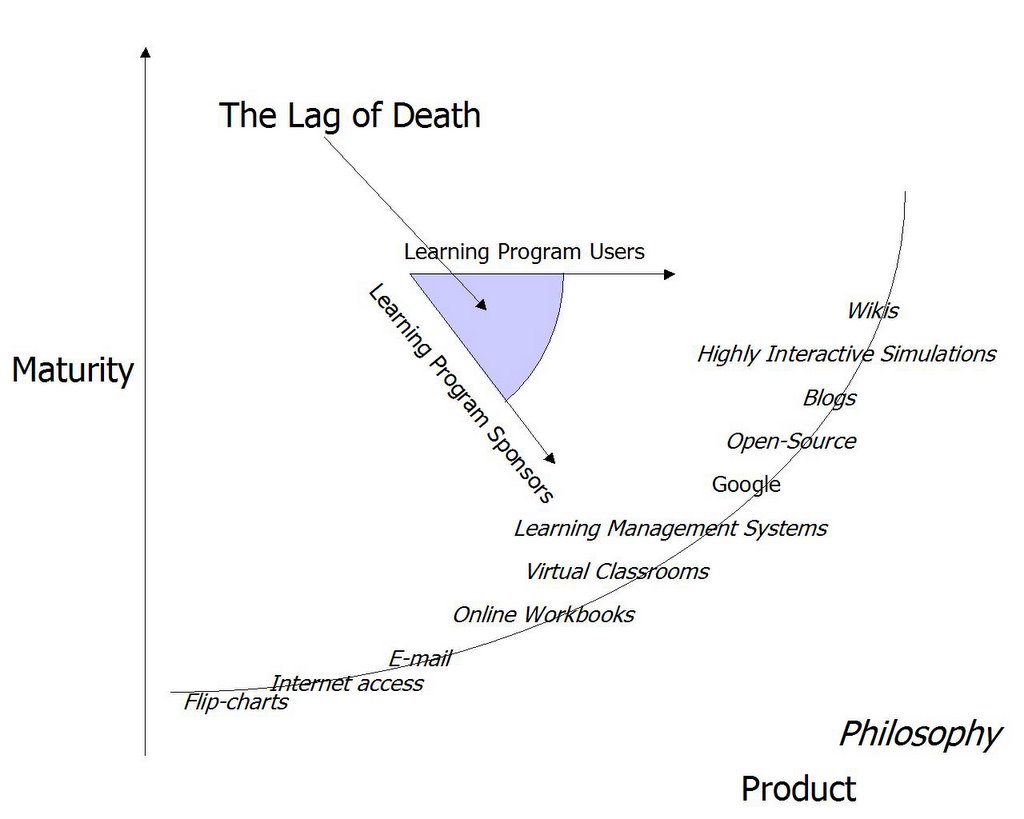
Navigating the Lag of Death


Technology is always, at best, two steps forward, one step back. But the more comfortable you are with the technology, the more you can take advantage of the good and mitigate the bad (although too much comfort can blind you to the bad, but that's another point).
One of the trickiest parts of producing a learning program is to navigate what I will call the lag of death. This is the difference (or delta, if I am feeling insecure) between the comfort level of learning program sponsors and learning program users.
Typically, the less mature technology people have a greater comfort in short term predictability, command and control, processes, certification, ease of use, eveness of distribution, and risk mitigation. The more mature technology people have a greater belief in communities, engagement, richness of experience, and short term chaos leading to long term order, uneven distribution, and person responsibility.
Navigating this lag of death is tricky, high stakes, and critical. But it increasingly has to be done if we are to thrive.

* note: this chart is a back-of-the-napkin sketch, more thematic than specific. I look forward to enriching it based on the comments of others.

Saturday, October 29

Googlizing Learning

I'm not sure if Googlizing is a word but the way this steam engine is rolling I'm sure it will be soon.

David Grebow's recent post (Wait a minute, let me Google it ...) really got me thinking and since I hate the fact that comments do not get seen by those receving RSS feeds of this blog I decided to do a follow-on post rather than a comment.

--
Breaking News! Google is doing all kinds of interesting stuff, much of which will have an impact on learning. One of their latest endeavors is Google Base:
Google Base is Google’s database into which you can add all types of content. We’ll host your content and make it searchable online for free.
Sounds like a potential learning object repository to me. Read more about it. Couple this with their free Google Desktop (to index and search your computer and intranet files) and you may have a pretty decent knowledge management solution.
--

No doubt about it, Google is great especially when it comes to connectng people to content. However, as a learning resource, it falls quite short. Fundamentally the quality of the content is often suspect for just because something appears on a web page does not mean that it is correct. And ironically today's search engines are almost too good - there is simply too much content available now.

To me learning is always made up of content AND collaboration. I learn more from reading a book and discussing it than just simply reading it.
Content + Collaboration = Learning
(see my post on Search sucks - where's the context?)

So you can see where I'm going to go with this ... Google needs to add a way to explicitly rate the content (Google's PageRank implicitly ranks the popularity of a web page) and Google needs to add a way for people to add comments to the web page links that result from a search query.

"Who creates it? Who maintains it?"
Easy. Those who use Google. They have the option to rate the pages and the option to leave a comment. Google has a large enough (massive) user base to make this work. Think of this as a 'people filter'.

This ability to connect people to people through content I think is critical. I often go to Amazon.com and read the book reviews for I what to know what actual people think of the content. Those that have validated identities I trust more than those that don't. A search is not always going to give me the answer I am looking for - this approach gives me the option to tap into the collective knowledge of other users.

Content is so Web 1.0; People is Web 2.0. (grin) Google has the opportunity to start connecting people to people - let's see if they will take advantage of it.

Is this the poor man's version of Jay Cross' workflow learning? What do you think - is Google becoming the best way for rapid, informal learning?

Friday, October 28

Virtual Classrooms and Virtually No Data

Face it, you generally can't see participants' faces in a virtual classroom. How do we know they are getting it? Are they sorting spam in Outlook or checking sports scores on ESPN.com?

I remember quite a few high school & university classes where class participation counted as a relatively significant part of your grade. With most integrations between virtual classrooms and LMS products it seems like launching the classroom URL is about all that is tracked.

This strikes me as the equivalent of getting credit for class participation by walking in the door. At least some of the better integrations check to see that you didn't walk out (leave the meeting URL) before the end of class, or they have a "completion" threshold of some sort (percentage of meeting actual duration or, minimum time spent in the session).

A good virtual classroom facilitator or instructor draws the participants into the content with chat, pools, simulations and all sorts of interactions. But how is that tracked or managed? I might remember the names of a few active participants, but then again eyewitness reports aren't always accurate. Allowing the instructor or leader to enter a value or description for participation after the fact is a start, but how about automating this too.

Could we have integrations that reported back individual's quiz scores from virtual classes, a participation status indicated by upstream VoIP, frequencies or length of chat entries, questions asked?

Is anybody else wanting more real data from virtual classes? What data would you want and how would you foresee using these reports?

Tom King, Macromedia

Tuesday, October 25

Dead Elephants in the E-Learning Room

As I work with organizations in developing e-learning, I am increasingly aware of dead elephants in the room, large reference points that we have to avoid because we can't wrap our minds around them. Here are some:
  • When you talk about development time, the context is downloadable flash based mini-games. Flash based mini-games, like this one, can be developed in just a few weeks. And yet they still have critical messages, and higher interactivity.
  • When you talk about manuals and online references, even FAQ's, the dead elephant in the room is Wiki's. Fluid, up to date, organic, they grow faster and are more accurate than most published documents. Wikipedia outgrew the Encylopedia Britannica.
  • When you talk about knowledge management, the hidden context is blogs and podcasts.
  • When you talk about interactivity in e-learning, the spector is of computer games. Clicking a few buttons now and then can just never compare with the total engagement of Halo 2.

What are some other dead elephants?

Monday, October 24

Living off the Land: Capturing The Voice of Experts

In one project on which I am working, I have been asked for a strategy to quickly capture a lot of presentations from a lot of people to share with others.

My first thought was using Centra, but the client always uses the telephone for voice, and I am not sure if they have save capability.

A second option is to use the record voice option in PowerPoint.

A third is to use a tool like Audacity to record an MP3, and then have some one else align that with slides.

Does anyone know of either a great approach, or even great instructions that someone else has prepared to take individuals through this process?

Sunday, October 23

From Illiteracy to Technological Literacy

Despite the heavy investments societies have invested in literacy over the past couple of hundred years, it is no longer pursued by some as a desired educational goal. Mihai Nadin, the author of The Civilization of Illiteracy, writes how the pursuit of it has taken four main branches:

Those:

  • for whom literacy is a skill.
  • using it as a means for studying values based on literacy.
  • functioning in a world of prepackaged artifacts.
  • active beyond the limitations of literacy, such as stretching cognitive boundaries or defining new means and methods of communication and interaction.


Writers, editors, and some educators see it as a skill in which they make a living by knowing and applying rules of correct language usage.

Others gain value by exploring the great wealth of writings, poetry, history, and philosophy.

The majority, which is estimated at about 75 percent of the population, view it as an artifact or service, such as the mathematics in a calculator, the writing on a greeting card, or the spelling and writing routines incorporated into word processors.


And finally, groups, such as artists and designers, who actively attempt to push it beyond its limits.

For instructional designers, these four branches of literacy are quite useful in that they help us to identify the type of media preferred by our target audience. In addition, they show the branch that teachers, trainers, educators, instructional designers, etc. must join if they desire to help others learn -- the artists and designers who actively attempt to push it beyond its limits. For it is only by pushing literacy to its limits that we will be able to reach the broadest group of learners possible.

While some may bemoan the decline of literacy, others look forward to the instruments that are slowly, but surely, replacing it, such as audio, visual media, and text messages. While this last medium does sound quite literate at first, it manages to break almost every rule in order to obtain velocity:


Grade schoolers are starting to get laptops and of course literacy skills, such as handwriting and spelling, start to suffer. Yet, there was life before literacy, and there will be life when it declines. Thus, maybe it is better to not look at it as "declining," but rather as being...well...replaced.


Literacy presupposes the existence of a shared symbol system that mediates information between the individual's mind and external events (see Technological Literacy Reconsidered). Thus, just as mathematicians from all over the world can share and understand formulas; savvy cellphone uses can understand the above text message.

The literacy that is shaping the netcitizens of today is technological literacy -- knowledge about what technology is, how it works, what purposes it can serve, and how it can be used efficiently and effectively to achieve specific goals. It encodes and decodes messages via three dimensions:


These three dimensions closely relate to Dyrenfurth's (1991) three dimensions: "Technological literacy is a multidimensional term that necessarily includes the ability to use technology (practical dimension = knowledge), the ability to understand the issues raised by our use of technology (civic dimension = capabilities), and the appreciation for the significance of technology (cultural dimension = thinking & acting)." For more on these dimensions, see the Quicktime movie.

Knowledge acquisition took place at a slow place during the age of literacy. With the advancement of technology, we are no longer at the mercy of language (and the literacies associated with it) as the exchange of complex data via graphics, multimedia. etc., are more appropriate to our faster paced society. Our present knowledge economy is not driven by faster computers, but rather by human cognition embodied in experiences that support further diversification of experiences. And the more means we find to diversify our experiences, then the faster our knowledge acquisition will be.

NOTES

You can find the The Civilization of Illiteracy in three types of formats:

Dyrenfurth, M. (1991). Technological literacy synthesized. In M. J. Dyrenfurth & M. R. Kozak (Eds.), Technological literacy (40th Yearbook of the Council on Technology Teacher Education, pp. 138 183). Peoria, IL: Macmillan, McGraw-Hill.

Tags

[Illiteracy]
[technological literacy]

Thursday, October 20

If it ain't fixed, should we break it?


I hope I didn't sound too much like a Luddite when I wrote " Let’s stop building, advertising and selling systems and technologies that will provide the solution. " My intention isn't to impede progress and continued experimentation. I do believe that the various technologies many of us have been developing for years render vital services and that their impact will grow. I also believe that growth will only become significant when a few cultural changes take place within the world of learning. On the other hand, I don’t believe current conditions are yet favorable for that moment of quantum leap.

My major beef is with the hyper-commercialisation, the “advertising and selling” part rather than the “building” part. Elliot asked some years ago “if we build it, will they come?”. Given the number of items that have been built and delivered, it’s probably safe today to say that the answer is “no” (thanks, Anonymous, for summary of the HCE study). Before we build, however, we need to design. And before we design we need to have an idea of why we are designing (other than the hope of eventually selling it to the select few because the design looks good and exploits this year's augmented processing power).

I believe – as many do -- that more will come out of the Open Source movement than from vendors of systems (who are becoming fewer and fewer, as Ben Watson reminds us). My healthy doubts about what Open Source will ultimately deliver hover around how non-commercial creativity can fare in a vehemently and violently commercial world. But that’s a philosophical and sociological problem, not an educational problem.

Flipcharts actually have evolved in various ways, but the ways of using them by creative trainers have evolved much more than the technology itself. With electronic gadgets, it’s the opposite. The people responsible for making learning happen are deprived of the means of doing anything about it. Moore’s law has taught us that every 18 months someone’s going to deliver to our doorstep (COD, of course) everything we need to solve the problems we are too backward, poor, unorganized or handicapped (in terms of technological savvy) to solve ourselves. If we don’t pay, we’re excluded from the community of “best practice”, which might more accurately be called “best purchase”. The laws of the production/consumer society trump all others. The race for innovation, which should be about creativity and solving real learning problems, is dominated by the rich and lazy, those with the biggest marketing budgets.

It’s no wonder then that trainers and learners – as the CHE study reveals – feel not so much alienated as simply excluded. Still the technology is there to be used and in fact is being used, but with little sense of purpose and, I would submit, a great deal of waste. I guess that’s the price of hype.

Saturday, October 15

Curious about the future of history based simulations?

As I have said before, I hate it when e-learning hacks make superficial, overly-broad analogies to hot trends. "E-learning should be like hybrid cars; Training should be like Ipod Nanos; Lessons learned from FEMA."

Having said that, I love a real analogy. For example, six years ago, I found it very useful to apply experiences with ERPs and CRMs to the then emerging area of LMSs. It did provide real glimpses into the future. As a rule, cold trends actually provide more insight than hot trends.

So with all of that as a caveat, I would like to present up an analogy that I hope is an example of the second, not first, category.

  • If you want to see how educational simulations will be created to teach history to the K-12 and undergraduate environment, look at the various Star Trek computer games.

Here's why.
  • Star Trek is a series of many, many (far too many?) stories, that cover a coherent timeline, with consistant cultures and technologies. Furthermore, Star Trek events, despite the single brand, have been created by many, many individuals and teams. There are missing links; there are contradictions. This background material is a fairly good analogy of history source material.
  • Game developers have tried to capture the essence of the story in game forms. Star Trek games have more often than not used existing genres (First Person Shooter, Real Time Strategy, now MMORPG). They have often had to go deep (space ship battles in general) over broad (from beginning to end of Wrath of Kahn). Some new genres have been created (Bridge Commander, Starfleet Command). Some games have been created by modding other games (Star Trek mod for Half-Life 2). Some are very complex, developing deep expertise; some could not be more simple. Some just use the high level theme over an existing game (Star Trek pinball or Star Trek trivia game). This maps fairly well to the effort that different developers will probabbly go through to create historical educational sims.
  • Star Trek fans are very engaged in the process. Every new Star Trek game brings heaps of criticism, people trashing the experience as being not accurate enough (What about episode 212 when Captain Yeri fired six photon blasts in less than five seconds), or fun enough, or broad/comprehensive enough. They then mod the experience, in some cases fixing inaccuracies, in some cases making something less accurate but more fun. This maps fairly well to the role of other historians/instructors looking at the experience.

Some Lessons learned:

  • No one sim will capture the entire experience. Sims will often go deep, not broad.
  • The more accurate the sim, the more frustrating it will be to play the first time.
  • The less accurate the sim, the easier it is to game it, but all sims, no matter how accurate, can be gamed at some point. Multi-player games creates environments where people are faster to break the illusion and try to exploit the rules.
  • Debates around specifics are inevitable, but should not be used an excuse to discount the entire experience. 100% accuracy is neither possible nor desirable.
  • Huge holes in source material will be uncovered that were missed by linear thinkers but that are glaring to more dynamic content creators.
  • Creating new genres is more powerful but also more risky than using old ones.
  • Small simple games can be more instructive than super complex ones, especially for teaching about high level relationships.
  • Sims won't replace the source material, but augment it.
  • Time lines are less important than interactions.
  • Communities are key.

I think the real power of educational simulations in K-12 and higher-ed will come when we rethink our curriculum all together. But for those intent on history based educational simulations (and my hat goes off to everyone of you - let me know how I can help!), I think the analogy is a good one.

Wednesday, October 12

consolidation continues - BlackBoard + WebCT & more ...

Wow, consolidation is running rampart in the eLearning space as everyone continues to merge or acquire. Look to your left and look to your right; easily one of those will not be around in six months. Today BlackBoard announced plans to merge with WebCT; the two leading providers in the higher education eLearning space (BlackBoard alone forecasts US$150M+ for their fiscal year).

Now having gone through a "merger" myself (SkillSoft and SmartForce) it sounds like BlackBoard is really acquiring WebCT and it doesn't bode well for WebCT given that there is a tremendous amount of product overlap between the two companies (a similar comparision would be if SkillSoft and NETg, the leading providers in the corporate education space, merged). It also doesn't bode well for WebCT's willingness to play with open source (sorry Harold!) If you are a WebCT employee you may want to dust off your resume with comments like this:
The combined company expects to realize significant efficiencies by leveraging shared development infrastructure, and mitigating duplicative marketing initiatives and administrative expenditures.

This announcement comes on the heels of Saba acquiring Centra. Now this deal makes more sense as Saba continues evolve beyond its Learning Management Software (LMS) roots (Saba recently bought THINQ) by rounding out its services offering. Personally I like its focus on 'on-demand learning' and its Services Oriented Architecture as I think generic content is a tough business to be in. Plus Saba + Centra creates a US$100M revenue company which is not too shabby!

And of course back in August we had WebEx buying Intranets.com and SumTotal (created out of Docent + Click2Learn) buying PathLore as I discussed in this post.

Clark - you need to update your Chart of Consolidations!

The Resulting Big Five: (forecasted annual revenue)
SkillSoft $200M+
NETg $150M-200M?
BlackBoard $150M+
Saba $100M+
SumTotal $100M
* strangely none of the investors like any of these deals as the stocks of the related companies have all dropped when they have announced their news.

So whom do you think will be doing a merger or acquisition next?

What do you think of these recent ones?

Confessions of an e-learning dropout

Six months or so of focusing on a real (rather than a virtual) theme -- in this case, intercultural communication -- led me far away from the specific “culture of e-learning” shared by the participants of this blog, although my intercultural work inevitably involves online deployment. Coming back into the fold by posting a message on this blog is in itself an interesting cultural experience, a kind of re-entry shock.

Having spent so much time with a broadly international crowd of people who spend very little, if any, of theirs speculating about the future of technology for training has allowed me to take some distance and possibly see a few things with more focus. One of the things that strikes me is how linked e-learning culture is to certain trends in the U.S. economy, even though the implications are necessarily global. And if I mention “e-learning culture” it means that I can identify a group of people who share that culture (namely, us) in contrast to all the other groups of people that don’t share it. Which introduces the somewhat embarrassing question of whether e-learning culture is really compatible with other cultures.

Listening to Eliot Masie correctly telling me (through an audio feed) that memory sticks will allow all sorts of things that no one could have imagined made me realize why I seriously doubt that any of what he describes will ever make an impact on learning. I feel exactly the same way about games, simulations and all kinds of “ideal” and idealized content (and I’ve spent twenty years of my life designing, producing and publishing the stuff). It all makes sense… but, when all is said and done, it just doesn’t seem to take off, even though we can usually get it to work (and even prove that it can produce results).

One of the major reasons for failure is culture specific: Eliot’s idea – and many others born out of technological innovation -- supposes learners are social monads, the thought of which is relatively easy to entertain in an individualist culture such as that of the U.S. but unimaginable elsewhere. And even in the U.S. it’s easier to imagine than achieve, because even though our culture teaches us to think of ourselves as monads and our pragmatic sense tells us to try out any promising solution, we actually aren’t monads: we are heavily linked to others through visible and invisible social networks (that, by the way, only vaguely parallel our technical networks). And those networks provide most of our models of behavior, whether we’re aware of it or not.

Looking back at fifty years of technological innovation, what do I see? The only true revolutionary breakthrough in training technology is… the flipchart! It changed things much more than we think (PowerPoint did as well, but in a totally different – and I would say regressive - direction). CBT/multimedia/eLearning has produced a niche market for products and services but bears less resemblance to a revolutionary development in training than it does to the hula-hoop (a great concept, a new and intriguing object, fun to have a go at, a winning topic of conversation, mildly frustrating to start using, possibly addictive in the short term but destined to have a short lifetime). What’s great about the flipchart is that nobody noticed it or talked about it. It arrived stealthily and did its job, allowing us to create, store, distribute and display flexible information in original ways. It also provided a fascinating link to group dynamics, giving trainers a tool to change learners’ perception of the learning environment and the goals associated with it (e.g. by having groups work in parallel and post their results on the wall). It was (and is) absolutely wonderful technology. And using it requires only minimal writing and drawing talents plus a bit of imagination on what to do with the pages. And best of all, no rival vendors telling you that their flipchart has more features than the one you just bought (and should feel guilty about). And no yearly upgrades!

So my suggestion is to do something similar with all our electronic technologies. Adopt and use them because we need them for storage and communication (independently of training) and then just have them around to help those who have something to teach others (formally or informally) get their messages across. Let’s stop building, advertising and selling systems and technologies that will provide the solution. Where Plato banned poets from the Republic, I would ban the vendors. People will end up providing the solution if you let them just use the technology they spontaneously accept for other purposes. Down with the constraints of training-specific technology. And down with instructional design (yeah, Jay, I’m with you as usual).

Working for a Strong Brand

I have noticed a pattern that I would like to share, even though it is somewhat tangential to the theme of this blog. I just saw it again yesterday.

There are "Strong Brand" organizations: Microsoft, Google, Harvard University, IBM, Accenture. Even actors in a high-profile television series.

New employees are excited to get in. The parents are thrilled. Friends are jealous.

The new employees struggle, learn the culture, learn the rules, gain a lot of interesting perspectives and SOPs. Their prestige in the outside world climbs as a result of their new home.

To the outside world, these people have it made. They are part of a superb organization. They have access to resources. But to the no-longer new employee, they start getting restless. At some point, they realize that they are supporting the brand, not necessarily helping themselves. Their own professional identity risks becoming too associated with the Strong Brand. They do not have as much control as they would like. To some degree, the view of outsiders towards them becomes increasingly at odds with the internal organization's.

Unless they are fast-tracked, they grow resentful, ultimately either leaving, or sticking around but detached.

I don't know what the solution is. But everyone I know who is in that cycle feels unique, so I thought I would share this.

Tuesday, October 11

Stepping Out: The Application Becomes the Platform

AJAX. Heard of it? You will. You've already seen it in action on the Web somewhere. How about Widgets? No, not for Mac (although that's where they come from) - for Windows. I actually made on the other day. Heard about Google's API's being open? How about the Google sidebar? MSN revealing its APIs? America's Army (the free game) now has a site touting its availability (the game's) as a platform. How about the fact that the highly anticipated release of Civilization 4, the latest installment in one of the most profitable game franchises ever (and one frequently cited as educational), is being built from the ground up in way that will empower people to change the game in more ways than have ever been possible before?

What is all this pointing to? Simply my new mantra - the application is becoming the platform. Wikis, blogs, podcasting - all part of the same dynamic. Call it what you will but things that we used to think of as "applications" - discrete programs used for specific purposes, a search engine, a game, are becoming platforms for development. The first browser was an application unti people started developing for the Web instead of the Net. eBay was an application, an auction site, until people started developing programs that were based on eBay - like automated auction programs.

This isn't exactly breakthrough thinking here but my question is really...where is this dynamic happening in the learning world? This is as much me actually asking the question and looking for answers as it is a rhetorical device. I want to know. Who are the folks creating "learning platforms" on which future learning applications will be able to be developed? If the answer here is silence or even a muted reply, then the next question must be why? Why, in the face of such staggering successes in other fields (computer gaming really took off with the release of the first DOOM in 1993 and that was largely due to two factors - they gave away the first three levels for free and it came with an editor - that's right, from its release it was sold, marketed and exploded at least in part because it became a platform.

So one final time and then I'll be quiet - who is developing learning products which can both serve a primary function as a learning product but are also designed to act as development platforms - at little or no additional cost?

Sunday, October 9

What would I see if I rode on a beam of light?


Before Einstein, scientists would observe and record something, and then find the right mathematics to explain the results. Einstein comes along and reverses the process by finding a beautiful piece of mathematics based on some very deep insights into the way the universe works and then makes predictions about what ought to happen in the world.

Behold the power of human creativity.

Mihaly Csikszentmihalyi wrote that the creative process normally takes five steps (Creativity, 1996, p. 79):
  1. Preparation: becoming immersed in problematic issues that are interesting and arouses curiosity.
  2. Incubation: ideas churn around below the threshold of consciousness.
  3. Insight: the "Aha!" moment when the puzzle starts to fall together.
  4. Evaluation: deciding if the insight is valuable and worth pursuing.
  5. Elaboration: translating the insight into its final work (Creativity is 99% perspiration and 1% inspiration - Edison).
The physicist Freeman Dyson wrote two papers that were published in Physical Review that brought together Richard Feynman and Julian Schwinger's theories of quantum mechanics. After Dyson's papers, Feynman and Schwinger's ideas became understandable and thus led to the two being awarded the Noble prize in physics. There is no doubt in most minds that the two would never have been awarded the prize if it was not for Dyson being able to explain and connect their ideas.

Dyson's story is interesting as it fits the five steps of creativity:
  1. Preparation: He goes to Princeton to study under the greats. He gets personally acquainted with the two central figures, recognizes the two theories are connected, and then goes through a six month period of directed preparation.
  2. Incubation: He spends two weeks relaxing
  3. Insight: and is hit with the "Aha!" of how to explain and connect the two.
  4. Evaluation: He then spends another six months creating, evaluating,
  5. Elaboration: and elaborating two papers that are accepted by the editors of Physical Review.
Fred Stratton (CEO of Briggs & Stratton) once said that genius lay in the ability to see how two things that nobody else sees as related are indeed related. This ability to recognize distant analogies unlocks a world of potential -- Edison recognized that space and time are not absolute; while Dyson recognized a connection between Feynman and Schwinger's two theories when no one else could.

The Learning Process in the Knowledge Economy

Skills needed in this so called "knowledge economy" go beyond rote memory to the next level -- the ability to think both critically and creatively.

Yet traditional learning systems have typically been centralized and operate on the principle that learners are unable to decide what they need to learn, thus the system does it for them, which in turn creates a vicious cycle -- put the learners in a system that does very little to encourage critical thinking, formal reasoning, or meta-learning; then tell them they are unable to decide what they need to learn, thus others will have do it for them. And this carries on from schools to the business world.

This central control is stifling...it is closed to the possibility that people need to have a say in what they learn. It is closed to the next step in the learning process -- building a variety of experiences in order to build a strong knowledge base; which then creates the possibility for building a context or connection that no one else has created before. This is how problems are solved and novel ideas are created.

Learning needs to follow a similar process as Csikszentmihalyi's Five Steps of Creativity:
  1. Preparation: A two step process:
    • Rote learning in order to create the building block of logic -- the means to use rules to make inferences, choose courses of action and answer questions.
    • The collecting of information (called ontologies) -- In philosophy, an ontology is a theory about the nature of existence, of what types of things exist; ontology as a discipline studies such theories. The most typical kind of ontology has a taxonomy and a set of inference rules.
  2. Incubation: A period to reflect and interact with others.
  3. Insight: Making new connections.
  4. Evaluation: Metacognition - planning, setting time lines, and allocating resources (Schank & Abelson, 1977) for new "connections." It also designs strategies for accomplishing goals once they have been set.
  5. Elaboration: Turning the idea into reality.
Our learning systems have performed a good job with the first step of "Preparation", yet it seems quite hesitate to go beyond this by riding the beam of light rather than just observing it.

This Tuesday (October 11, 2005) on PBS -- Einstein's big idea: The Legacy of E = mc2

Friday, October 7

Intelligent Design....of Learning

Learning 2.0 || Web 2.0


Maybe this is a thought crime, but the meme that's propagating in my head this morning is that instructional design will once again mimic software design. (Where do you think those human performance flowcharts came from anyway?) Read this article about lightweight software development and the surge toward Web 2.0.

Now, let me indulge in some cut-and-paste thinking. Modify the article by substituting instructional or instruction for software, and Cross for Fried. Here's what you get.
Traditional instructional development is expensive, resource-intensive, and born of a Cold War mentality, Cross said. His advice is to "think about one-downing, instead of one-upping, and underdoing-competitors" –beating them with less.
According to Cross, in the era of lightweight apps and simple products you need less money, people, time, abstractions and instruction.

Cross believes that money mostly buys salaries and you only need three people–a designer, programmer and utility player, which he calls a "sweeper." The feature set should be scaled for the headcount. Having less time is also an advantage. "You spend time in unproductive meetings and overanalyzing the product. Less time forces you to spend less time on better things," Cross said.

He suggested 30 hours per week per person, which "forces you into building better products and being creative with your time." And, if you have less time, you have less time to think about abstractions, such as functional specification documents, which Cross characterized as a waste of time. "Instead, build the product and start from the user interface customer experience first; then wrap with the technology," Cross said. "The interface screens are the functional specification."

Finally, building less instruction means fewer features, less documentation, minimal support and less confusion in selling the product. "Less instruction is key to building very specific tools. There are a million simple problems to solve with less. Competitors solving complicated ones are most likely to fail," Cross said. "For Web-based instruction there are plenty of simple problems to pick from and you can nail."
The more I dig into how people learn, the more convinced I become that we've been trying to do things the hard way. We used to think our job was designing instructional systems. I'm beginning to think we're nurturing the evolution of learning experiences.

Instructional design tries to fix things that are broken. It begins with assessing what's wrong, "gaps," and leads to developing grandiose, cure-all solutions. Learning evolution begins with what you've got and nurtures incremental improvement.

We see the same sort of issue on the front page of our newspapers. One the one hand, some people believe a master designer released Earth 1.0 about six thousand years ago. Others folks believe Earth beta has been evolving for billions of years; it's a web without a weaver.

Do you believe in the intelligent design of instruction or the evolution of species of learning?


Next up: Instead of "the network is the computer," think "the network is the brain."

Tuesday, October 4

A New Web Writing Tool

This post has been ported into LCB from a new collaborative writing tool that is currently in beta called writely. Harold Jarche gave it a nice write up on his his blog inspiring me to take a look at it. The functionality is very intuitive and seems to combine the best of word processing and wiki technologies to create a collaborative platform. Currently it struggles with some issues around formatting (trying to fix a table that was messed up in the upload from Word was a real mess), but they do make it clear that you're using a beta. The ability to collaborate with as many people as you wish on a document by document basis is great. I see the following functions as real positives:

  • That you can post out to most blogs
  • bring content to writely by email, upload, or original creation,
  • download into Word, HTML,
  • all with revision history and the ability to revert to previous versions at the click of a button.

I agree with Harold, this is definitely the future for use today.


A Meta-Interview

Thiagi asked me to do a brief interview about games and simulations, which he published here. Take a look at it, if you want, before you continue. I would like you to consider it at two levels.

First, there are a few nuggets of interesting perspectives on simulation design.

But more importantly, there is a lot of space and energy, both on my part as the writer and your part as the consumer, dedicated to humor. Think of your own experience as a reader plowing through the material.

  • Some will find it engaging.
  • Some will find it lame.
  • Some will find it a waste of space (mostly the people who really care about the material).
  • Some will read all of the material because of the humor, which lowers tension and builds connectedness with the reader.

My meta-point to the interview was to let readers experience a game element themselves (the humor), and come to their own opinions on the risks and benefits of using game elements generally.

Who says learning by doing has to be complex?

Saturday, October 1

Darn Spam!

Once again LCB was flooded with spam in the comments. I've decided to utilize Blogger's new word varification tool for posting comments. It's a simple extra step for you when you are posting a comment. Hopefully it will save me from losing another Saturday spent ferretting out spam! If you happen to see any stray spam on the site, please drop me a note via the "email the Blogmeister" link at the top of the sidebar.

you humble Blogmeister,
Dave

Friday, September 30

You Want Numbers?

You want metrics data? I got yer data right here....

Check out PubSub's new LinkRank Service, measuring inbound and outbound links to any site! Check out Learning Circuit's LinkRank...

Wednesday, September 28

Blogging by the Numbers

Not everything that can be counted counts,
and not everything that counts can be counted.
- Albert Einstein

One of the projects in the revitalization of Learning Circuits Blog has been the establishment of a data set for capture and resulting metrics. I thought it might be of interest to share our work in this area.

The purpose for creating a trackable set of data and corresponding metrics is simply so that we will have an idea as to whether or not we are succeeding at this blogging venture. Simple purpose however, does not necessarily lead to simple implementation. Two factors contributed to this being a rather extensive task. 1) We had no data collection practice in place and 2) Blogger, for all it’s great features, just doesn’t collect data for their free users.

A couple free stat counters (thanks SiteMeter and Bravenet) and several tracking spreadsheets that border on frightening later, we have a solid set of raw data. The data fall into two categories – "Activity" which I use to refer to the posting and comments by the Blog Squad and guest and "Traffic" which refers to the comings and goings of all of you good folks. The raw data we are capturing include:


ACTIVITYTRAFFIC
  • Posts
  • Author
  • Date posted
  • Comments
  • Comment Author
  • Date Commented
  • Days with no Activity
  • Unique Visits
  • Page Views
  • First time visitors
  • Returning Visitors
  • Referring Page
  • Entry Page
  • Exit Page
From these raw data we can build metrics to determine in what direction, if any at all, LCB is moving and why. There are all the ratio metrics (i.e., posts per day, comments per post, zero activity days per month, etc.) and comparison metrics (i.e., August was twice as active as July, or Clark leads all Blog Squad members in postings).

Some metrics which seem to be emerging as meaningful as everything settles in are:
  1. Total Activity - Posts and Comments are weighted equally. It seems a better representation of the work that is being done by the Blog Squad.
  2. Unique Visitors vs. Returning Visitors - This metric seems to indicate that we are drawing people in, but not doing enough to have them return in a timely fashion.
  3. Total Activity vs. Page Views - this has been the real surprise thus far. The ratio of page views per post or comment seems to have settled in at just aound 24-26 pages. Including in August when Activity tripled and page view followed suit. It's too early to know if this consistency is a coincidence or whether it will turn out to be a dynamic predictive metric.
I have a couple of questions I'd love to get some response from the LCB community on regarding metrics:
  1. Are there metrics you see as key when looking at a blog?
  2. Do you know of any benchmarking sources for blog metrics?
  3. Do you track metrics for your blog? If so, care to swap info with LCB?

Authoring Simulation Genres: Game based models

One well-understood simulation genre is game-based models.

With the goal of “making learning fun,” students engage familiar and entertaining games such as Wheel of Fortune®, solitaire, or memory, with important pieces of linear or task-based content replacing trivia or icons. More diagnostic than instructional, game-based models nonetheless might be the technique of choice by traditional educators and training groups looking to quickly goose their reputation, student satisfaction, and even effectiveness. Game-based models also introduce, in the purest possible way, game elements that all educational simulation designers will need to understand in the near future.

Some authoring environments include:
• EGames Generator
• Games2Train


Do people know of other toolkits for game-based models?

Authoring Simulation Genres: Interactive Spreadsheets

One well-understood simulation genre is interactive spreadsheets.

Interactive spreadsheets focus on abstract business school issues such as supply chain management, product lifecycle, accounting, and general cross-functional business acumen. Students allocate finite resources along competing categories at successive turn-based fixed intervals, and each time they watch their results play out on dense graphs and charts.
This is often done in a multi-player or team-based environment and often with facilitators.
The subtlety, unpredictability, and variability make them appropriate for training b-school students and high-potential supervisors through the direct reports to the CEO. They are often the cornerstones of multi-day programs to align a fractured department or organization by building shared knowledge and understanding.

Another is straight Excel.

Do people know of other great authoring tools?

Authoring Simulation Genres: Branching Stories

One well-understood simulation genre is branching stories.

In branching stories, students make multiple-choice decisions along an ongoing sequence of events around what to say to another person in a given situation. The decisions impact the evolution of the story, ultimately terminating in either successful or unsuccessful outcomes.
Their ease of use, ease of deployment, and content style make them highly appropriate for entry-level salespeople, call center representatives, freshmen, customer-facing retail positions, and entry-level managers. Any high-turnover position should be trained, although not exclusively, using branching stories. Companies like WILL Interactive have advanced the genre to handle more moral and complex situations, making them also appropriate for higher-level employees as well.

One tool kit is:

You can also use PowerPoint, although it is tricky.

Do people know of other branching story toolkits?

Sunday, September 25

The New Ways of Describing the Life of Content

I have been thinking a lot about life of content. A few different dichotimies seem to frame conversations.

Staged vs. Organic: Staged events are one-shot. They need significant pre-establisehd processes and project management. They use up a lot of advertising and communication. Organic approaches are more incremental. They use small layers to build up over time. Television shows are staged, but they can also evolve over many episodes, as writers seize onto relationships, or the right directors are found. Organic content lifecycles stress less perfection up front, and often more feedback.

Transient vs. Peristent : This refers to the size of the window of availability, and/or the timeliness of the material. Even these can be fuzzy. DVDs should be totally persistant, for example, but advertising and shelf-issues make them somewhat more transient. Also, as with movies, there is a perceived success (being number one on the charts) that drives more success, and more of a staged content approach. DVDs can also make movies a bit more incremental, with multiple versions available. Computer games can also have various versions, and can also be patched on the fly.

Controlled vs. Community: Is their one-voice shapping this or multiple? Mods for computer games can subvert a very controlled piece of content. From a formal learning perspective, I always ask, how can I get the training group out of the way? How can the community generate the content, and how can the training group help that?

Is there a "so what" for these lenses? I think so. One is to recognize our own biases, and accept that these biases might be interfering with coversations with sponsors. The other is to recognize the current trends that are pushing towards incremental, persistant, and community, and selectively embrace some of this approach, and challenge others.

Tuesday, September 20

Small Pieces Loosely Joined

When talking about platforms, the opposite of a single monolothic approach (cough Windows cough) is small pieces loosely joined.

We in the learning industries seem to be good at the
  • big pieces, tightly joined (degrees, curricula, certification)
  • small pieces, tightly joined (LMS delivered content)
  • small pieces, not at all joined (Google, mapquest, bubble help)

So what is it that can/does loosely join our small pieces of learning? Is it our PC? Outlook? The database in Google Desktop Search? Our PDA? Is it our organization? Our annual review? Our interests? Company? Career? Industry?

At the end of our day, it is probably summed up in our résumé, our sometimes forced, often surprising organization of the things we have demonstratably done. But at the heart, we are our own platform, constantly both writing to others and being written upon, vastly ranging in productivity and capability.

I would say for the last few hundred years we have probably been Human 2.0. And we are getting close, I think, to v3.

The Lowly Binder

It is a symbol of "old school" training. It is a joke, a dinosaur, a deep sea anchor. It wastes billions of dollars of office space in filing cabinets and cubicle shelving. It is THE TRAINING BINDER.

We, the Learning Cognoscenti, "prove" our own credentials to the world by openly disdaining them. '"What to do about the classroom binder?' you ask. 'How about dig a deep hole and throw them all in!'" Then we chuckle and drink our cognac and tighten our smoking jacket.

And yet...

And yet there are still a lot of them being produced. Almost every classroom experience, and there are a lot of them, support the activity with binders. Conferences do as well, I need hardly mention. I, as dutifully as the next speaker, turn in my PowerPoint stack for inclusion in whatever event I am part. I also helped build a workbook to support rolling out next-gen-sim Virtual Leader, which significantly increased usage.

So it might be worth a few moments to, with appropriate humility and pragmastism, reflect upon what are some of the tools available that can make for a good binder.

  • Removable overviews, often in the front sleeve, that provide context and a map to what comes next, or a tip/cheat sheet to an application
  • PDFs of the entire thing, available for download and storage; perhaps zipped files as well
  • Copies of slides, for people to take notes in real time
  • Color paper and/or tabs, to distinguish between sections and aid navigation ("Go to the yellow section...")
  • Biographies, with face shots and contact information, of speakers and ideally participants, at the back
  • Appendixes, with articles and links
  • CD-ROMS, with editable versions of slides and spreadsheets
  • Clear cover and spine, with subject and dates
  • Three-ring rather than bound, so that users can dynamically and deliberately add or subtract what they want or don't want.

What are your thoughts? What should or should not be part of a well constructed binder?

Saturday, September 17

Emotionally Evocative Design


For many an Instructional Designer, design follows analysis, with its main function being to identify all the important things that need to go into a course. Its end product is a curriculum, syllabus, or blue-print to build the learning module on.

Next comes development, which adds content so as to give depth to the end product of design. This mainly consists of the adding of "information."

Context is also used to add a third dimension to the design puzzle -- layers of activity so that the learners gain a variety of viewpoints, thus allowing them to gain experience with the information in a relative safe manner.

This mix of design, development, and context should theoretically help the learners build their knowledge and skill bases. Yet this combination often fails because it leaves one important piece of the puzzle -- Emotionally Evocative Design.


While Instructional Designers normally are quite good at ensuring that the important parts that build content, such as objectives and outcomes, are entered into the design equation; the total design process needs a second layer that captures the emotions of the learners so that they actually want to engage with or use the content.

Engagement does not have to be that complex as it is simply a means of inviting the learners' emotions into the environment. Emotions are the reason that we do anything -- without them we would simply be walking zombies. Emotions are what adds zest to life...to include learning

For example, a good metaphor invites the user to reflect over the information by asking her to relate the new information with a past experience. A good picture invites two senses into the mix. A problem begs for closure. A critical piece of information delivered "just-in-time" is utter relief.

What have you done lately to ensure that your designs are emotionally evocative?

Monday, September 5

CNN vs Education

I would not suggest that higher education institutions need to operate like CNN, but I find it fascinating to read Elliot Masie's observations of how CNN dealt with the flow of content and information in the wake of Hurrican Katrina. In CNN Newsroom in the Midst of Katrina - "Rapid Development... Content Objects... Learning Implications":

There were some incredible learnings and observations as I quietly watched the news gathering and assembly process and interviewed the Learning team at CNN. Many of these items relate directly to how organizations will be assembling content in the near future.


The question is, will educational institutions be one of these organizations? Below I have take some of Maise's descriptions of CNN and put them besides a gross and likely over generalized observation of higher education. Yes, there are numerous exceptions and counter examples to every one of my points, but as a whole, when you read how CNN operates and put it besides how your higher education institution operates, the contrast should be rather vivid.

CNN: Content From Multiple and Unconventional Sources: The nature of content in journalism is changing dramatically as media flows from non-traditional sources. CNN calls an aspect of this "Citizen Journalism" as they receive pictures and video feeds from digital cameras and even mobile phones.


Education: Content comes nearly solely from instructors and "trusted" resources like publishers and "refereed" journals. And content from students would be suspect or written off as "cute" but not useful. Is there an equivalent of Citizen Teaching? If so it is the inspired individual's effort of placing a tutorial or resource on the net.

CNN: Content To Multiple Formats: As content was created in the CNN newsroom, it flowed to multiple formats. Content started as video feeds, became streamed video, text on the website and even a mention for a scroll at the bottom of the screen. Each piece of content was "tagged" as it came into the newsroom, timecoded, meta-tags were added with context and it could be viewed by CNN staff around the world in low-res format. The concept was to see each media object as being highly reusable and redeployable.


Education: Content primarily text, email, PDFs to print, hand coded/Dreamweaver-ed HTML, and.. PowerPoint. Media objects are un-reusable, un-findable, and in-redeployable and would never be available in this kind of time frame.

CNN: Digital News Gathering: The footprint and format for news production is changing radically as the size and mobility of equipment evolves radically. I watched newsfeeds coming from CNN reporters using satellite phones (after the cell network dropped). They were even feeding content that was edited on laptops in the field using Final Cut Pro.


Education: Not much to compare except we do not think of educational content being created "in the field" or with portable devices... while some are moving towards laptops in place of desktop computers, they are used primarily in the same vein (a laptop on the desk). We still print a lot of material or offload this printing to students-- we do not "think"/"operate" primarily in digital, and much of what we do digital is the digital equivalent of print.

CNN: Content Repository: CNN operates a content and media repository that is quite impressive. The content objects are viewable, editable and sharable. Key levels of data is kept for how each object is being used and deployed. Digital Rights Management is tracked, to honor the appropriate use of each media object. I was struck by how easily every CNN staff person could access and work with this content repository.


Education: This is still a dream, despite years of wrangling over "Learning Objects" and the construction of numerous "repositories" few if any that have the features described above AND as much content. Data on the use of objects is absent and DRM is spotty.

CNN: Rapid Development: While CNN clearly has a breaking news model, it was fascinating to watch this process in action, including use of templates, collaborative and team-based editing and content refinement, focus on content ethics, standards and legal/compliance issues. I witnessed a team of professionals, drawn from a wide set of backgrounds, deeply focused on producing content that had value for viewers and the hurricane's victims.


Education: The development cycle is measured in months, perhaps as summer projects or long term grants, and is pretty much an individual cottage industry. Editing and development are solo projects.

So, how does Big U stand up to CNN?

Saturday, September 3

Education's Collage of Subsidies

I was thinking about Clark's (the other Clark) post on learner rights, and then the broader learner marketplace. One of the trickiest parts about development of formal learning programs is that so often, the learner only has a passing relationship to the cost of the program.

Enterprise Programs
Enterprise training programs are paid by the corporate, military, or government sponsor.
Their goal is usually some form of increased productivity or compliance.
Any vendor has to care more about meeting the need of the training director, and the training sponsor, than the end learner. Even the cost of the classroom environment is often subsidized by the enterprise, penalizing e-learning, outside classes, or even training outsourcing.

K-12
K-12 schools are paid by taxpayers, not the students of course, nor even the family directly (even a family that goes on lavish vacations, for example, gets their education subsidized (of course if they have big houses, they also big property taxes; and then there is the private school whammy, where they are paying twice...).).
As we are also learning, some K-12 activity is subsidized by softdrink/juice/water vendors, that come with strings attached.
There are grant based subsidies that push activities in one way or another.
And there are more subtle subsidies, making land cheaper than building supplies or technology, relative to other building projects.
Of course, K-12 is required of students, which can be considered an anti-subsidy (increasing its cost to the student, while still interfering with the learner marketplace). Lack of choice for any required course also represents an anti-subsidy.

College
In many college situation, parents significantly augment the students' ability pay at least some of the tuition. Then there are scholarships for academic, sports, and music. And scholarships, like other endowments, are subsidies by alums, meaning schools have to do things specifically to keep alums happy (while students do certain things to meet the criteria of the scholarship), not necessarily in the interest of the students. Furthermore, the reason many students put up with schools is to get better jobs, which means that while corporations might subsidize universities directly, they anti-subsidize them indirectly. Any certification, in fact, is anti-subsidized by the organization that values it

These are just a few examples from the K-12, Higher Ed, and enterprise world. But every subsidy and anti-subsidy distorts the natural value proposition away from the learner marketplace. Getting over all of these will be our challenge for the decade.

Note: This blog post has been subsidized by my most recent book, Learning By Doing. New book review here.

Monday, August 29

Learning By Doing: The Tool is the Curriculum

I had to brush up on project management skills over the weekend. Did I read a book on it? No. Did I find someone who was an expert to help me? Nope.

I downloaded Open Workbench (for me, a random open-source project management tool) and played around with it. I mapped a few of my projects into it. I looked through all of the fields and capabilities. And I learned quite a bit, including what I needed to know, plus a lot more that I am very happy to know.

For those home schoolers looking at math curricula, I would suggest Microsoft Excel. Whatever math you need to know, you can learn by getting deeper and deeper into Excel functionality, including calculus, logic, probability, graphing, and more.

And you can learn by trial and error, by playing, by experimenting. You discover the material; you own the material.

There are plenty of dangers, I suppose, with having the tool be the curriculum. I am sure academics will be happy to tell me what they are. But increasingly mature software tools represent philosophies, approaches, domain knowledge that is much more sophisticated than the more trivial linear experts. And you can learn by doing.

My grandparents learned to read by picking up the classics out on the farm. Bach learned music, I am told, by copying over the sheets of the great composers before him. I wonder if today's tools will be considered tomorrow's classics?

Saturday, August 27

E-Learning: Channels, piracy, and outrage PLUS REGULATIONS

I was thinking about the earlier post on how will we know we are getting close to e-learning meeting its potential. I thought of one more, slightly further down the road.

  • Regulations! How long until we see- WARNING - Use this e-learning product only as specified. It is against the law to use this e-learning product in a manner inconsistent with its labeling.

Friday, August 26

A Snapshot of Leadership Training in the Enterprise


As part of rolling out Virtual Leader, it has been interesting for me to note how most organization who do formal leadership training actually do formal leadership training.

I think most terms are self-evident, but external coaching can also include board involvement. Tools include focused performance support.

The high-potential focus is not exclusive of other manager and supervisor leadership training.

Wednesday, August 24

MoodleQuest

I am going spend about two weeks now trying to get up to speed on Moodle, ultimately evaluating it (against other tools) for implementation.

I will share relevant data and artifacts as I come across them.

All comments are appreciated.

How to Optimize Organizational Learning (inclusive)

Here is the newest version of my accord chart. I continue to update it based on experiences in the field and even comments from this blog! It is a snapshot of all of our various options, the arrows in our quiver. Each have trade-offs; each have benefits. The question is no longer, which to do, but more, can you do each at the right time?
As with the consolidation chart, I am happy to send it anyone who emails me for it.