I have often sung the praise of IT Conversations, which has so many great presentations, and a few duds.
One presentation I both loved and would consider required listening is Paul Graham's presentation on Great Hackers. I had thought, by the title, this would be a piece profiling evil programmers. Instead, it talks about why and how companies attract and keep the best of the best.
One of the key points for me was the need and ability to focus for extended periods of time without being interupted. This speaks against cubicles specifically. But also, it gets to the issues that great producers of IP have to put themselves in the right mood, and that the threat of constant interuption can prevent one from putting oneself in that state of productivity, as well as the reality.
I would greatly value other people's reactions to the presentation.

Friday, July 29
Why Internal Training Departments can't keep Type-A personalities
I believe training should be one of the most important parts of an organization. Yet training is often (not always) one of the least important (if that is just perception, or reality as well, depends on the organization,). One thing I have tried to understand is why this discrepancy.
One observation I previously posted was that training promotions often lead to career ghettos.
But something that I would like to explore here is the reactiveness of training. Training almost always sweeps up after the parade.
- There is a big crisis, it is studied, it is researched, task forces look at root causes, and THEN training is presented as an answer and implemented.
- A new application is developed, piloted, tested, and THEN training is developed
- Sales people pioneer this great new technique, it is identified, vetted, and THEN training is brought in to scale it up.
This constant lag drives Type-A's batty. Almost all leave the department. Some flee to vendors, but then they still have to deal with the Type-B's who are left in the training department.
It is hard to know how to circumvent this, or even if it should be circumvented. But in understanding the role and profession, it is hard to ignore it much longer.
The "can you learn from computer games" gotcha!
David's comments got me thinking.
There is an emerging argument with which I disagree that goes something like:
"Some of you are saying that computer games teach.
If you say computer games teach, aren't computer games teaching violence?"
My argument back is saying:
Consider:
There is an emerging argument with which I disagree that goes something like:
"Some of you are saying that computer games teach.
If you say computer games teach, aren't computer games teaching violence?"
My argument back is saying:
- Chess teaches you some general strategy.
- Chess does not teach you how to kill kings.
Consider:
Every day, in every class, students learn interface/cyclical skills. Again, these are the highly precise skills they learn through constant repetition. Here are some examples of the types of cyclical content that our K-12 experiences have taught, and we refine in corporate classes:
- How to be called by the teacher when you know the answer;
- How not to be called by the teacher when you do not know the answer;
- How to be the first to answer all of the easy questions;
- How and when to ask for extra help to feign interest;
- When to make eye contact when listening to a teacher;
- How to draw in notebook when pretending to take notes;
- How to obtain very good snacks/lunch; and
- How and when to observe classmates without getting caught.
- The first lesson I teach is: “Stay in the class where you belong.”
- The second lesson I teach is for students to turn on and off like a light switch with every new topic.
- The third lesson I teach students is to surrender their will to a predestined chain of command.
- The fourth lesson I teach is that only I determine what curriculum the students will study.
- In lesson five I teach that a student's self-respect should depend on an observer’s measure of his or her worth.
- In lesson six I teach is that every student is being watched.
Saturday, July 23
On Being Digital
So first I read about age being a factor in Tom Hoffman's post, Outta My Way Geezer!

Then I see this cool movie by Stephen that he refers to in his post about Moviemaker.
So, here's my movie about the subject of being digital.

So using Moviemaker or another tool that shows you are a digital native, what do you think?
Happy Movie Making,
Donald Clark
Then I see this cool movie by Stephen that he refers to in his post about Moviemaker.
So, here's my movie about the subject of being digital.
So using Moviemaker or another tool that shows you are a digital native, what do you think?
Happy Movie Making,
Donald Clark
Friday, July 22
How Bill Gates is overhauling High Schools

Over the past few years I have read several articles about the US$30B (that's right, thirty billion) Gates Foundation set up by Bill Gates to fund several key initiatives including improving education and global health. Of course you can do a lot of good with that kind of money and though I have read articles on the foundation it always seem to be more PR oriented than talking about end results. With regard to education Bill is probably best known for his recent speech that contained the quote "America’s high schools are obsolete". However I came across today a very interesting article that specifically talks about how the Foundation is giving out large grants to encourage changes in high schools and uses one high school as a concrete example.
Bill Gates' Guinea Pigs
The Gates Foundation wants to remake American education, and ground zero for their billion-dollar experiment is Mountlake Terrace High School. Results so far? It's been a learning experience.
This notion of creating smaller specialized communities within a high school I think is a very interesting concept (my high school had over 3,000 students) and I wonder what implications it could have for corporate learning and adult education. We keep hearing about how learning is more informal and less formal but high schools struggle with the same sort of challenges we face - high drop out rates, low test scores, one-size-fits-all mentality etc.
How do we balance the notion that for communities "smaller is better" with "the bigger, the better" (see the recent BusinessWeek article The Power Of Us - Mass collaboration on the Internet). How much does it matter anymore what we know versus who we know? Is knowledge disposable? (like water; after learning how to drink you just dip into the well when you need it).
What do you think?
Is the foundation just wasting it's money?
Who cares - this has nothing to do with adult learning!
This is the next generation of workers so we better pay attention
Hit the Comments link below and tell us your thoughts!
Tuesday, July 19
Text- The Neglected Media in Multimedia Design
Occasionally we gloss over the basics. Here's a good resource, Usability News, and a good read on single versus multiple column layouts that we can apply to learning and elearning materials.
Apologies about the duplication to readers of my own blog, but I thought this worthy of posting here. Even an immersive VR simulation has been known to start with or include some text.
In summary, the major findings regarding line length, justification, and multi-column displays and online reading have been:From Is Multiple-Column Online Text Better? It Depends! by J. Ryan Baker, full article here: http://psychology.wichita.edu/surl/usabilitynews/72/columns.htm
- Longer line lengths generally facilitate faster reading speeds.
- Shorter line lengths result in increased comprehension.
- The optimal number of characters per line is between 45 and 65.
- Paging through online text generally results in better comprehension than scrolling.
- Reading speed is faster for both single and multiple columns, but preference is for multiple short columns.
- Left-justified text is read faster than full-justified text.
Apologies about the duplication to readers of my own blog, but I thought this worthy of posting here. Even an immersive VR simulation has been known to start with or include some text.
Thursday, July 14
Online Learning in Higher Education
IRRODL (International Review of Research in Open and Distance Learning) has a nice article on the diffusion of online learning into mainstream college offerings. In addition to some very interesting data in their review of the current state of online learning, the authors put forward four variables that their research indicates are key in the adoption of technology for online learning by faculty members:
- levels of interaction in their online courses (more is better)
- technical support
- a positive experience in learning and developing their online course
- the discipline area that they teach
Thursday, July 7
Esse quam videri
That's Latin for "To be, rather than to seem." It's the state motto of North Carolina, and that's the only way I know that, for I left my Latin studies behind long ago.
 If you work for a business, be a business person.
T+D (formerly called Training & Development) is the magazine of ASTD (formerly known as the American Society for Training & Development). The cover story of the last issue tells WLP (workplace learning and performance) professionals that Business Acumen is Priority One.
The article, Build Your Business Acumen, tells us that we WLP professionals "need to think and talk like their internal customers." The article advises readers to understand the business and how it operates, to use business terminology to gain credibility, to recognize business priorities, to create a value proposition, and to advance the learning and performance business agenda. Follow the instructions and you can become an Enabler, trusted by management to help run the business.
This is fine advice but it doesn't go far enough. You can do more than sharpen your business acumen, use management's vocabulary, and position yourself as an understanding, savvy helper. Instead of acting like a business person, why not become one? "Earning a seat at the table" is not enough; you need to be invited back frequently.
 If it looks like a duck, walks like a duck, and quacks like a duck, it's a duck. If a WLP professional looks like a business person, walks like a business person, and talks like a business person, why shouldn't she join a business community of practice and become a business person?
Am I being too subtle? You are paid to help create value, not to train people or design learning environments: those are but the means to an end. Make yourself profitable. Add value. Don't fake it. Just do it.
If you work for a business, be a business person.T+D (formerly called Training & Development) is the magazine of ASTD (formerly known as the American Society for Training & Development). The cover story of the last issue tells WLP (workplace learning and performance) professionals that Business Acumen is Priority One.
The article, Build Your Business Acumen, tells us that we WLP professionals "need to think and talk like their internal customers." The article advises readers to understand the business and how it operates, to use business terminology to gain credibility, to recognize business priorities, to create a value proposition, and to advance the learning and performance business agenda. Follow the instructions and you can become an Enabler, trusted by management to help run the business.
This is fine advice but it doesn't go far enough. You can do more than sharpen your business acumen, use management's vocabulary, and position yourself as an understanding, savvy helper. Instead of acting like a business person, why not become one? "Earning a seat at the table" is not enough; you need to be invited back frequently.
If it looks like a duck, walks like a duck, and quacks like a duck, it's a duck. If a WLP professional looks like a business person, walks like a business person, and talks like a business person, why shouldn't she join a business community of practice and become a business person?Am I being too subtle? You are paid to help create value, not to train people or design learning environments: those are but the means to an end. Make yourself profitable. Add value. Don't fake it. Just do it.
As Janis Joplin advised, "Don't compromise yourself. You're all you've got." Esse quam videri.
Monday, July 4
Fireworks are Fabulous!
To our colleagues from the US, the Blog Squad hopes you had an enjoyable and safe Independence Day weekend. To everyone else, don't you just love it when an event calls for fireworks?
Well we're about to launch a number of firsts for Learning Circuits Blog. Some cosmetic like the new masthead for the top of the front page (the fireworks won't be there forever) and some clean up of the screens to finally a nearly complete archive of LCB's history back to April 2002.
I hope you noticed the quote included in the masthead. This thought from The Cluetrain Manifesto is a perfect description of how the members of the the Blog Squad have represented to me what they'd like LCB to become. A place for light hearted buy serious discussions leading to new insights and ways of doing our jobs. And it needs to involve you as well. We're not the "experts who have the crystal ball" regarding eLearning's future. The solution will come in collaboration with verterans of our field as well as the newcomers with new ways of thinking.
A few weeks ago, we added an FAQ and in the next week or so we'll be adding an interactive Blog Squad roster section to the site that will help you get to know the members of the team better.
There's a lot popping here at the Learning Circuits Blog, so forgive the noise. But we just had to shoot off a few fireworks to let you know!
Well we're about to launch a number of firsts for Learning Circuits Blog. Some cosmetic like the new masthead for the top of the front page (the fireworks won't be there forever) and some clean up of the screens to finally a nearly complete archive of LCB's history back to April 2002.
I hope you noticed the quote included in the masthead. This thought from The Cluetrain Manifesto is a perfect description of how the members of the the Blog Squad have represented to me what they'd like LCB to become. A place for light hearted buy serious discussions leading to new insights and ways of doing our jobs. And it needs to involve you as well. We're not the "experts who have the crystal ball" regarding eLearning's future. The solution will come in collaboration with verterans of our field as well as the newcomers with new ways of thinking.
A few weeks ago, we added an FAQ and in the next week or so we'll be adding an interactive Blog Squad roster section to the site that will help you get to know the members of the team better.
There's a lot popping here at the Learning Circuits Blog, so forgive the noise. But we just had to shoot off a few fireworks to let you know!
Thursday, June 23
iPods for Learning
Apple has sold over 15 million iPods worldwide and sales are not fading -- 5.3 million were sold in the first quarter of 2005. The iPod has also spawned a major accessory and peripheral boom (e.g. cases, speakers, and radio transmitters).
Unlike a lot of fads, such as the Hula Hoops or Pet Rocks, iPods actually affect behavior. Duke University saw iPods as a teaching tool and gave each incoming freshmen one, however, it recently stopped this practice (almost all of the incoming students already own one anyway). The iPod is no longer just a sound machine for listening to music and podcasts as it now stores photos, notes, and books.
Recently, a communication technologies class at Marymount Manhattan College created audio guides to nine Museum of Modern Art paintings. They're part of a project on how new technology empowers people to break free of traditional media, in this case the museum's own human guides. You can get them free of charge at MOBS.
So, do iPods have any any value in a corporate training setting? For example, could you place an audio and visual guide of your organization on an iPod and send new hires on a "tour" of their own, rather than having them sit through a PowerPoint presentation? Or perhaps record a step-by-step procedure of a task, along with a few picture and/or notes to an iPod and use it as a training device? Or use a podcast as a lecturing device?
Cheers,
Donald Clark
Unlike a lot of fads, such as the Hula Hoops or Pet Rocks, iPods actually affect behavior. Duke University saw iPods as a teaching tool and gave each incoming freshmen one, however, it recently stopped this practice (almost all of the incoming students already own one anyway). The iPod is no longer just a sound machine for listening to music and podcasts as it now stores photos, notes, and books.
Recently, a communication technologies class at Marymount Manhattan College created audio guides to nine Museum of Modern Art paintings. They're part of a project on how new technology empowers people to break free of traditional media, in this case the museum's own human guides. You can get them free of charge at MOBS.
So, do iPods have any any value in a corporate training setting? For example, could you place an audio and visual guide of your organization on an iPod and send new hires on a "tour" of their own, rather than having them sit through a PowerPoint presentation? Or perhaps record a step-by-step procedure of a task, along with a few picture and/or notes to an iPod and use it as a training device? Or use a podcast as a lecturing device?
Cheers,
Donald Clark
Monday, June 20
Multi-media elearning...
I'm curious what elearning designers and managers are doing with multimedia. Five years ago, text was the leper of elearning design. Video, games, simulations, and audio were intended to replace, not augment text learning. Clark Aldrich has posted on games and simulations on this forum. What are others doing?
In my recent experience, text seems to be more dominant than ever (and I don't necessarily think that's a bad thing). What has caused the stall of media development? Is it expense? Several years ago our department at Red River College spent hundreds of hours in video design and development in order to expand our reach to geographically dispersed markets. The video has been well used...but not quite for the intended market. On-campus learners are using it to review in-lab presentations. Learners have a way of messing up a designers intentions :).
Unfortunately, I haven't heard much excitement around multi-media elearning lately. The hype is gone. Though I imagine, that somewhere in the bowels of academia and corporate training departments, some really exciting stuff is happening. It's just not surfacing yet...
In my recent experience, text seems to be more dominant than ever (and I don't necessarily think that's a bad thing). What has caused the stall of media development? Is it expense? Several years ago our department at Red River College spent hundreds of hours in video design and development in order to expand our reach to geographically dispersed markets. The video has been well used...but not quite for the intended market. On-campus learners are using it to review in-lab presentations. Learners have a way of messing up a designers intentions :).
Unfortunately, I haven't heard much excitement around multi-media elearning lately. The hype is gone. Though I imagine, that somewhere in the bowels of academia and corporate training departments, some really exciting stuff is happening. It's just not surfacing yet...
Wednesday, June 15
Dear Blogmeister - June 15, 2005
Hey everyone. One of our readers has a question for the community.
I hope these sites and other suggestions that I'm sure will come from the Blog Squad and the LCB community will help you!
Good Luck,
Dave
your humble blogmeister
... I have a question for you. I am looking for some examples ofVicki, here are a couple of resource sites that you can start with. There are various listings on each of these sites. In some instances there are community resources (chats, forums, etc.) as well.
wikis and blogs used in classes (corporate, higher ed or even K-12 ) or in
professional publications or newsletters or the like that are being used
when learning, delivering training or developing training. Not blogs or
wikis about learning or training, but ones that are being used as part of
the process or learning or delivering/developing training. (I did not see
any of these on Learning Circuits and why I am directing this question to
you).
Do you know or resources or sites or links that you could point me to?
Any/all would be great!
Vicki Cerda
VP Programs, Miami ASTD Chapter
edublog awards - the best in educational blogging
educational bloggers network - a great practitioners' site
Xplanazine - a great overall resource site
eSchool News Online - an amazing site focused on k-12 and technology. It's somewhat overwhelming in its scope so I'd suggest you start out in the ed-tech insider section.
I hope these sites and other suggestions that I'm sure will come from the Blog Squad and the LCB community will help you!
Good Luck,
Dave
your humble blogmeister
Workflow learning vs. the "me-focus" culture
The idea of workflow learning is surprisingly controversial. I attended the “Innovations in E-learning” symposium last week, put together by George Mason University, the US Naval Education and Training Command, and the Defence Acquisition University. I was interested in hearing what Jay Cross, Clark Aldrich, Harvey Singh and Ben Watson had to say about workflow learning, collaboration, and simulations, since these are things I have always been passionate about.
Jay’s presentation, as usual, was delightfully challenging, non-linear, evocative, and provocative. But the presentation on “embedded learning” by Michael Littlejohn of IBM astonished me. He provided a well-structured overview of the practical deployment issues of embedded learning. My surprise was not so much at what he said, but that it was being said by IBM. If Big Blue is advocating it, then workflow learning has come a long way, baby.
I did a piece on this on my own blog, and have already had a lot of back-channel skeptical feedback. In all that I have read about workflow learning, I have yet to hear anyone argue that it is not a great idea conceptually, but there are a whole lot of people who can’t believe workflow learning will ever work in practice. They are blinded by their culture.
It reminds me of the mid-to-late 1990s when I was promoting online learning to a resistant training community, who could not believe that anyone would prefer a computer to a classroom, or that any online learning could be as effective as that delivered by a trainer. Many were also desperately afraid of having to re-invent themselves. At the time, my mantra was “it’s warmer on the web,” because I was trying to get through to trainers that online learning was all about connecting people, building communities, mutual mentoring, and sharing experience. To a largely techno-skeptical audience numbed by the self-indulgent atrocities of CD-ROM courses, online learning was never going to fly.
The key that unlocked the e-learning Pandora’s box, unleashing a few gems within a cloud of pestilence, was a culture shift. Corporations started taking for granted ubiquitous desktop computing and internet connections, and started looking to leverage them to improve business processes and cut costs. Trainers started to get as myopically starry-eyed about e-learning as they had about PowerPoint. Workers started to appreciate the need to keep themselves current, valuable, and marketable because it became clear that companies were not going to provide more than the basic essentials. Training vendors saw a need to defend against more tech-savvy competitors, as well as an opportunity to broaden markets and raise margins. Quite a lot of learners had a few good e-learning experiences, mind-sets started shifting from resistance to acceptance, if not enthusiasm, and e-learning was airborne.
Workflow learning requires similar, though probably more dramatic, organizational and personal culture changes. A major prerequisite for workflow learning is a culture that fosters collaboration and sharing, that rewards (rather than punishes) individual support initiatives, that builds a fundamental responsibility for informal coaching and mentoring into every employee’s job description, and that places as much value on time spent helping others perform as it does on time spent performing. Another prerequisite is a widespread personal attitude toward supporting others that values highly the giving of both time and knowledge – two things most workers jealously protect. It's not about the technology or the processes (though of course they are important), because without the individual will and the corporate mandate, the technology will gather dust.
To change corporate culture, you need to demonstrate to senior decision-makers how much money can be made or saved (preferably this quarter) as a result of the proposed change. If they buy into the financial reward, corporations can move mountains. But how do you formalize, in a way that bean-counters will accept, the ROI from something as apparently fuzzy and informal as workflow learning? IBM advocates thinking small and running a pilot. That may be a starting point, but it's not a strategy. Do you need to get conceptual buy-in at CEO level and have a bold shake-up, top-down, in order to achieve any sustainable culture shift? Or do you abdicate and wait for a bottom-up worker-driven evolution that effectively bypasses formal learning systems?
However you do it, without a culture shift away from the "me-focus" that most organizational review/reward systems instill, and toward a "we-focus," workflow learning just ain't going to fly!
Godfrey Parkin
Jay’s presentation, as usual, was delightfully challenging, non-linear, evocative, and provocative. But the presentation on “embedded learning” by Michael Littlejohn of IBM astonished me. He provided a well-structured overview of the practical deployment issues of embedded learning. My surprise was not so much at what he said, but that it was being said by IBM. If Big Blue is advocating it, then workflow learning has come a long way, baby.
I did a piece on this on my own blog, and have already had a lot of back-channel skeptical feedback. In all that I have read about workflow learning, I have yet to hear anyone argue that it is not a great idea conceptually, but there are a whole lot of people who can’t believe workflow learning will ever work in practice. They are blinded by their culture.
It reminds me of the mid-to-late 1990s when I was promoting online learning to a resistant training community, who could not believe that anyone would prefer a computer to a classroom, or that any online learning could be as effective as that delivered by a trainer. Many were also desperately afraid of having to re-invent themselves. At the time, my mantra was “it’s warmer on the web,” because I was trying to get through to trainers that online learning was all about connecting people, building communities, mutual mentoring, and sharing experience. To a largely techno-skeptical audience numbed by the self-indulgent atrocities of CD-ROM courses, online learning was never going to fly.
The key that unlocked the e-learning Pandora’s box, unleashing a few gems within a cloud of pestilence, was a culture shift. Corporations started taking for granted ubiquitous desktop computing and internet connections, and started looking to leverage them to improve business processes and cut costs. Trainers started to get as myopically starry-eyed about e-learning as they had about PowerPoint. Workers started to appreciate the need to keep themselves current, valuable, and marketable because it became clear that companies were not going to provide more than the basic essentials. Training vendors saw a need to defend against more tech-savvy competitors, as well as an opportunity to broaden markets and raise margins. Quite a lot of learners had a few good e-learning experiences, mind-sets started shifting from resistance to acceptance, if not enthusiasm, and e-learning was airborne.
Workflow learning requires similar, though probably more dramatic, organizational and personal culture changes. A major prerequisite for workflow learning is a culture that fosters collaboration and sharing, that rewards (rather than punishes) individual support initiatives, that builds a fundamental responsibility for informal coaching and mentoring into every employee’s job description, and that places as much value on time spent helping others perform as it does on time spent performing. Another prerequisite is a widespread personal attitude toward supporting others that values highly the giving of both time and knowledge – two things most workers jealously protect. It's not about the technology or the processes (though of course they are important), because without the individual will and the corporate mandate, the technology will gather dust.
To change corporate culture, you need to demonstrate to senior decision-makers how much money can be made or saved (preferably this quarter) as a result of the proposed change. If they buy into the financial reward, corporations can move mountains. But how do you formalize, in a way that bean-counters will accept, the ROI from something as apparently fuzzy and informal as workflow learning? IBM advocates thinking small and running a pilot. That may be a starting point, but it's not a strategy. Do you need to get conceptual buy-in at CEO level and have a bold shake-up, top-down, in order to achieve any sustainable culture shift? Or do you abdicate and wait for a bottom-up worker-driven evolution that effectively bypasses formal learning systems?
However you do it, without a culture shift away from the "me-focus" that most organizational review/reward systems instill, and toward a "we-focus," workflow learning just ain't going to fly!
Godfrey Parkin
Tuesday, June 14
The Power of Us
For anyone who has heard me rant about the power of the Internet being it's ability to connect people together on a scale previously not possible it is invigorating to see that the June 20th US edition of BusinessWeek is all about this topic. The cover story, titled "The Power of Us" is an excellent article about how the Internet can connect all of us in new and exciting ways (there are also some online exclusives like Tour the Collectives of Cyberspace which are well worth checking out).
Continuing this theme of collaboration Sam Adkins wrote an article called "Innovations in Collaboration" for the latest issue of the Chief Learning Officer magazine which is a great indepth review around the state of collaboration for learning (I have known Sam from his early days at Microsoft where he created the Microsoft Online Institute! (my first company, scholars.com, was a founding partner with Microsoft)). I'm happy to see that more and more people are starting to realize that the Internet is more than connecting people to websites, it is about connecting people to people to leverage their existing knowledge so we can learn/work better faster (for anyone following the writings of Jay Cross (blog), this kind of collaborative mentoring is an essential part of his concept of workflow learning (website)).
Of course the challenge is that for collaboration to be effective it needs to be linked back to something, like an underlying event or topic (i.e. something that provokes collaboration versus being just passive). Collaboration for the sake of collaboration just doesn't work anymore (just look at the state of the commerical social networking companies out there). Patti Anklam has it right when she talks about "object-centered sociality" in her blog posting "Linking Out and Looking for Objects". Effective mentoring (rant - collaboration to me is a guy using a nickname to go into an AOL chatroom to talk about essentially nothing; collaborative mentoring is about forming deeper long term relationships where something of value is exchanged) is more than technology, it is focused around optimizing the connections both between users and the collaboration technologies. You need things like eBay's rating system or Amazon.com's feedback forms when you start connecting tens of thousands of people together; the vast majority of whom do not know one another and thus have no context for evaluating interactions (this notion of trust and reputation). Heck, it is about making the whole process scaleable because the value of the network increases exponentially based on the number of using (basically known as the 'network effect') so you need a lot of people in order to get effective knowledge sharing occuring across all types/groups of people.
You think learning objects (i.e. *content* objects) was/is exciting? Wait until this kind of collaboration gets (better) integrated into the process of learning!
What do you think? Is the collaboration in online learning today good enough or do we need to improve it (or does it really matter?)
Continuing this theme of collaboration Sam Adkins wrote an article called "Innovations in Collaboration" for the latest issue of the Chief Learning Officer magazine which is a great indepth review around the state of collaboration for learning (I have known Sam from his early days at Microsoft where he created the Microsoft Online Institute! (my first company, scholars.com, was a founding partner with Microsoft)). I'm happy to see that more and more people are starting to realize that the Internet is more than connecting people to websites, it is about connecting people to people to leverage their existing knowledge so we can learn/work better faster (for anyone following the writings of Jay Cross (blog), this kind of collaborative mentoring is an essential part of his concept of workflow learning (website)).
Of course the challenge is that for collaboration to be effective it needs to be linked back to something, like an underlying event or topic (i.e. something that provokes collaboration versus being just passive). Collaboration for the sake of collaboration just doesn't work anymore (just look at the state of the commerical social networking companies out there). Patti Anklam has it right when she talks about "object-centered sociality" in her blog posting "Linking Out and Looking for Objects". Effective mentoring (rant - collaboration to me is a guy using a nickname to go into an AOL chatroom to talk about essentially nothing; collaborative mentoring is about forming deeper long term relationships where something of value is exchanged) is more than technology, it is focused around optimizing the connections both between users and the collaboration technologies. You need things like eBay's rating system or Amazon.com's feedback forms when you start connecting tens of thousands of people together; the vast majority of whom do not know one another and thus have no context for evaluating interactions (this notion of trust and reputation). Heck, it is about making the whole process scaleable because the value of the network increases exponentially based on the number of using (basically known as the 'network effect') so you need a lot of people in order to get effective knowledge sharing occuring across all types/groups of people.
You think learning objects (i.e. *content* objects) was/is exciting? Wait until this kind of collaboration gets (better) integrated into the process of learning!
What do you think? Is the collaboration in online learning today good enough or do we need to improve it (or does it really matter?)
Monday, June 13
What do you think?
Clark Aldrich is touring the continent to introduce his new book, Learning by Doing. I've been fortunate to hear him twice in the last month. Talking with diverse people in new places gets Clark thiinking about many issues. He has been sharing them here. Some people think it's great to have a steady stream of intriguing ideas; others consider it undue self-promotion for the book. The Learning Circuits Blogteam has mixed feelings.
What do you think? Leave a comment.
By the way, here's what greeted me this morning on Amazon:

What do you think? Leave a comment.
By the way, here's what greeted me this morning on Amazon:
Saturday, June 11
Understanding Systems Content
Anyone who creates formal learning experiences has to understand how something happens in order to present it, to test it, and increasingly to create an environment where people can play/practice in it.
To do this beyond the most simple examples, the next generation of educational content creators are going to have to get good at identifying and building systems. Spreadsheets, STELLA, and some of Forio's tools all are places to practice. Computer games are places to see the results of some interesting systems that others have built.
Just some of the terms that soon should be commonpace are:
To do this beyond the most simple examples, the next generation of educational content creators are going to have to get good at identifying and building systems. Spreadsheets, STELLA, and some of Forio's tools all are places to practice. Computer games are places to see the results of some interesting systems that others have built.
Just some of the terms that soon should be commonpace are:
- Energy of activation
- Feedback
- Feedback loops
- Negative feedback loops
- Blancing factors
- Delay
- Pendulums
- Noise
- Load balancing
- All-or-nothing activation
- Fuzzy logic
- Throttles
- Butterfly effect
- Geometric growth
- Primary variables
- Secondary and tertiary variables
- Chaos theory
- Rate determining steps
- Calibrating agents
- Nodes and supernodes
- Short-term fixes
- State-based systems
Friday, June 10
Open Source E-Learning vs. bundled vs. merging vs. stand-alone
There are a lot of e-learning things. LMSs, LCMSs, Virtual Classroom Tools. Online courses on Windows and biology 101 and ethics.
The question used to be, what would be bundled? Would EPSs bundle LMSs? Would IM bundle virtual classrooms.
Then the question is, what will be merged/acquired. Which LMSs and LCMSs will merge? Will content vendors merge with other content, or with tools?
Now there is open source.
How we will do what we want to do is getting increasingly interesting.
The question used to be, what would be bundled? Would EPSs bundle LMSs? Would IM bundle virtual classrooms.
Then the question is, what will be merged/acquired. Which LMSs and LCMSs will merge? Will content vendors merge with other content, or with tools?
Now there is open source.
How we will do what we want to do is getting increasingly interesting.
Monday, June 6
A Reading from "Learning By Doing"
If anyone is interested, I read a bit from my new book at Second Life; the 13 minute downloadable MP3 is posted. It gave me a chance to present one of my favorite charts:
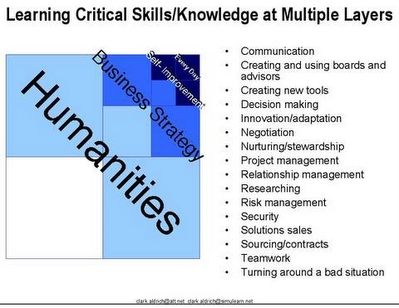

It suggests in order to understand "The Humanities" (the wisdom of the people who came before us), one thing you have to understand is business strategies. In order to understand business strategies, one thing you have to understand is personal improvement. And in order to understand personal improvement, one thing you have to look at is what you do everyday.
All of the most important skills/knowledge/wisdom cut across all these layers. Just focusing on one layer is almost always distorting. Most importantly, viewing content as just linear is crippling.
Accepting this view, one might see a unification
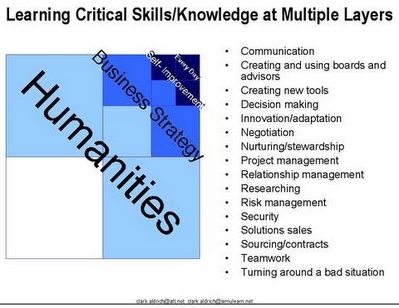

It suggests in order to understand "The Humanities" (the wisdom of the people who came before us), one thing you have to understand is business strategies. In order to understand business strategies, one thing you have to understand is personal improvement. And in order to understand personal improvement, one thing you have to look at is what you do everyday.
All of the most important skills/knowledge/wisdom cut across all these layers. Just focusing on one layer is almost always distorting. Most importantly, viewing content as just linear is crippling.
Accepting this view, one might see a unification
- between academics and business,
- between what we know and what we do, and
- between understanding the past and impacting the future.
Sunday, June 5
Living by Eating
How many times have you or someone you know do something over and over again, yet learn nothing from it? If you are like me, then at least a few times.
On the other hand, Elliot Massie once said something to the effect that if you hand a salesperson a crumpled and smudged fax that explains how to increase her sales and thus increase her commissions, then more than likely, she will learn how to increase her sales. So did she learn by doing? If you call reading "doing" something, then she "learned by doing." If I turn an idea or thought over in my head (reflect) and learn something new, am I'm doing something or am I'm doing nothing?
In the July 23, 2004 edition of Science Journal, it was reported that information is obtained by two means; 1) trial-and-error tactics and 2) watching others. So if we watch someone do something and gain information from this act, did we learn by doing?
So when we say we "learn by doing," what exactly do we mean? Is it the same thing as saying that we "live by eating?" Or does it mean something more specific?
On the other hand, Elliot Massie once said something to the effect that if you hand a salesperson a crumpled and smudged fax that explains how to increase her sales and thus increase her commissions, then more than likely, she will learn how to increase her sales. So did she learn by doing? If you call reading "doing" something, then she "learned by doing." If I turn an idea or thought over in my head (reflect) and learn something new, am I'm doing something or am I'm doing nothing?
In the July 23, 2004 edition of Science Journal, it was reported that information is obtained by two means; 1) trial-and-error tactics and 2) watching others. So if we watch someone do something and gain information from this act, did we learn by doing?
So when we say we "learn by doing," what exactly do we mean? Is it the same thing as saying that we "live by eating?" Or does it mean something more specific?
Saturday, June 4
Aldrich Axioms of Resistance to Change in Formal Learning Programs
- There is a difference between supporters of learning and supporters of e-learning.
- Every new formal learning technology/approach is judged against a standard that older formal learning technology/approach would fail.
- It is easier to criticize more/precise content than less/vague content.
- There is no e-learning that is so cheap that people will not complain about the price; there is no e-learning so brief that people will not complain about the time it takes to consume it.
- If a formal learning program has six new features and one traditional feature, people will evaluate the program on how the one traditional feature compares to existing programs; Any thing wrong with any part of a program invalidates the entire program.
- There is no right way of spelling e-Learning.
Subscribe to:
Posts (Atom)

 Posts
Posts


