Sunday, October 9

What would I see if I rode on a beam of light?


Before Einstein, scientists would observe and record something, and then find the right mathematics to explain the results. Einstein comes along and reverses the process by finding a beautiful piece of mathematics based on some very deep insights into the way the universe works and then makes predictions about what ought to happen in the world.

Behold the power of human creativity.

Mihaly Csikszentmihalyi wrote that the creative process normally takes five steps (Creativity, 1996, p. 79):
  1. Preparation: becoming immersed in problematic issues that are interesting and arouses curiosity.
  2. Incubation: ideas churn around below the threshold of consciousness.
  3. Insight: the "Aha!" moment when the puzzle starts to fall together.
  4. Evaluation: deciding if the insight is valuable and worth pursuing.
  5. Elaboration: translating the insight into its final work (Creativity is 99% perspiration and 1% inspiration - Edison).
The physicist Freeman Dyson wrote two papers that were published in Physical Review that brought together Richard Feynman and Julian Schwinger's theories of quantum mechanics. After Dyson's papers, Feynman and Schwinger's ideas became understandable and thus led to the two being awarded the Noble prize in physics. There is no doubt in most minds that the two would never have been awarded the prize if it was not for Dyson being able to explain and connect their ideas.

Dyson's story is interesting as it fits the five steps of creativity:
  1. Preparation: He goes to Princeton to study under the greats. He gets personally acquainted with the two central figures, recognizes the two theories are connected, and then goes through a six month period of directed preparation.
  2. Incubation: He spends two weeks relaxing
  3. Insight: and is hit with the "Aha!" of how to explain and connect the two.
  4. Evaluation: He then spends another six months creating, evaluating,
  5. Elaboration: and elaborating two papers that are accepted by the editors of Physical Review.
Fred Stratton (CEO of Briggs & Stratton) once said that genius lay in the ability to see how two things that nobody else sees as related are indeed related. This ability to recognize distant analogies unlocks a world of potential -- Edison recognized that space and time are not absolute; while Dyson recognized a connection between Feynman and Schwinger's two theories when no one else could.

The Learning Process in the Knowledge Economy

Skills needed in this so called "knowledge economy" go beyond rote memory to the next level -- the ability to think both critically and creatively.

Yet traditional learning systems have typically been centralized and operate on the principle that learners are unable to decide what they need to learn, thus the system does it for them, which in turn creates a vicious cycle -- put the learners in a system that does very little to encourage critical thinking, formal reasoning, or meta-learning; then tell them they are unable to decide what they need to learn, thus others will have do it for them. And this carries on from schools to the business world.

This central control is stifling...it is closed to the possibility that people need to have a say in what they learn. It is closed to the next step in the learning process -- building a variety of experiences in order to build a strong knowledge base; which then creates the possibility for building a context or connection that no one else has created before. This is how problems are solved and novel ideas are created.

Learning needs to follow a similar process as Csikszentmihalyi's Five Steps of Creativity:
  1. Preparation: A two step process:
    • Rote learning in order to create the building block of logic -- the means to use rules to make inferences, choose courses of action and answer questions.
    • The collecting of information (called ontologies) -- In philosophy, an ontology is a theory about the nature of existence, of what types of things exist; ontology as a discipline studies such theories. The most typical kind of ontology has a taxonomy and a set of inference rules.
  2. Incubation: A period to reflect and interact with others.
  3. Insight: Making new connections.
  4. Evaluation: Metacognition - planning, setting time lines, and allocating resources (Schank & Abelson, 1977) for new "connections." It also designs strategies for accomplishing goals once they have been set.
  5. Elaboration: Turning the idea into reality.
Our learning systems have performed a good job with the first step of "Preparation", yet it seems quite hesitate to go beyond this by riding the beam of light rather than just observing it.

This Tuesday (October 11, 2005) on PBS -- Einstein's big idea: The Legacy of E = mc2

Friday, October 7

Intelligent Design....of Learning

Learning 2.0 || Web 2.0


Maybe this is a thought crime, but the meme that's propagating in my head this morning is that instructional design will once again mimic software design. (Where do you think those human performance flowcharts came from anyway?) Read this article about lightweight software development and the surge toward Web 2.0.

Now, let me indulge in some cut-and-paste thinking. Modify the article by substituting instructional or instruction for software, and Cross for Fried. Here's what you get.
Traditional instructional development is expensive, resource-intensive, and born of a Cold War mentality, Cross said. His advice is to "think about one-downing, instead of one-upping, and underdoing-competitors" –beating them with less.
According to Cross, in the era of lightweight apps and simple products you need less money, people, time, abstractions and instruction.

Cross believes that money mostly buys salaries and you only need three people–a designer, programmer and utility player, which he calls a "sweeper." The feature set should be scaled for the headcount. Having less time is also an advantage. "You spend time in unproductive meetings and overanalyzing the product. Less time forces you to spend less time on better things," Cross said.

He suggested 30 hours per week per person, which "forces you into building better products and being creative with your time." And, if you have less time, you have less time to think about abstractions, such as functional specification documents, which Cross characterized as a waste of time. "Instead, build the product and start from the user interface customer experience first; then wrap with the technology," Cross said. "The interface screens are the functional specification."

Finally, building less instruction means fewer features, less documentation, minimal support and less confusion in selling the product. "Less instruction is key to building very specific tools. There are a million simple problems to solve with less. Competitors solving complicated ones are most likely to fail," Cross said. "For Web-based instruction there are plenty of simple problems to pick from and you can nail."
The more I dig into how people learn, the more convinced I become that we've been trying to do things the hard way. We used to think our job was designing instructional systems. I'm beginning to think we're nurturing the evolution of learning experiences.

Instructional design tries to fix things that are broken. It begins with assessing what's wrong, "gaps," and leads to developing grandiose, cure-all solutions. Learning evolution begins with what you've got and nurtures incremental improvement.

We see the same sort of issue on the front page of our newspapers. One the one hand, some people believe a master designer released Earth 1.0 about six thousand years ago. Others folks believe Earth beta has been evolving for billions of years; it's a web without a weaver.

Do you believe in the intelligent design of instruction or the evolution of species of learning?


Next up: Instead of "the network is the computer," think "the network is the brain."

Tuesday, October 4

A New Web Writing Tool

This post has been ported into LCB from a new collaborative writing tool that is currently in beta called writely. Harold Jarche gave it a nice write up on his his blog inspiring me to take a look at it. The functionality is very intuitive and seems to combine the best of word processing and wiki technologies to create a collaborative platform. Currently it struggles with some issues around formatting (trying to fix a table that was messed up in the upload from Word was a real mess), but they do make it clear that you're using a beta. The ability to collaborate with as many people as you wish on a document by document basis is great. I see the following functions as real positives:

  • That you can post out to most blogs
  • bring content to writely by email, upload, or original creation,
  • download into Word, HTML,
  • all with revision history and the ability to revert to previous versions at the click of a button.

I agree with Harold, this is definitely the future for use today.


A Meta-Interview

Thiagi asked me to do a brief interview about games and simulations, which he published here. Take a look at it, if you want, before you continue. I would like you to consider it at two levels.

First, there are a few nuggets of interesting perspectives on simulation design.

But more importantly, there is a lot of space and energy, both on my part as the writer and your part as the consumer, dedicated to humor. Think of your own experience as a reader plowing through the material.

  • Some will find it engaging.
  • Some will find it lame.
  • Some will find it a waste of space (mostly the people who really care about the material).
  • Some will read all of the material because of the humor, which lowers tension and builds connectedness with the reader.

My meta-point to the interview was to let readers experience a game element themselves (the humor), and come to their own opinions on the risks and benefits of using game elements generally.

Who says learning by doing has to be complex?

Saturday, October 1

Darn Spam!

Once again LCB was flooded with spam in the comments. I've decided to utilize Blogger's new word varification tool for posting comments. It's a simple extra step for you when you are posting a comment. Hopefully it will save me from losing another Saturday spent ferretting out spam! If you happen to see any stray spam on the site, please drop me a note via the "email the Blogmeister" link at the top of the sidebar.

you humble Blogmeister,
Dave

Friday, September 30

You Want Numbers?

You want metrics data? I got yer data right here....

Check out PubSub's new LinkRank Service, measuring inbound and outbound links to any site! Check out Learning Circuit's LinkRank...

Wednesday, September 28

Blogging by the Numbers

Not everything that can be counted counts,
and not everything that counts can be counted.
- Albert Einstein

One of the projects in the revitalization of Learning Circuits Blog has been the establishment of a data set for capture and resulting metrics. I thought it might be of interest to share our work in this area.

The purpose for creating a trackable set of data and corresponding metrics is simply so that we will have an idea as to whether or not we are succeeding at this blogging venture. Simple purpose however, does not necessarily lead to simple implementation. Two factors contributed to this being a rather extensive task. 1) We had no data collection practice in place and 2) Blogger, for all it’s great features, just doesn’t collect data for their free users.

A couple free stat counters (thanks SiteMeter and Bravenet) and several tracking spreadsheets that border on frightening later, we have a solid set of raw data. The data fall into two categories – "Activity" which I use to refer to the posting and comments by the Blog Squad and guest and "Traffic" which refers to the comings and goings of all of you good folks. The raw data we are capturing include:


ACTIVITYTRAFFIC
  • Posts
  • Author
  • Date posted
  • Comments
  • Comment Author
  • Date Commented
  • Days with no Activity
  • Unique Visits
  • Page Views
  • First time visitors
  • Returning Visitors
  • Referring Page
  • Entry Page
  • Exit Page
From these raw data we can build metrics to determine in what direction, if any at all, LCB is moving and why. There are all the ratio metrics (i.e., posts per day, comments per post, zero activity days per month, etc.) and comparison metrics (i.e., August was twice as active as July, or Clark leads all Blog Squad members in postings).

Some metrics which seem to be emerging as meaningful as everything settles in are:
  1. Total Activity - Posts and Comments are weighted equally. It seems a better representation of the work that is being done by the Blog Squad.
  2. Unique Visitors vs. Returning Visitors - This metric seems to indicate that we are drawing people in, but not doing enough to have them return in a timely fashion.
  3. Total Activity vs. Page Views - this has been the real surprise thus far. The ratio of page views per post or comment seems to have settled in at just aound 24-26 pages. Including in August when Activity tripled and page view followed suit. It's too early to know if this consistency is a coincidence or whether it will turn out to be a dynamic predictive metric.
I have a couple of questions I'd love to get some response from the LCB community on regarding metrics:
  1. Are there metrics you see as key when looking at a blog?
  2. Do you know of any benchmarking sources for blog metrics?
  3. Do you track metrics for your blog? If so, care to swap info with LCB?

Authoring Simulation Genres: Game based models

One well-understood simulation genre is game-based models.

With the goal of “making learning fun,” students engage familiar and entertaining games such as Wheel of Fortune®, solitaire, or memory, with important pieces of linear or task-based content replacing trivia or icons. More diagnostic than instructional, game-based models nonetheless might be the technique of choice by traditional educators and training groups looking to quickly goose their reputation, student satisfaction, and even effectiveness. Game-based models also introduce, in the purest possible way, game elements that all educational simulation designers will need to understand in the near future.

Some authoring environments include:
EGames Generator
• Games2Train


Do people know of other toolkits for game-based models?

Authoring Simulation Genres: Interactive Spreadsheets

One well-understood simulation genre is interactive spreadsheets.

Interactive spreadsheets focus on abstract business school issues such as supply chain management, product lifecycle, accounting, and general cross-functional business acumen. Students allocate finite resources along competing categories at successive turn-based fixed intervals, and each time they watch their results play out on dense graphs and charts.
This is often done in a multi-player or team-based environment and often with facilitators.
The subtlety, unpredictability, and variability make them appropriate for training b-school students and high-potential supervisors through the direct reports to the CEO. They are often the cornerstones of multi-day programs to align a fractured department or organization by building shared knowledge and understanding.

Another is straight Excel.

Do people know of other great authoring tools?

Authoring Simulation Genres: Branching Stories

One well-understood simulation genre is branching stories.

In branching stories, students make multiple-choice decisions along an ongoing sequence of events around what to say to another person in a given situation. The decisions impact the evolution of the story, ultimately terminating in either successful or unsuccessful outcomes.
Their ease of use, ease of deployment, and content style make them highly appropriate for entry-level salespeople, call center representatives, freshmen, customer-facing retail positions, and entry-level managers. Any high-turnover position should be trained, although not exclusively, using branching stories. Companies like WILL Interactive have advanced the genre to handle more moral and complex situations, making them also appropriate for higher-level employees as well.

One tool kit is:

You can also use PowerPoint, although it is tricky.

Do people know of other branching story toolkits?

Sunday, September 25

The New Ways of Describing the Life of Content

I have been thinking a lot about life of content. A few different dichotimies seem to frame conversations.

Staged vs. Organic: Staged events are one-shot. They need significant pre-establisehd processes and project management. They use up a lot of advertising and communication. Organic approaches are more incremental. They use small layers to build up over time. Television shows are staged, but they can also evolve over many episodes, as writers seize onto relationships, or the right directors are found. Organic content lifecycles stress less perfection up front, and often more feedback.

Transient vs. Peristent : This refers to the size of the window of availability, and/or the timeliness of the material. Even these can be fuzzy. DVDs should be totally persistant, for example, but advertising and shelf-issues make them somewhat more transient. Also, as with movies, there is a perceived success (being number one on the charts) that drives more success, and more of a staged content approach. DVDs can also make movies a bit more incremental, with multiple versions available. Computer games can also have various versions, and can also be patched on the fly.

Controlled vs. Community: Is their one-voice shapping this or multiple? Mods for computer games can subvert a very controlled piece of content. From a formal learning perspective, I always ask, how can I get the training group out of the way? How can the community generate the content, and how can the training group help that?

Is there a "so what" for these lenses? I think so. One is to recognize our own biases, and accept that these biases might be interfering with coversations with sponsors. The other is to recognize the current trends that are pushing towards incremental, persistant, and community, and selectively embrace some of this approach, and challenge others.

Tuesday, September 20

Small Pieces Loosely Joined

When talking about platforms, the opposite of a single monolothic approach (cough Windows cough) is small pieces loosely joined.

We in the learning industries seem to be good at the
  • big pieces, tightly joined (degrees, curricula, certification)
  • small pieces, tightly joined (LMS delivered content)
  • small pieces, not at all joined (Google, mapquest, bubble help)

So what is it that can/does loosely join our small pieces of learning? Is it our PC? Outlook? The database in Google Desktop Search? Our PDA? Is it our organization? Our annual review? Our interests? Company? Career? Industry?

At the end of our day, it is probably summed up in our résumé, our sometimes forced, often surprising organization of the things we have demonstratably done. But at the heart, we are our own platform, constantly both writing to others and being written upon, vastly ranging in productivity and capability.

I would say for the last few hundred years we have probably been Human 2.0. And we are getting close, I think, to v3.

The Lowly Binder

It is a symbol of "old school" training. It is a joke, a dinosaur, a deep sea anchor. It wastes billions of dollars of office space in filing cabinets and cubicle shelving. It is THE TRAINING BINDER.

We, the Learning Cognoscenti, "prove" our own credentials to the world by openly disdaining them. '"What to do about the classroom binder?' you ask. 'How about dig a deep hole and throw them all in!'" Then we chuckle and drink our cognac and tighten our smoking jacket.

And yet...

And yet there are still a lot of them being produced. Almost every classroom experience, and there are a lot of them, support the activity with binders. Conferences do as well, I need hardly mention. I, as dutifully as the next speaker, turn in my PowerPoint stack for inclusion in whatever event I am part. I also helped build a workbook to support rolling out next-gen-sim Virtual Leader, which significantly increased usage.

So it might be worth a few moments to, with appropriate humility and pragmastism, reflect upon what are some of the tools available that can make for a good binder.

  • Removable overviews, often in the front sleeve, that provide context and a map to what comes next, or a tip/cheat sheet to an application
  • PDFs of the entire thing, available for download and storage; perhaps zipped files as well
  • Copies of slides, for people to take notes in real time
  • Color paper and/or tabs, to distinguish between sections and aid navigation ("Go to the yellow section...")
  • Biographies, with face shots and contact information, of speakers and ideally participants, at the back
  • Appendixes, with articles and links
  • CD-ROMS, with editable versions of slides and spreadsheets
  • Clear cover and spine, with subject and dates
  • Three-ring rather than bound, so that users can dynamically and deliberately add or subtract what they want or don't want.

What are your thoughts? What should or should not be part of a well constructed binder?

Saturday, September 17

Emotionally Evocative Design


For many an Instructional Designer, design follows analysis, with its main function being to identify all the important things that need to go into a course. Its end product is a curriculum, syllabus, or blue-print to build the learning module on.

Next comes development, which adds content so as to give depth to the end product of design. This mainly consists of the adding of "information."

Context is also used to add a third dimension to the design puzzle -- layers of activity so that the learners gain a variety of viewpoints, thus allowing them to gain experience with the information in a relative safe manner.

This mix of design, development, and context should theoretically help the learners build their knowledge and skill bases. Yet this combination often fails because it leaves one important piece of the puzzle -- Emotionally Evocative Design.


While Instructional Designers normally are quite good at ensuring that the important parts that build content, such as objectives and outcomes, are entered into the design equation; the total design process needs a second layer that captures the emotions of the learners so that they actually want to engage with or use the content.

Engagement does not have to be that complex as it is simply a means of inviting the learners' emotions into the environment. Emotions are the reason that we do anything -- without them we would simply be walking zombies. Emotions are what adds zest to life...to include learning

For example, a good metaphor invites the user to reflect over the information by asking her to relate the new information with a past experience. A good picture invites two senses into the mix. A problem begs for closure. A critical piece of information delivered "just-in-time" is utter relief.

What have you done lately to ensure that your designs are emotionally evocative?

Monday, September 5

CNN vs Education

I would not suggest that higher education institutions need to operate like CNN, but I find it fascinating to read Elliot Masie's observations of how CNN dealt with the flow of content and information in the wake of Hurrican Katrina. In CNN Newsroom in the Midst of Katrina - "Rapid Development... Content Objects... Learning Implications":

There were some incredible learnings and observations as I quietly watched the news gathering and assembly process and interviewed the Learning team at CNN. Many of these items relate directly to how organizations will be assembling content in the near future.


The question is, will educational institutions be one of these organizations? Below I have take some of Maise's descriptions of CNN and put them besides a gross and likely over generalized observation of higher education. Yes, there are numerous exceptions and counter examples to every one of my points, but as a whole, when you read how CNN operates and put it besides how your higher education institution operates, the contrast should be rather vivid.

CNN: Content From Multiple and Unconventional Sources: The nature of content in journalism is changing dramatically as media flows from non-traditional sources. CNN calls an aspect of this "Citizen Journalism" as they receive pictures and video feeds from digital cameras and even mobile phones.


Education: Content comes nearly solely from instructors and "trusted" resources like publishers and "refereed" journals. And content from students would be suspect or written off as "cute" but not useful. Is there an equivalent of Citizen Teaching? If so it is the inspired individual's effort of placing a tutorial or resource on the net.

CNN: Content To Multiple Formats: As content was created in the CNN newsroom, it flowed to multiple formats. Content started as video feeds, became streamed video, text on the website and even a mention for a scroll at the bottom of the screen. Each piece of content was "tagged" as it came into the newsroom, timecoded, meta-tags were added with context and it could be viewed by CNN staff around the world in low-res format. The concept was to see each media object as being highly reusable and redeployable.


Education: Content primarily text, email, PDFs to print, hand coded/Dreamweaver-ed HTML, and.. PowerPoint. Media objects are un-reusable, un-findable, and in-redeployable and would never be available in this kind of time frame.

CNN: Digital News Gathering: The footprint and format for news production is changing radically as the size and mobility of equipment evolves radically. I watched newsfeeds coming from CNN reporters using satellite phones (after the cell network dropped). They were even feeding content that was edited on laptops in the field using Final Cut Pro.


Education: Not much to compare except we do not think of educational content being created "in the field" or with portable devices... while some are moving towards laptops in place of desktop computers, they are used primarily in the same vein (a laptop on the desk). We still print a lot of material or offload this printing to students-- we do not "think"/"operate" primarily in digital, and much of what we do digital is the digital equivalent of print.

CNN: Content Repository: CNN operates a content and media repository that is quite impressive. The content objects are viewable, editable and sharable. Key levels of data is kept for how each object is being used and deployed. Digital Rights Management is tracked, to honor the appropriate use of each media object. I was struck by how easily every CNN staff person could access and work with this content repository.


Education: This is still a dream, despite years of wrangling over "Learning Objects" and the construction of numerous "repositories" few if any that have the features described above AND as much content. Data on the use of objects is absent and DRM is spotty.

CNN: Rapid Development: While CNN clearly has a breaking news model, it was fascinating to watch this process in action, including use of templates, collaborative and team-based editing and content refinement, focus on content ethics, standards and legal/compliance issues. I witnessed a team of professionals, drawn from a wide set of backgrounds, deeply focused on producing content that had value for viewers and the hurricane's victims.


Education: The development cycle is measured in months, perhaps as summer projects or long term grants, and is pretty much an individual cottage industry. Editing and development are solo projects.

So, how does Big U stand up to CNN?

Saturday, September 3

Education's Collage of Subsidies

I was thinking about Clark's (the other Clark) post on learner rights, and then the broader learner marketplace. One of the trickiest parts about development of formal learning programs is that so often, the learner only has a passing relationship to the cost of the program.

Enterprise Programs
Enterprise training programs are paid by the corporate, military, or government sponsor.
Their goal is usually some form of increased productivity or compliance.
Any vendor has to care more about meeting the need of the training director, and the training sponsor, than the end learner. Even the cost of the classroom environment is often subsidized by the enterprise, penalizing e-learning, outside classes, or even training outsourcing.

K-12
K-12 schools are paid by taxpayers, not the students of course, nor even the family directly (even a family that goes on lavish vacations, for example, gets their education subsidized (of course if they have big houses, they also big property taxes; and then there is the private school whammy, where they are paying twice...).).
As we are also learning, some K-12 activity is subsidized by softdrink/juice/water vendors, that come with strings attached.
There are grant based subsidies that push activities in one way or another.
And there are more subtle subsidies, making land cheaper than building supplies or technology, relative to other building projects.
Of course, K-12 is required of students, which can be considered an anti-subsidy (increasing its cost to the student, while still interfering with the learner marketplace). Lack of choice for any required course also represents an anti-subsidy.

College
In many college situation, parents significantly augment the students' ability pay at least some of the tuition. Then there are scholarships for academic, sports, and music. And scholarships, like other endowments, are subsidies by alums, meaning schools have to do things specifically to keep alums happy (while students do certain things to meet the criteria of the scholarship), not necessarily in the interest of the students. Furthermore, the reason many students put up with schools is to get better jobs, which means that while corporations might subsidize universities directly, they anti-subsidize them indirectly. Any certification, in fact, is anti-subsidized by the organization that values it

These are just a few examples from the K-12, Higher Ed, and enterprise world. But every subsidy and anti-subsidy distorts the natural value proposition away from the learner marketplace. Getting over all of these will be our challenge for the decade.

Note: This blog post has been subsidized by my most recent book, Learning By Doing. New book review here.

Monday, August 29

Learning By Doing: The Tool is the Curriculum

I had to brush up on project management skills over the weekend. Did I read a book on it? No. Did I find someone who was an expert to help me? Nope.

I downloaded Open Workbench (for me, a random open-source project management tool) and played around with it. I mapped a few of my projects into it. I looked through all of the fields and capabilities. And I learned quite a bit, including what I needed to know, plus a lot more that I am very happy to know.

For those home schoolers looking at math curricula, I would suggest Microsoft Excel. Whatever math you need to know, you can learn by getting deeper and deeper into Excel functionality, including calculus, logic, probability, graphing, and more.

And you can learn by trial and error, by playing, by experimenting. You discover the material; you own the material.

There are plenty of dangers, I suppose, with having the tool be the curriculum. I am sure academics will be happy to tell me what they are. But increasingly mature software tools represent philosophies, approaches, domain knowledge that is much more sophisticated than the more trivial linear experts. And you can learn by doing.

My grandparents learned to read by picking up the classics out on the farm. Bach learned music, I am told, by copying over the sheets of the great composers before him. I wonder if today's tools will be considered tomorrow's classics?

Saturday, August 27

E-Learning: Channels, piracy, and outrage PLUS REGULATIONS

I was thinking about the earlier post on how will we know we are getting close to e-learning meeting its potential. I thought of one more, slightly further down the road.

  • Regulations! How long until we see- WARNING - Use this e-learning product only as specified. It is against the law to use this e-learning product in a manner inconsistent with its labeling.

Friday, August 26

A Snapshot of Leadership Training in the Enterprise


As part of rolling out Virtual Leader, it has been interesting for me to note how most organization who do formal leadership training actually do formal leadership training.

I think most terms are self-evident, but external coaching can also include board involvement. Tools include focused performance support.

The high-potential focus is not exclusive of other manager and supervisor leadership training.

Wednesday, August 24

MoodleQuest

I am going spend about two weeks now trying to get up to speed on Moodle, ultimately evaluating it (against other tools) for implementation.

I will share relevant data and artifacts as I come across them.

All comments are appreciated.

How to Optimize Organizational Learning (inclusive)

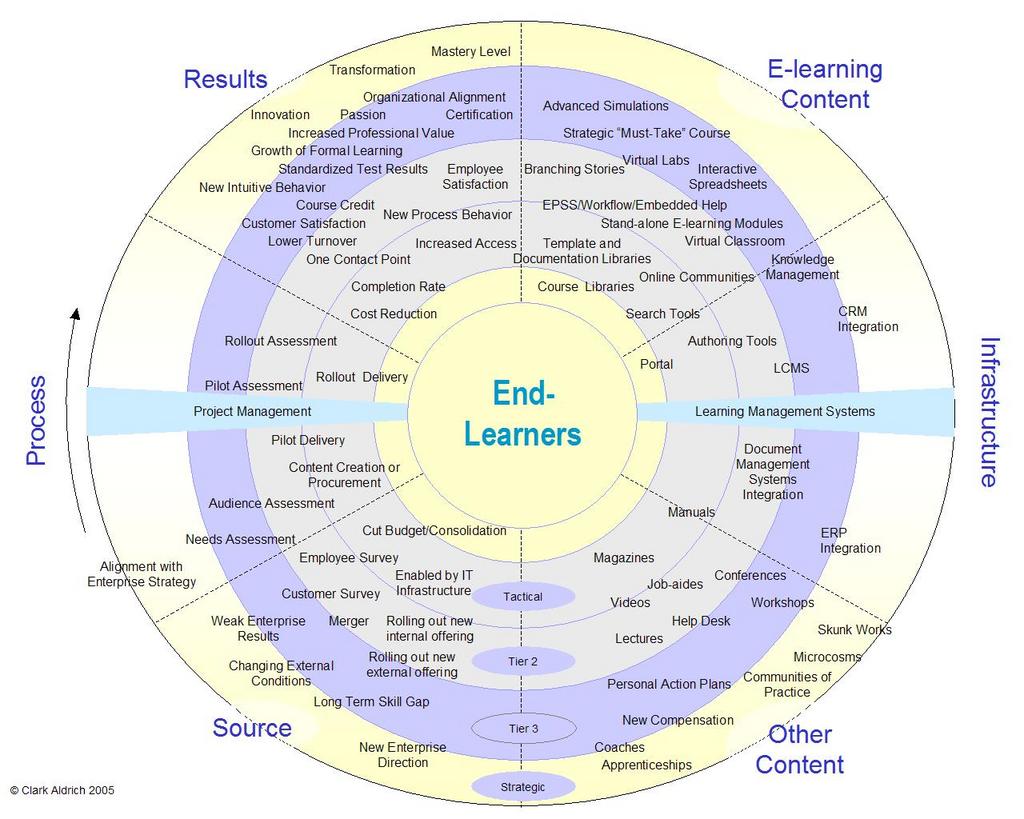
Here is the newest version of my accord chart. I continue to update it based on experiences in the field and even comments from this blog! It is a snapshot of all of our various options, the arrows in our quiver. Each have trade-offs; each have benefits. The question is no longer, which to do, but more, can you do each at the right time?
As with the consolidation chart, I am happy to send it anyone who emails me for it.

Tuesday, August 23

How to Optimize Organizational Learning

Recently while researching on the web on topics regarding Communities of Practice I came across the Community Intelligence Labs (CoIL) website. While it seems the website may have gone the way of the Brontosaurus (the last update was in Feb 2004), it's resources are still there for the viewing. Among them I found the following 14 guidelines on How to Optimize Organizational Learning written by Entienne Wenger in the summer of 1996 for the Healthcare Forum Journal.

I thought it would be interesting to get your take on these 14 guidelines now 9 years after Wenger first penned them. He introduced these guidelines with:
Here are the 14 guidelines to help you work with rather than
against the inner logic of organizational learning:
  1. View learning as work and work as learning. Recognize learning in all it's forms in order to find ways to nurture it and connect it across the organization.
  2. Count on the informal. That is where work gets done.
  3. If there is a learning problem, look for patterns of social participation and exclusion.
  4. Keep learning as close to practice as possible.
  5. Treat Communities of practice as assets.
  6. View individuals as members of communities of practice, not by stereotyping them, but by honoring the meaningfulness of their participation.
  7. Encourage the formation and deepening of communities of practice by legitimizing the work of pulling them together and valuing the informal learning they facilitate.
  8. Manage boundaries between communities of practice as opportunities for learning.
  9. Expect transformations, misunderstandings, and reinterpretations when people, artifacts and information cross boundaries of practice.
  10. Value the work of brokering learning among communities; it often does not look like work.
  11. Be attuned to the emergence of new practices at boundaries.
  12. View the organization as a constellation of interconnected practices.
  13. Put communities of practice in charge of their learning, recognizing that they need access to other practices in order to proceed.
  14. Make sure that the organizational apparatus is in the service of practices, and not the other way around.
Obviously, 9 years later, some of these guidelines are either proven or widely held to be true. I also would say it's obvious that communities of practice are thriving that would indicate that these guidelines are being well applied. Some of the questions I'd like to hear the LCB community chime in on are:
  • Are any of these guidelines obsolete, or impractical to such a level, that they should be struck from the list?
  • Which among the 14 are the "pain points" that corporate cultures just can't seem to get past, thus blocking the emergence of vibrant CoP's?
  • What's the role of collaborative technologies to date in this? Have they helped nudge along a very slow adaptation process? Or have then hindered the effort?

Monday, August 22

What's your most memorable conference experience?

What makes for a conference event with impact? I'm building a list of what works best. What's your most memorable conference event? What delivered the most learning impact? I'll tell you mine; tell us yours in the Comment section.

About ten years ago I attended a presentation by the late Gordon MacKenzie, the "creative enigma" of Hallmark Cards and author of the wonderful book Orbiting the Giant Hairball. He hung a clothesline across the stage at the annual meeting of the Instructional Systems Association and pinned a dozen doodles on 8 1/2" x 11" sheets to it. The audience would point to a sheet, and Gordon would tell its story.

Gordon's stories were heartfelt, emotional, and often very personal. At times it felt like the story was telling Gordon rather than the other way around. Gordon broke into tears several times, and tears streamed down our faces in empathy.

Gordon shared another story with me over lunch. When he started a day with no particular objective, he would tell himself that during the day he was going to be amazed. And he always was. Gordon taught me a lot about feelings and sensitivity to others that day. He also demonstrated that the sequence of stories in a presentation isn't always that important. I mourned when his widow told me Gordon had passed on.

"Grand Theft Auto"ing Edutainment Software

Grand Theft Auto might be the worst game series ever, in part because it might be the best.

Almost Microsoft-esque, GTA has absorbed and fairly seamlessly integrated different genres, including driving games, first person shooters, fighting games, gambling games, flight simulators, adventure games, shopping games, role-playing games and more.

My last post got me thinking. What if one took a GTA approach to edutainment software?

What if you could create, over multiple iterations, an experience that both included a generic, open ended "real-world" environment with specific missions to increase capability?

You could absorb:
  • Pet simulators/trainers
  • Lemonade stands
  • Tycoon (designing interactive environments, such as store layouts and zoos)
  • Designing (building cars for example, or new computers, or new clothes. If a persistant world had a GTA visual structure, you could see hundreds of people wearing your trendy new hats as you walked down the street)
  • Business building/ logistics
  • Logic games
  • Historic settings
  • Physics simulators
  • Medical/vet
  • Ecosystems/genetic engineering
  • Space
  • Traffic Emergencies
  • Negotiation simulators
Trucks, dinosaurs, dating, status, shopping, horses could co-exist in different locations as themes and reward structures. Mathematics could exist as an optional but useful lens. Multi-player and massively multiplayer would of course be optional key components. Building up business empires, huge houses, and vast social networks could start at humble activities, including creating great inventions and training animals. You could call in favors, as well as generate more and more people loyal to you. You could live in the stables, or labs, or making deliveries, or in the operating room as well if you wanted to.

I'm in!

Once a Booming Market, Educational Software for the PC Takes a Nose Dive

The New York Times ran a piece today about the crash and burn of the K-12 educational software market. To sum it up, once thriving, large, and profitable, the industry niche today, well, isn't.

I would be the first in line to buy any software that helps my son. But my own personal experiences with the "edutainment" software was pretty unsatisfying.

There were technical problems, production problems, quality problems, and just uninspired content problems.

Often times, the game elements, such as the cartoon rabbit, were not things to which my son could relate.

The general genre itself, the adventure game punctuated by unrelated, abstract exercises, was pretty uninteresting, especially as it was disconnected from the content.

I wrote in Learning By Doing:

Some game-based models use adventures games, a genre popularized in early computer games. Students traverse maps, either from a firstperson or top-down perspective, looking for pieces of information or performing small tasks to unlock new parts of the map.
This was the model for much of the early educational software. ("Sure Miss Squirrel, you can come into our clubhouse filled with toys and friends. But you have to identify these right four physics laws to get the key." There are also corporation examples, that might read, "Sure Mrs. Squire, you can come into the executive board room filled with stock options and great contacts, but you have to identify the right four ethics policies to get the key.")


Besides the reasons mentioned by the article, Will Wright has mentioned one reason he thought was the problem: increasingly kids are choosing/buying software, not adults.

Here are some reflections I have for the edutainment marketplace:
  • Interactivity is key, with real interactivity around the learning, not just propping up workbook style content.
  • Math is especially tricky. Math doesn't exist on its own! Math is itself a pedagogical layer, a set of tools to better understand the world. It needs to be handled as such, not futher burried under more and more layers of abstractions.
  • Game elements need to be specific to the user. Anything interjected to be "fun" has to be able to be modded very easily, almost like skins. Any student should have a choice of at least five different themes.
  • Building rewards creativity, and gives more ownership to the player.

Having said all of that, edutainment needs to be re-invented. As with American car manufacturers after producing Gremlins and Falcolns, there is so little credibility that a new brand has to emerge.

Saturday, August 20

E-Learning: Channels, piracy, and outrage

I said back in a speech in 1999 that e-learning was over-rated in the short term and under-rated in the long term.

I believe that statement is probably more true today, at least for the formal learning area. (Tools like Google and IM have proven the killer-apps for the informal areas.)

Wearing my analyst hat, I am looking for at least three things to see when formal e-learning hits the big time:

  • One is channels. We have talked about this on this blog. When e-learning becomes its own category at Amazon, that will be a milestone. The best producer of the types of simulations I would call branching stories, WILL Interactive, created an experience about sexually transmitted diseases. Users play one of two characters as they live an afternoon and an evening, making key decisions. The experience is honest, educational, relevant, and potentially life saving. Why isn't this in every library in the United States? There are plenty of people "studying" simulations. I would say to all of them, use your resources instead to go on a mission and get that single experience widely distributed. You will both learn more, and help more, than studying eight year olds playing computer games or bringing together academics and corporate people to talk about best practices in simulation design.
  • The second is piracy. Are people ripping off e-learning courses? Are e-learning courses being downloaded, tinkered with, and being resold on the black (or gray) market? Are some government officials in a poorer nation deciding that it is worth a bit of heat to distribute knock-offs of life improving exeriences? Why not?
  • The third is outrage. We are seeing a tiny taste of it with University of Phoenix. At some point, however, the success of formal e-learning will be putting a lot of professors out of work. More importantly, there will be complaints of vast homoginization of high school and university content. Ironically, there will be a race, between using simulation techniques to actually better preserve local ways of doing business, and the the propagation of single ways (much, much better skills than are possible today) that will threaten to erase diversity of knowledge. Buzz words like mono-knowledge will get headlines.

Are we there yet? We are not even close.

Friday, August 19

San Francisco and Los Angeles as different (but complementary) models for Formal Learning

There continues to be a movement in corporate formal learning programs to uber-empower the learner and focus the role of content designers to a more infrastructure role. Google and Instant Messenger are the perfect model for many. And I mostly agree with this "Bay Area" position.

But I also believe that "Passionate learners come from Passionate designers." Call it the "Los Angeles" take. The best movies, television shows, books, and computer games come from people passionate about the content, (although they rely on and assume the infrastructure). This passion was often true during the mom and pop instruction era, and it has to be more true in the era of scalable instructional content as well.

Being involved in, and watching, this passion around content is one reason why the educational simulation/ serious games movement is very interesting to me.

Thursday, August 18

Smackdown Learning

I find myself drifting to Kathy Sierra's blog, Creating Passionate Users, because it seems a lot like creating passionate learners. Plus it is wacky and inspirational.

I have no clue how I first stumbled on it, but take a look at this recent entry- The Smackdown Learning Model.
What happens to your brain when you're forced to choose between two different--and potentially conficting--points of view? Learning. That's what makes the smackdown model such an effective approach to teaching, training, and most other forms of communication.
Cognitive dissonance meets Celebrity Deathmatch. You gotta love/hate it.

SimJournal: The "problems" with richer content

Simulations require more content than linear content. Much more. This changes a lot.
  • There is an exploration of failure. Most corporate people don't like talking about, let alone mapping out, things that went wrong. Obviously finding people to talk about failure in detail is difficult.
  • You can't be politically correct at the expense of accuracy when creating a simulation. Can you imagine making a simulation of a car that works the way the designers hoped a car would drive, instead of the way a car really drove? Of course not. Likewise, simulations that present idealized world views are quickly found out.
  • The more content, the harder it is to translate to other languages. Many people act as if ease of translation of a course is a good thing, not a bad. Of course it takes less time and resources, but less content is less content. Some say, "simulations get into cultural issues and behavior, which makes them harder to localize." I say, "simulations get into cultural issues, so they actually work."

I think the best quote about simulations comes from outside the field:

Nineteenth-century mathematicians discovered to their discomfort that as the conceptual machinery of mathematics became more precise, it became more difficult.—David Berlinski, The Advent of the Algorithm

Wednesday, August 17

SimJournal: Stumbling upon a great score

Every once in a while, some one will do very well in Virtual Leader, but doesn't know why and can't repeat it.

The tools are there to analyze the play, but they quickly move on, assuming that they are just naturally good. Then they hit a wall, sometimes even replaying the same situation, get stuck, and then get very frusterated.

For some people, this strikes them as being unrealistic. But the more I think about it, the more I realize how very realistic it is. There are too many managers who got lucky a few times, and then are desperate not to understand their own success, but just assume they are naturally gifted and get promoted.

Simulations will continue to change our view of learning, and even our view of ourselves.

Tuesday, August 16

Computer Games and Classrooms already share one limiting feature

People, such as myself, are advocating a time when classrooms borrow more lessons from computer games. But they already share one, not-so-great similarity. They are both self-referential.
  • Doing well within the world of a computer game, be it buying the biggest house or uniting the world, is in itself victory. There is no need to transfer that to the outside world before getting the accolades. And you are not directly better prepared to actually buy a bigger house, or unite the world, for having played the game.
  • Similarly, most classrooms are self-referential. Getting the 'A' does not mean that you were successful outside the classroom, just inside.

Now in both cases, there may be correlations. The 'A" student and great gamer might be better able to get and perform complex jobs. And in the case of the 'A" students, they can stay in the self-referential academic world indefinitely, eventually getting tenure. But there is also the opportunity to 'game' the systems, building skills sets that actually hurt the opportunity for success outside the enclosed environments.

With all of that as background, I found these ideas on massively multi-player online role playing games (thanks, Kevin Kruse for sending it to me) very interesting. There are at least two parts to it. One is what happens when games have consequences outside the self-reference. The second is, how can gamers, like our life-long academics, never leave the self-reference and do quite well.

Still, with the exception of a few monks, the vast majority of us are going to have to transfer skills, knowledge, and perspectives between these various walled gardens. Smoothing those transitions are both quite difficult and, I suspect, world-changing.

Monday, August 15

Learning to Control our Moods

In Do Androids Dream of Electric Sheep?, author Philip Dick imagined a society where people regularly took drugs to change their mood.

The only two pills I personally take are vitamins and the occasional Tylenol. I love my morning coffee, enjoy a dose of chocolate every couple of days, and probably have one alcoholic drink a month, on average.

But I realize that I am increasingly using my Ipod (with no music, mind you, just podcasts) as my personal mood regulator. I listen to IT Conversations when I want to build a healthy motivation and "white collar" work level, including driving to a meeting. I listen to political commentary when I want to physically rev myself up, say when doing yard work. And I listen to movie reviews at the end of the day to wind down.

I noticed a similar trend in myself when I started organizing Internet bookmarks/favorites by day of the week. Some clicks were better for Monday, and others for Friday or Saturday.

I believe this kind of mood awareness/engineering may become increasingly relevant for both deploying personalized learning programs and even planning formal learning events.

Friday, August 12

Criticizing the person versus criticizing the idea

One aspect of Virtual Leader that I have liked is that it forces players to differentiate between criticizing ideas and criticizing the people who sponsor them.

And yet, the exact mixture of the two provides a lot of additional information as to how raw, even how religious, the conversation is getting.

A post I made on schools and business hating each other definitely hit a bit of a nerve with some people outside our community, posting in.

But no topic raises such primal emotions as talking about post-literacy. The very idea that books are "just" a technology, three steps forward and one step back (my own working definition of any technology), strikes some people as blasphemous. It comes off as anti-book, as if being pro-automobile is the same as being anti-walking. One friend asked me not to use the phrase around her.

We are going to have to begin talking about post-literacy. The irony is that as we explore the topic, our love for reading and writing will become more heightened, not less.

Thursday, August 11

Flow

Dutch composer Simeon ten Holt wrote Canto Ostinato (mp3 file) for various instruments and flexible duration. Ten Holt uses repetition and minimalist permutations to create an original, evolving work with ever-shifting moments. These parts are woven together into an overlapping and flowing whole.

One popular arrangement is to have three or four pianos facing each other in the center of a room, and normally, unlike conventional performances, the audience is allowed to move and surround the performers as they play.


Canto Ostinato has 106 figures or parts and the players themselves, decide on the stage, how many times they repeat each section, etc. Ten Holt has said, "that what happens on-stage is like you're looking at an object from different angles, and the object is changed by the input people put into it. If you look at an object from above or below, it's still the same object, but the colours are different, the shapes are different, and that's what happens on-stage. So the players' input is very important."

Canto Ostinato has become a metaphor for a new approach to design (Thackara, 2005). The composer, score, musicians, stage, and audience all interact in subtle, yet complex ways. Neither the musicians or the audience knows exactly what will happen next as the arrangement is quite flexible. But they are not flying blindly as there are principles and to a point, a score. Thus, the situation itself, in a sense, becomes designed.

Flows are not just one element of social organization, they are the expression of the processes dominating our economic, social and symbolic life - Manual Castells in The Rise of Network Society.


Notice how this relates to performance management. There is a space of flows in each performance situation -- techniques, technologies, information, sounds, symbols, people, and the performance itself. Yet, like the Canto Ostinato, while there is a score (goal or blueprint); life unfolds anew, thus, each situation basically designs itself.

Fredick Taylor's Scientific Management tried to freeze the performance and then totally script it. While Taylor's method focused primarily on the process itself, flow is more about helping people to develop so that they can perform. The manager becomes more like Ten Holt in that he or she givers her players a score to follow and conducts them, while at the same time giving them the freedom so that the situation is allowed to design itself, rather than just becoming a carbon copy. Thus, rather than just simply following a script, interaction becomes a major part of the performance.

Reference
1. Arrangement (mp3 file) by Jeroen Van Veen

Evaluation of Formal Learning Programs is a marketing activity

One should not evaluate a formal learning program to justify that the money and time were well spent. One should evaluate a formal learning program to get resources for the next program.

If there is a "level 6" evaluation of a training program, it is, "did it lead to growth of the training program/growth of the training group/promotion of the sponsor?" If not, all other metrics are irrelevant.

Of course lessons learned should make the next program (the X+1 program) better. But the driver of those improvements is to get an even better evaluation of X+1 than of X, so that selling the X+2 program is easier.

There are those who view marketing as selective truth telling at best and lying at worst. That is too bad, because ultimately marketing is evolving the premise for a sustainable vendor relationship. It involves as much listening as talking.

Credibility is hugely important, therefore. Honesty is a sine que non of any sustainable brand. But the culture of the group has to be growth through success, not just introspection. Evaluations should be done looking forward and outward, not backwards and inward.

How effective is your learning evaluation?

The evaluation of training is too important to be left to trainers.

At the individual intervention level, at the strategic enterprise level, and at all points inbetween, the quality assurance processes applied to formal learning initiatives in most organizations are, in my experience, rudimentary at best.

Training departments are usually stretched thin, and don’t have the time or resources to do a “proper” quality assurance job at either the course level or at the aggregate departmental level. Implementing a regimen that elevates the strategic importance of evaluation (across all levels) and places it on a more professional level will do two vital things. It will improve significantly the effectiveness and efficiency of all learning activities; and it will save a tremendous amount of unnecessary, un-useful, or redundant work.

My fear is that with the advent of LMS-based evaluation and record-keeping, the information we have about the quality of our learning activities is becoming more narrowly focused, and its usefulness is becoming further diluted. Just as LMS functionality tends to constrain the nature of our design of instruction, it constrains the nature of our inquiry into its impact.

I’d like to see more training departments creating evaluation units and staffing them with a trained expert or two who can help get past the simplistic "smile-sheet & ROI" approach and start building systems that put the important issues on the dashboards of individual trainers, instructional designers, and senior learning managers.

Tuesday, August 9

Short Essay Question (worth 20 points)

In a fictitious Fortune 1000 organization, there is a 20-person group dedicated to managing real estate assets. Seven of the people were chosen to take a two-day, off-site course on negotiating, which all but one attended.

Questions:

  • How do you think the members of the team felt who went to the training?
  • How do you think the members of the team felt who did not?
  • What does this say about the perception of training?
  • Is this situation a good one or bad one for the organization?
  • Could/does this situation happen in your organization?

You have five minutes to respond.

Monday, August 8

24 Questions about computer games and education

  1. Are computer games inherently counter-cultural?
  2. Are some computer games bad for children?
  3. Do computer games herald a revolution in education?
  4. For a given curricula, where would one ideally use books? Where would one ideally use computer games/educational simulations? Given educational objectives, how do you support them with computer games/educational simulations?
  5. How can computer games/educational simulations augment existing curricula; inspire new curricula? Do computer games/educational simulations increase the types of content that can be learned formally?
  6. How can modding be used to better use existing computer games in formal learning programs?
  7. How can teachers/professors/trainers use existing computer games (as is) in formal learning programs?
  8. How can you create a marketplace for educational simulations?
  9. How do you create a computer game for education?
  10. How do you measure the effectiveness of computer games/educational simulations?
  11. How do you use a computer game structure to capture and model expert behavior? What then has to happen to make it an educational simulation?
  12. How does someone who grew up playing computer games learn differently than someone who did not?
  13. How much should an educational simulation cost? To build? To buy?
  14. Should educational simulations be fun, the way that a computer game is fun?
  15. What are educationally relevant artifacts from computer games/educational simulations?
  16. What does one learn from a computer game? What does someone learn from Civilization III? Grand Theft Auto? What are the new frameworks/vocabularies needed to talk about this new content?
  17. What is the impact of looking at computer game genres, as opposed to computer games? Do we need new genres for education, or are existing computer game genres sufficient?
  18. What is the relationship between production values and effectiveness?
  19. What should a professor do about computer games? What are early steps? What are later steps?
  20. What toolkits exist for an e-learning developer to quickly and cost-effectively make an educational game?
  21. When should an educational simulation be single-player/multiplayer/massively multi-player?
  22. Which computer games today are appropriate for formal learning programs?
  23. Which computer games today are worthwhile from an instructional/liberal arts perspective?
  24. Will educational simulations be to computer games what documentaries are to movies?

Brainstorm: The New Curriculum for E-Learning Developers

I have a question for this community. If you were a university offering an advanced degree in Instructional Technology, what are the tools (not philosophies) you would strongly urge your students to learn?

Saturday, August 6

Digital Tools / Paper Mindsets

Someone, perhaps unwisely, gave me keys to this blog and asked me to write. We'll see how long it lasts...

For this first post are some long held observations on the use of communications technology. We know and see people spending a majority of their workday, or just walking around town, plus what they do at home, in front of the computer, the cell phone, the blackberry-- immersed in digital tools. However, it sure seems we still think in a paper mindset. Think about our terminology. We read web pages. We insert bookmarks to remember pages. Heck, I am surprised we do not refer to web sites as web books.

Mainly I am thinking of email, both boon and bane of our workday. Sharing information by email in our organization is the expected norm-- and the scourge of spam is bad enough in terms of time and productivity wasters, but also when it is used be well intended people in an inefficient way.

The ones that make me scratch my head are messages that arrive with subject lines like "Tuesday Planning Meeting Agenda" and upon opening the message is no agenda, no message, just an attached Word document. This makes the agenda, essentially text only content, yet one more click, and one more application launch away. And what does one really do with a nicely formatted list of basic bullet points? Print it? When I send agendas, they are right there in the body of the email, readily scanned, right there ins the message.

One of our groups, actually a technology group, has done this for years. But they've recently stepped up the level. They've created a portal for online community building. Oi! So the meeting notice is like, this, "Upcoming meeting. Click here for agenda." I click there. It's certainly a portal like pile of boxes and links. I find the one labeled meetings. I click the link for this month. It's another web page. I click a link that is labeled "agenda". What do I get?

It's the same old Word document. So now the agenda is about 3 clicks and an application launch away. It's what happens when we are stuck in document - paper - print mindsets. It is all about the "page" and not the content.

This was a puny example of a syndrome I have elsewhere labeled email attachment disorder. Beyond Google's gmail, general e-mail is about the worst and most inefficient system for organizing information. Much of the information shared in our system has no permanence beyond what is stuffed into an email. But there is no long term organizational memory or archiving of email, it is rarely widely searchable, and for large media files, it is sent to many more people than will actually view it. It is a paper mindset, stick a copy in everyone's mailbox.

For as long as I've been responsible for our office's online content, I've had to urge, remind, nag to always plan up front that everything we do have some sort of electronic presence, record, etc, especially for those that are unable to participate in our activities. Groups I am responsible for put their agenda up as a URL and filled in later by meeting notes. Our Ocotillo Online Learning Group has held monthly meetings back to 2000, which I know because all meeting notes have been archived, making them potentially searchable and internally linked to relevant content. This is what happens when you think about information in a web mindset, freed from the constraints of single throw away documents.

How about the N-factorial e-mail messages needed for N number of people to plan a meeting? For a different tactic, see Lee LeFever's Common Craft article on Wiki and the Perfect Camping Trip. Now that is using digital tools in a non-paper frame of mind. And it's been done in real life.

This web thinking is playing into our new plans to cease the print publication of a long running journal, which costs our unit thousands of dollars per year plus intense time spent in editing (getting the one off print version perfect), in lieu of a web publication that will, we hope, expand the range and types of content we can publish, plus add features not available in print.

We are trying to break of the proverbial box, which is after all... a paper product.

So what's it like in your organization? How does it organization and archive its processes? e.g. is there organizational memory? Are digital communication tools used to push around electronic bits of paper? Or does it really leverage the power of the digital terrain? Are they thinking digitally?

Friday, August 5

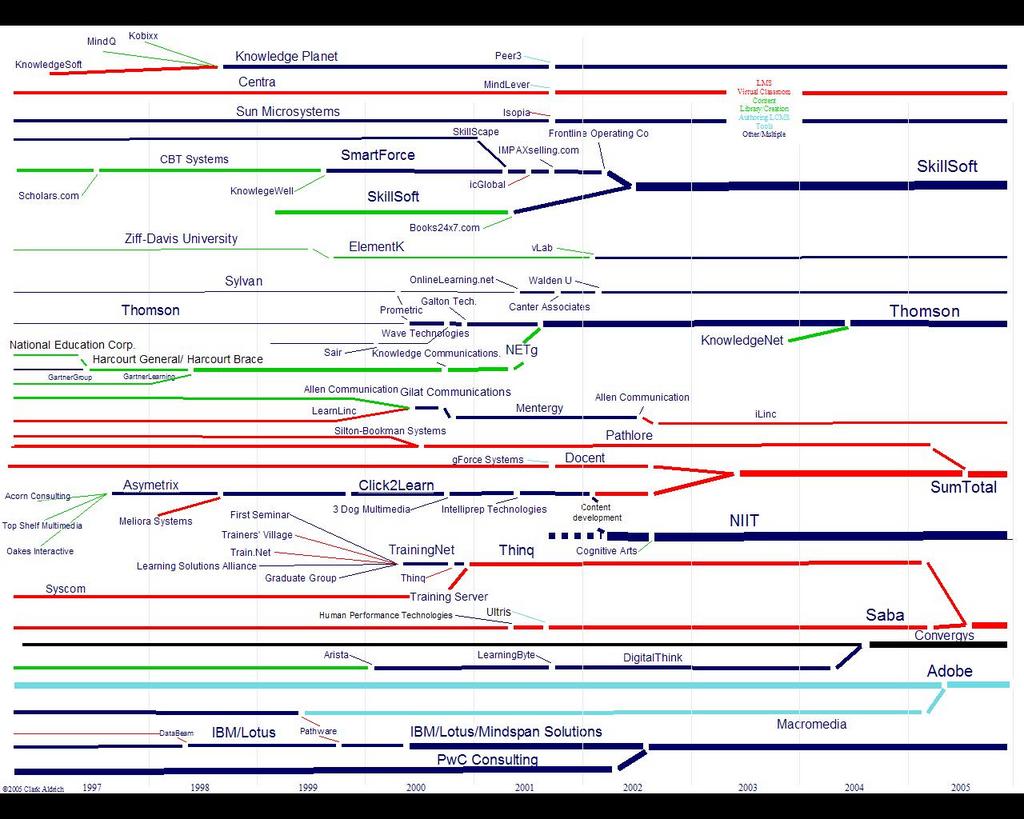
A Chart of Consolidations (US Centric, E-Learning Centric)

Tools of E-Learning Hacks

This is an odd industry, sometimes a very cruel industry. What amazed me when I first entered it, and what still amazes me today, was the amount of hacks that people generally accepted as experts. There was/is this bizarre premium on volume and intensity over actually well thought-out and/or well-researched and/or deeply intuitive statements.

The framework/snake-oil of many of these hacks is: say something that superficially sounds smart or interesting, but that can't be taken any deeper.

  • Any statement that starts something like: The X Myths about e-Learning, Training, Learning, or whatever is always suspect. Most of so-called myths have very little supporters, or are bizarrely vague in and of themselves. i.e. Myth #1: E-Training equals E-Learning, or Myth #2: People only learn in formal training situations.
  • Another hack device, one that I have mentioned here before, is invoking every hot new technology. Training/Learning should be more like TiVo, or iPods, or Computer Games, Segways, or Viagra, or GPSs, or whatever. Don't get me wrong: if you are Kurt Squire and just finished your dissertation of actually using the computer game Civilization III in the classroom, I want to hear all about it. But if you just watched your kids playing a racing game on an Xbox, and want to make a sweeeping statement, you don't win visionary points from me.

Anyway, enough of that. I would like to show you how smart I am and tell you why Harvard Business School is doomed. And all of this fancy new technology is a waste as well.

Think about it. Why spend two years of your life, and all of that work and money, to get an advanced degree? The point is to control your life, right? All you really need is an email with tomorrow's winning lottery number. The infrastrucutre is so simple: an email address, which everyone has, and even a very old computer. Text only. You could even get it on your cell phone or pager (that would be m-learning). Or someone could call you and leave a message on the phone and answering machine you already have! And be honest: you may not spend three hours doing all of your homework, but you would definately spend three hours to get to the right store to buy a lottery ticket, right? You would be set for life!

That's the future. Yup, Harvard and all of those other places that just don't get it are doomed.

What is your favorite hack device?

Thursday, August 4

Pop Ups and Spam

Just a quick operational note to everyone.

Apologies to anyone who was subjected to a barrage of pop up advertisements. I have shut down the "Invite or Seduce?" flash poll (the trend was pretty obvious anyway!) because it was this Bravenet tool that was the culprit. Because LCB is entirely volunteer and operates with no financial support we seek out free resources. Unfortunately, most of these come at a price of advertising being pushed through your website. I will continue to work to keep this to as unobstrusive a presense as possible. If you are aware of any free web-based tools which are also advertising free, please let me know.

In addition, if you run across any spam comments, please drop me a quick note by hitting the "email the Blogmeister" link in the sidebar. I found 14 spam comments this morning throughout LCB. Fortunately they were fairly benign in content, but I may have missed 1 or 2. Scouring through the comments in Blogger is not easy.

Thanks everyone! Now I can get back to reading all the great discussions you all have been posting in the last few days! WOW! Keep it up!

Dave
Your humble blogmeister.

Brainstorm: What have been the major e-learning mergers of the last five years?

I have a question for everyone reading this blog. What do you think have been the major e-learning mergers over the last five years? List them by year if you have that information off the top of your head, but the actual merger is more important.

Wednesday, August 3

Merger mania in and around eLearning

First, on Monday, WebEx buys intranets.com for $45M in cash (details) then today SumTotal buys Pathlore for $29M in cash (details) and $19M in stock. And then I hear that back on July 27 Premiere Global Services announced that it was buying Netspoke for $23.2M in cash (details).

So a virtual meeting company buys a collaboration company.
A LMS company buys another LMS company.
And a communication services company buys a collaboration company.

Looks like the convergence that Elliott Masie has been talking about taking place is finally happening. Anyone familiar with my posts and company knows that I am a big believer in the power of collaboration (and ideally done to such a level of integration that it results in mentoring not just with 'experts' but also with your peers) so it is heartening to see that finally we are moving past 'simplistic' collaboration (i.e. like stand-alone web meetings) in learning with WebEx+intranets.com and PGS+Netspoke while the fragmented LMS sub-industry is getting so much needed consolidation with SumTotal+Pathlore (and remember that SumTotal is the March 2004 merger of Docent and Click2learn).

All of this comes of the heels of SkillSoft releasing SkillSoft Dialogue, their version of a virtual classroom and NETg buying KnowledgeNet last year for their virtual classroom technology/LMS resulting in their Knowledge Now suite.

Are we finally getting to the point where educational content is merging with collaboration technologies which is merging with learner management infrastructure?

Collaboration is important as it allows learning to become a continuous process and acts as a quality feedback loop while helping to generate new content out of the resulting interactions, all of which sits on top of the learning management system. It has been long neglected in the eLearning industry due to it's complexity (trust me I founded scholars.com and struggled with the scalability of it's mentoring model long after SmartForce bought it) for it has been far easier to manage content objects than collaboration objects. I always said while at SkillSoft/SmartForce/CBT Systems that the value of SkillSoft is not the 5000+ hours of training but the fact that you could potentially tap into the collective knowledge of their 3 million users. Of course the Internet bubble burst and they went back to the tried-and-true model of producing generic content.

Anyway ... sorry for the rant but I have been concerned about the health of the eLearning industry over the last 2 years and I am glad to see this much needed consolidation taking place. Hopefully it will result in some truly innovative stuff versus people scrambling to get into liferafts. Think social networking analysis, workflow learning, collective intelligence, presence awareness, expert locating, communities of knowledge (made up of smaller communities of practice) ...

Or as BusinessWeek recently put it - The Power of Us. If you haven't read their cover story on how mass collaboration is shaking up business you should as they talk about how large scale collaboration has changed the delivery of services like auctions (eBay) and product like books (amazon.com) which makes you think about how mass collaboration could change the sharing of knowledge which until recently has been done on a small scale, typically geographically driven, basis or through static content.

PS - for those that care it is interesting to note that the 2 collaboration acquisitions were basically done at 2x trailing 2004 revenues (Netspoke) and 3x projected 2005 revenue (intranets.com) while the LMS acquisition was done at 2x trailing 2004 revenues (Pathlore). These multiples are indicative that there is a resurgence of interest and hence increased value.

Schools hate businesses, businesses hate schools

As a gross generalization, schools hate business and businesses hate schools.

Let me defend that:

Schools hate business
1. Many academics view any skills that empowers an individual outside of academics as either "vocational" or "turning students into drones of capitalistic societies." (Yet they have no problem rewarding skills that turn students into drones of academic environments.)

I mention teaching subjects like "project management"and"solutions sales" to teachers and they recoil.

2. Professors are even encouraged to downplay their consulting to corporations. Even in b-school environment, what consulting is done, according the school mythology, is prostitution, a pursuit of lucre at the expense of integrity, unless it is done at the board level of a Fortune 500 company.

3. A lot of academics smile when the stock market dives, vindication of both their world view and their own personal career choice.

Businesses hate schools
1. Businesses rail against classrooms, even their own training classes. Corporate people love to complain about training classes. "Classes don't work!" "Training doesn't teach anything." "No one ever learned anything of important in a classroom." Many training books and training professionals love quoting high profile individuals (such as CEO's or brand-name consultants) hacking at classrooms, thinking "beyond the classroom." If you listened to all of them talk, you would assume that employees are spending half of the lives trapped in basement lectures. Most people spend less time in classes than they spend waiting in line at their organization's cafeteria. It reminds me a bit of the supporters of the a flag burning amendment. I wish people wouldn't burn the American flag as much as anyone, but as far as I can tell, there is just not an epidemic of flag burning. And there sure is no epidemic of too much classroom training. The railing is really just posturing.

2. Business people love talking about academic reform. But when a company is performing sub-par, business people don't talk about Xerox reform or corporate reform. They talk about change management, growth, and re-invention. They talk about "taking a short-term profit hit" to "restructure."

3. Even amonst the corporations that do the most training, I have never seen a business sponsor an internal remedial history class, or art class, or literature class, or any kind of liberal arts experience. They say they respect it on a resume, but if you don't arrive with it, they are sure not going to give it to you.

4. And businesses fight hard for tax breaks, which come out of school pockets.

All with a big smile
But both sides hide their animosity reasonably well. The development side of schools want donations from businesses. They talk to parents about preparing students for the future. Businesses want to appear helpful and benevolent and part of the community.

It is only after the love-fest meetings and PR events do the real feelings emerge.

And I believe the friction, the misalignment, this cold war between these two hurts students, hurts our GDP and standard of living, hurts schools, and hurts business.

The Hope of T+D
In our profession, literally of the people reading this blog, lies either the opportunity to bring these two worlds together, or to create a bigger wedge to push them apart. It is an opportunity (and yes, responsibility) that I hope we all consider as we present our ideas, shape our strategies, postore, define ourselves, and invest in and execute our plans.

Tuesday, August 2

Innovate's special issue on the role of video game technology in educational settings

Innovate's special issue on the role of video game technology in educational settings is now available.

It features such power-thinkers as Gee and Squire.

I had an opportunity to present a take on what I believe is absolutely necessary for the next step in schools: the 20 simulation genre solution (this is in the second half of the interview), as well as explore throughout the truism "what is taught is governed by what can be taught" and the crippling bias of linear media.

Love it? Hate it? Get it? Let me know.

Monday, August 1

Why it is hard to trust analysts

I was recently asked to write an endorsement blurb for the back of a book by an author who had made the the same request of at least 19 other industry "experts."

I am assuming no more than five would make it to the back of the book. So if I cared about actually being quoted, I would have to write something amazingly positive. "Sell your children if you have to buy this book and make it your new reason for living. Quote it to friends. Post aphorisms from it on your walls. THIS BOOK WILL CHANGE YOUR LIFE ."

This reminded me of when I was at Gartner.

First, reporters would call me and several other respected e-learning analysts. The wanted a projected market-size in billions, and frankly would quote the biggest number. So if you wanted your name to appear in the Wall Street Journal or on ABC news, shoot high.

Second, if you have a beat within any "neutral" media organization, be it for a publication, a broadcast, or as an analyst, you have to compete for resources within your organization. So again, it benefited you to be as inflationary as possible. (And don't get me started about Wall Street!)

I hope the book will be a big success and I am sure I will recommend it personally to clients. But I turned down the author (I turn down over half the books that people ask me to do).

Having said that, I have no doubt the person will get at least five of people to say, "You must buy it now. YOU WILL LOOK BACK AT THE TIME BEFORE YOU READ IT AS A CRUEL CHARACTURE OF LIFE," or something like that.

Creating an environment where the best of the best builders thrive

I have often sung the praise of IT Conversations, which has so many great presentations, and a few duds.

One presentation I both loved and would consider required listening is Paul Graham's presentation on Great Hackers. I had thought, by the title, this would be a piece profiling evil programmers. Instead, it talks about why and how companies attract and keep the best of the best.

One of the key points for me was the need and ability to focus for extended periods of time without being interupted. This speaks against cubicles specifically. But also, it gets to the issues that great producers of IP have to put themselves in the right mood, and that the threat of constant interuption can prevent one from putting oneself in that state of productivity, as well as the reality.

I would greatly value other people's reactions to the presentation.

Friday, July 29

Why Internal Training Departments can't keep Type-A personalities

I believe training should be one of the most important parts of an organization. Yet training is often (not always) one of the least important (if that is just perception, or reality as well, depends on the organization,). One thing I have tried to understand is why this discrepancy.

One observation I previously posted was that training promotions often lead to career ghettos.

But something that I would like to explore here is the reactiveness of training. Training almost always sweeps up after the parade.

  • There is a big crisis, it is studied, it is researched, task forces look at root causes, and THEN training is presented as an answer and implemented.
  • A new application is developed, piloted, tested, and THEN training is developed
  • Sales people pioneer this great new technique, it is identified, vetted, and THEN training is brought in to scale it up.

This constant lag drives Type-A's batty. Almost all leave the department. Some flee to vendors, but then they still have to deal with the Type-B's who are left in the training department.

It is hard to know how to circumvent this, or even if it should be circumvented. But in understanding the role and profession, it is hard to ignore it much longer.

The "can you learn from computer games" gotcha!

David's comments got me thinking.

There is an emerging argument with which I disagree that goes something like:

"Some of you are saying that computer games teach.
If you say computer games teach, aren't computer games teaching violence?"

My argument back is saying:
  • Chess teaches you some general strategy.
  • Chess does not teach you how to kill kings.
We all must increasingly look at content through the lenses of linear, systems, and interface/cyclical. The reason is not just that we should think of teaching that type of content, but that we are teaching that type of content. This gets to the whole school issue as well.

Consider:

Every day, in every class, students learn interface/cyclical skills. Again, these are the highly precise skills they learn through constant repetition. Here are some examples of the types of cyclical content that our K-12 experiences have taught, and we refine in corporate classes:

  • How to be called by the teacher when you know the answer;
  • How not to be called by the teacher when you do not know the answer;
  • How to be the first to answer all of the easy questions;
  • How and when to ask for extra help to feign interest;
  • When to make eye contact when listening to a teacher;
  • How to draw in notebook when pretending to take notes;
  • How to obtain very good snacks/lunch; and
  • How and when to observe classmates without getting caught.
Classes also inadvertently teach students a tremendous amount about the system in which they are. This is where I would like to also quote John Taylor Gatto:
  • The first lesson I teach is: “Stay in the class where you belong.”
  • The second lesson I teach is for students to turn on and off like a light switch with every new topic.
  • The third lesson I teach students is to surrender their will to a predestined chain of command.
  • The fourth lesson I teach is that only I determine what curriculum the students will study.
  • In lesson five I teach that a student's self-respect should depend on an observer’s measure of his or her worth.
  • In lesson six I teach is that every student is being watched.
Until we get a handle on these different content types, we will teach mostly the wrong stuff, even/especially if people test well.

Saturday, July 23

On Being Digital

So first I read about age being a factor in Tom Hoffman's post, Outta My Way Geezer!


Then I see this cool movie by Stephen that he refers to in his post about Moviemaker.

So, here's my movie about the subject of being digital.


So using Moviemaker or another tool that shows you are a digital native, what do you think?

Happy Movie Making,
Donald Clark

Friday, July 22

How Bill Gates is overhauling High Schools


Over the past few years I have read several articles about the US$30B (that's right, thirty billion) Gates Foundation set up by Bill Gates to fund several key initiatives including improving education and global health. Of course you can do a lot of good with that kind of money and though I have read articles on the foundation it always seem to be more PR oriented than talking about end results. With regard to education Bill is probably best known for his recent speech that contained the quote "America’s high schools are obsolete". However I came across today a very interesting article that specifically talks about how the Foundation is giving out large grants to encourage changes in high schools and uses one high school as a concrete example.

Bill Gates' Guinea Pigs
The Gates Foundation wants to remake American education, and ground zero for their billion-dollar experiment is Mountlake Terrace High School. Results so far? It's been a learning experience.

This notion of creating smaller specialized communities within a high school I think is a very interesting concept (my high school had over 3,000 students) and I wonder what implications it could have for corporate learning and adult education. We keep hearing about how learning is more informal and less formal but high schools struggle with the same sort of challenges we face - high drop out rates, low test scores, one-size-fits-all mentality etc.

How do we balance the notion that for communities "smaller is better" with "the bigger, the better" (see the recent BusinessWeek article The Power Of Us - Mass collaboration on the Internet). How much does it matter anymore what we know versus who we know? Is knowledge disposable? (like water; after learning how to drink you just dip into the well when you need it).

What do you think?
Is the foundation just wasting it's money?
Who cares - this has nothing to do with adult learning!
This is the next generation of workers so we better pay attention

Hit the Comments link below and tell us your thoughts!

Tuesday, July 19

Text- The Neglected Media in Multimedia Design

Occasionally we gloss over the basics. Here's a good resource, Usability News, and a good read on single versus multiple column layouts that we can apply to learning and elearning materials.
In summary, the major findings regarding line length, justification, and multi-column displays and online reading have been:
  • Longer line lengths generally facilitate faster reading speeds.
  • Shorter line lengths result in increased comprehension.
  • The optimal number of characters per line is between 45 and 65.
  • Paging through online text generally results in better comprehension than scrolling.
  • Reading speed is faster for both single and multiple columns, but preference is for multiple short columns.
  • Left-justified text is read faster than full-justified text.
From Is Multiple-Column Online Text Better? It Depends! by J. Ryan Baker, full article here: http://psychology.wichita.edu/surl/usabilitynews/72/columns.htm

Apologies about the duplication to readers of my own blog, but I thought this worthy of posting here. Even an immersive VR simulation has been known to start with or include some text.

Thursday, July 14

Online Learning in Higher Education

IRRODL (International Review of Research in Open and Distance Learning) has a nice article on the diffusion of online learning into mainstream college offerings. In addition to some very interesting data in their review of the current state of online learning, the authors put forward four variables that their research indicates are key in the adoption of technology for online learning by faculty members:
  1. levels of interaction in their online courses (more is better)
  2. technical support
  3. a positive experience in learning and developing their online course
  4. the discipline area that they teach
Higher Ed folks, does this research ring true for you? What's your experience with getting faculty to adopt online learning? Everyone else, does there seem to be parallels in your areas?

Thursday, July 7

Esse quam videri

That's Latin for "To be, rather than to seem." It's the state motto of North Carolina, and that's the only way I know that, for I left my Latin studies behind long ago.

If you work for a business, be a business person.

T+D (formerly called Training & Development) is the magazine of ASTD (formerly known as the American Society for Training & Development). The cover story of the last issue tells WLP (workplace learning and performance) professionals that Business Acumen is Priority One.

The article, Build Your Business Acumen, tells us that we WLP professionals "need to think and talk like their internal customers." The article advises readers to understand the business and how it operates, to use business terminology to gain credibility, to recognize business priorities, to create a value proposition, and to advance the learning and performance business agenda. Follow the instructions and you can become an Enabler, trusted by management to help run the business.

This is fine advice but it doesn't go far enough. You can do more than sharpen your business acumen, use management's vocabulary, and position yourself as an understanding, savvy helper. Instead of acting like a business person, why not become one? "Earning a seat at the table" is not enough; you need to be invited back frequently.

If it looks like a duck, walks like a duck, and quacks like a duck, it's a duck. If a WLP professional looks like a business person, walks like a business person, and talks like a business person, why shouldn't she join a business community of practice and become a business person?

Am I being too subtle? You are paid to help create value, not to train people or design learning environments: those are but the means to an end. Make yourself profitable. Add value. Don't fake it. Just do it.

As Janis Joplin advised, "Don't compromise yourself. You're all you've got." Esse quam videri.


Monday, July 4

Fireworks are Fabulous!

To our colleagues from the US, the Blog Squad hopes you had an enjoyable and safe Independence Day weekend. To everyone else, don't you just love it when an event calls for fireworks?

Well we're about to launch a number of firsts for Learning Circuits Blog. Some cosmetic like the new masthead for the top of the front page (the fireworks won't be there forever) and some clean up of the screens to finally a nearly complete archive of LCB's history back to April 2002.

I hope you noticed the quote included in the masthead. This thought from The Cluetrain Manifesto is a perfect description of how the members of the the Blog Squad have represented to me what they'd like LCB to become. A place for light hearted buy serious discussions leading to new insights and ways of doing our jobs. And it needs to involve you as well. We're not the "experts who have the crystal ball" regarding eLearning's future. The solution will come in collaboration with verterans of our field as well as the newcomers with new ways of thinking.

A few weeks ago, we added an FAQ and in the next week or so we'll be adding an interactive Blog Squad roster section to the site that will help you get to know the members of the team better.

There's a lot popping here at the Learning Circuits Blog, so forgive the noise. But we just had to shoot off a few fireworks to let you know!