Friday, July 29

The "can you learn from computer games" gotcha!

David's comments got me thinking.

There is an emerging argument with which I disagree that goes something like:

"Some of you are saying that computer games teach.
If you say computer games teach, aren't computer games teaching violence?"

My argument back is saying:
  • Chess teaches you some general strategy.
  • Chess does not teach you how to kill kings.
We all must increasingly look at content through the lenses of linear, systems, and interface/cyclical. The reason is not just that we should think of teaching that type of content, but that we are teaching that type of content. This gets to the whole school issue as well.

Consider:

Every day, in every class, students learn interface/cyclical skills. Again, these are the highly precise skills they learn through constant repetition. Here are some examples of the types of cyclical content that our K-12 experiences have taught, and we refine in corporate classes:

  • How to be called by the teacher when you know the answer;
  • How not to be called by the teacher when you do not know the answer;
  • How to be the first to answer all of the easy questions;
  • How and when to ask for extra help to feign interest;
  • When to make eye contact when listening to a teacher;
  • How to draw in notebook when pretending to take notes;
  • How to obtain very good snacks/lunch; and
  • How and when to observe classmates without getting caught.
Classes also inadvertently teach students a tremendous amount about the system in which they are. This is where I would like to also quote John Taylor Gatto:
  • The first lesson I teach is: “Stay in the class where you belong.”
  • The second lesson I teach is for students to turn on and off like a light switch with every new topic.
  • The third lesson I teach students is to surrender their will to a predestined chain of command.
  • The fourth lesson I teach is that only I determine what curriculum the students will study.
  • In lesson five I teach that a student's self-respect should depend on an observer’s measure of his or her worth.
  • In lesson six I teach is that every student is being watched.
Until we get a handle on these different content types, we will teach mostly the wrong stuff, even/especially if people test well.

Saturday, July 23

On Being Digital

So first I read about age being a factor in Tom Hoffman's post, Outta My Way Geezer!


Then I see this cool movie by Stephen that he refers to in his post about Moviemaker.

So, here's my movie about the subject of being digital.


So using Moviemaker or another tool that shows you are a digital native, what do you think?

Happy Movie Making,
Donald Clark

Friday, July 22

How Bill Gates is overhauling High Schools


Over the past few years I have read several articles about the US$30B (that's right, thirty billion) Gates Foundation set up by Bill Gates to fund several key initiatives including improving education and global health. Of course you can do a lot of good with that kind of money and though I have read articles on the foundation it always seem to be more PR oriented than talking about end results. With regard to education Bill is probably best known for his recent speech that contained the quote "America’s high schools are obsolete". However I came across today a very interesting article that specifically talks about how the Foundation is giving out large grants to encourage changes in high schools and uses one high school as a concrete example.

Bill Gates' Guinea Pigs
The Gates Foundation wants to remake American education, and ground zero for their billion-dollar experiment is Mountlake Terrace High School. Results so far? It's been a learning experience.

This notion of creating smaller specialized communities within a high school I think is a very interesting concept (my high school had over 3,000 students) and I wonder what implications it could have for corporate learning and adult education. We keep hearing about how learning is more informal and less formal but high schools struggle with the same sort of challenges we face - high drop out rates, low test scores, one-size-fits-all mentality etc.

How do we balance the notion that for communities "smaller is better" with "the bigger, the better" (see the recent BusinessWeek article The Power Of Us - Mass collaboration on the Internet). How much does it matter anymore what we know versus who we know? Is knowledge disposable? (like water; after learning how to drink you just dip into the well when you need it).

What do you think?
Is the foundation just wasting it's money?
Who cares - this has nothing to do with adult learning!
This is the next generation of workers so we better pay attention

Hit the Comments link below and tell us your thoughts!

Tuesday, July 19

Text- The Neglected Media in Multimedia Design

Occasionally we gloss over the basics. Here's a good resource, Usability News, and a good read on single versus multiple column layouts that we can apply to learning and elearning materials.
In summary, the major findings regarding line length, justification, and multi-column displays and online reading have been:
  • Longer line lengths generally facilitate faster reading speeds.
  • Shorter line lengths result in increased comprehension.
  • The optimal number of characters per line is between 45 and 65.
  • Paging through online text generally results in better comprehension than scrolling.
  • Reading speed is faster for both single and multiple columns, but preference is for multiple short columns.
  • Left-justified text is read faster than full-justified text.
From Is Multiple-Column Online Text Better? It Depends! by J. Ryan Baker, full article here: http://psychology.wichita.edu/surl/usabilitynews/72/columns.htm

Apologies about the duplication to readers of my own blog, but I thought this worthy of posting here. Even an immersive VR simulation has been known to start with or include some text.

Thursday, July 14

Online Learning in Higher Education

IRRODL (International Review of Research in Open and Distance Learning) has a nice article on the diffusion of online learning into mainstream college offerings. In addition to some very interesting data in their review of the current state of online learning, the authors put forward four variables that their research indicates are key in the adoption of technology for online learning by faculty members:
  1. levels of interaction in their online courses (more is better)
  2. technical support
  3. a positive experience in learning and developing their online course
  4. the discipline area that they teach
Higher Ed folks, does this research ring true for you? What's your experience with getting faculty to adopt online learning? Everyone else, does there seem to be parallels in your areas?

Thursday, July 7

Esse quam videri

That's Latin for "To be, rather than to seem." It's the state motto of North Carolina, and that's the only way I know that, for I left my Latin studies behind long ago.

If you work for a business, be a business person.

T+D (formerly called Training & Development) is the magazine of ASTD (formerly known as the American Society for Training & Development). The cover story of the last issue tells WLP (workplace learning and performance) professionals that Business Acumen is Priority One.

The article, Build Your Business Acumen, tells us that we WLP professionals "need to think and talk like their internal customers." The article advises readers to understand the business and how it operates, to use business terminology to gain credibility, to recognize business priorities, to create a value proposition, and to advance the learning and performance business agenda. Follow the instructions and you can become an Enabler, trusted by management to help run the business.

This is fine advice but it doesn't go far enough. You can do more than sharpen your business acumen, use management's vocabulary, and position yourself as an understanding, savvy helper. Instead of acting like a business person, why not become one? "Earning a seat at the table" is not enough; you need to be invited back frequently.

If it looks like a duck, walks like a duck, and quacks like a duck, it's a duck. If a WLP professional looks like a business person, walks like a business person, and talks like a business person, why shouldn't she join a business community of practice and become a business person?

Am I being too subtle? You are paid to help create value, not to train people or design learning environments: those are but the means to an end. Make yourself profitable. Add value. Don't fake it. Just do it.

As Janis Joplin advised, "Don't compromise yourself. You're all you've got." Esse quam videri.


Monday, July 4

Fireworks are Fabulous!

To our colleagues from the US, the Blog Squad hopes you had an enjoyable and safe Independence Day weekend. To everyone else, don't you just love it when an event calls for fireworks?

Well we're about to launch a number of firsts for Learning Circuits Blog. Some cosmetic like the new masthead for the top of the front page (the fireworks won't be there forever) and some clean up of the screens to finally a nearly complete archive of LCB's history back to April 2002.

I hope you noticed the quote included in the masthead. This thought from The Cluetrain Manifesto is a perfect description of how the members of the the Blog Squad have represented to me what they'd like LCB to become. A place for light hearted buy serious discussions leading to new insights and ways of doing our jobs. And it needs to involve you as well. We're not the "experts who have the crystal ball" regarding eLearning's future. The solution will come in collaboration with verterans of our field as well as the newcomers with new ways of thinking.

A few weeks ago, we added an FAQ and in the next week or so we'll be adding an interactive Blog Squad roster section to the site that will help you get to know the members of the team better.

There's a lot popping here at the Learning Circuits Blog, so forgive the noise. But we just had to shoot off a few fireworks to let you know!

Thursday, June 23

iPods for Learning

Apple has sold over 15 million iPods worldwide and sales are not fading -- 5.3 million were sold in the first quarter of 2005. The iPod has also spawned a major accessory and peripheral boom (e.g. cases, speakers, and radio transmitters).

Unlike a lot of fads, such as the Hula Hoops or Pet Rocks, iPods actually affect behavior. Duke University saw iPods as a teaching tool and gave each incoming freshmen one, however, it recently stopped this practice (almost all of the incoming students already own one anyway). The iPod is no longer just a sound machine for listening to music and podcasts as it now stores photos, notes, and books.

Recently, a communication technologies class at Marymount Manhattan College created audio guides to nine Museum of Modern Art paintings. They're part of a project on how new technology empowers people to break free of traditional media, in this case the museum's own human guides. You can get them free of charge at MOBS.

So, do iPods have any any value in a corporate training setting? For example, could you place an audio and visual guide of your organization on an iPod and send new hires on a "tour" of their own, rather than having them sit through a PowerPoint presentation? Or perhaps record a step-by-step procedure of a task, along with a few picture and/or notes to an iPod and use it as a training device? Or use a podcast as a lecturing device?

Cheers,
Donald Clark

Monday, June 20

Multi-media elearning...

I'm curious what elearning designers and managers are doing with multimedia. Five years ago, text was the leper of elearning design. Video, games, simulations, and audio were intended to replace, not augment text learning. Clark Aldrich has posted on games and simulations on this forum. What are others doing?

In my recent experience, text seems to be more dominant than ever (and I don't necessarily think that's a bad thing). What has caused the stall of media development? Is it expense? Several years ago our department at Red River College spent hundreds of hours in video design and development in order to expand our reach to geographically dispersed markets. The video has been well used...but not quite for the intended market. On-campus learners are using it to review in-lab presentations. Learners have a way of messing up a designers intentions :).

Unfortunately, I haven't heard much excitement around multi-media elearning lately. The hype is gone. Though I imagine, that somewhere in the bowels of academia and corporate training departments, some really exciting stuff is happening. It's just not surfacing yet...

Wednesday, June 15

Dear Blogmeister - June 15, 2005

Hey everyone. One of our readers has a question for the community.
... I have a question for you. I am looking for some examples of
wikis and blogs used in classes (corporate, higher ed or even K-12 ) or in
professional publications or newsletters or the like that are being used
when learning, delivering training or developing training. Not blogs or
wikis about learning or training, but ones that are being used as part of
the process or learning or delivering/developing training. (I did not see
any of these on Learning Circuits and why I am directing this question to
you).

Do you know or resources or sites or links that you could point me to?
Any/all would be great!

Vicki Cerda
VP Programs, Miami ASTD Chapter
Vicki, here are a couple of resource sites that you can start with. There are various listings on each of these sites. In some instances there are community resources (chats, forums, etc.) as well.
edublog awards - the best in educational blogging
educational bloggers network - a great practitioners' site
Xplanazine - a great overall resource site
eSchool News Online - an amazing site focused on k-12 and technology. It's somewhat overwhelming in its scope so I'd suggest you start out in the ed-tech insider section.

I hope these sites and other suggestions that I'm sure will come from the Blog Squad and the LCB community will help you!

Good Luck,
Dave

your humble blogmeister


Workflow learning vs. the "me-focus" culture

The idea of workflow learning is surprisingly controversial. I attended the “Innovations in E-learning” symposium last week, put together by George Mason University, the US Naval Education and Training Command, and the Defence Acquisition University. I was interested in hearing what Jay Cross, Clark Aldrich, Harvey Singh and Ben Watson had to say about workflow learning, collaboration, and simulations, since these are things I have always been passionate about.

Jay’s presentation, as usual, was delightfully challenging, non-linear, evocative, and provocative. But the presentation on “embedded learning” by Michael Littlejohn of IBM astonished me. He provided a well-structured overview of the practical deployment issues of embedded learning. My surprise was not so much at what he said, but that it was being said by IBM. If Big Blue is advocating it, then workflow learning has come a long way, baby.

I did a piece on this on my own blog, and have already had a lot of back-channel skeptical feedback. In all that I have read about workflow learning, I have yet to hear anyone argue that it is not a great idea conceptually, but there are a whole lot of people who can’t believe workflow learning will ever work in practice. They are blinded by their culture.

It reminds me of the mid-to-late 1990s when I was promoting online learning to a resistant training community, who could not believe that anyone would prefer a computer to a classroom, or that any online learning could be as effective as that delivered by a trainer. Many were also desperately afraid of having to re-invent themselves. At the time, my mantra was “it’s warmer on the web,” because I was trying to get through to trainers that online learning was all about connecting people, building communities, mutual mentoring, and sharing experience. To a largely techno-skeptical audience numbed by the self-indulgent atrocities of CD-ROM courses, online learning was never going to fly.

The key that unlocked the e-learning Pandora’s box, unleashing a few gems within a cloud of pestilence, was a culture shift. Corporations started taking for granted ubiquitous desktop computing and internet connections, and started looking to leverage them to improve business processes and cut costs. Trainers started to get as myopically starry-eyed about e-learning as they had about PowerPoint. Workers started to appreciate the need to keep themselves current, valuable, and marketable because it became clear that companies were not going to provide more than the basic essentials. Training vendors saw a need to defend against more tech-savvy competitors, as well as an opportunity to broaden markets and raise margins. Quite a lot of learners had a few good e-learning experiences, mind-sets started shifting from resistance to acceptance, if not enthusiasm, and e-learning was airborne.

Workflow learning requires similar, though probably more dramatic, organizational and personal culture changes. A major prerequisite for workflow learning is a culture that fosters collaboration and sharing, that rewards (rather than punishes) individual support initiatives, that builds a fundamental responsibility for informal coaching and mentoring into every employee’s job description, and that places as much value on time spent helping others perform as it does on time spent performing. Another prerequisite is a widespread personal attitude toward supporting others that values highly the giving of both time and knowledge – two things most workers jealously protect. It's not about the technology or the processes (though of course they are important), because without the individual will and the corporate mandate, the technology will gather dust.

To change corporate culture, you need to demonstrate to senior decision-makers how much money can be made or saved (preferably this quarter) as a result of the proposed change. If they buy into the financial reward, corporations can move mountains. But how do you formalize, in a way that bean-counters will accept, the ROI from something as apparently fuzzy and informal as workflow learning? IBM advocates thinking small and running a pilot. That may be a starting point, but it's not a strategy. Do you need to get conceptual buy-in at CEO level and have a bold shake-up, top-down, in order to achieve any sustainable culture shift? Or do you abdicate and wait for a bottom-up worker-driven evolution that effectively bypasses formal learning systems?

However you do it, without a culture shift away from the "me-focus" that most organizational review/reward systems instill, and toward a "we-focus," workflow learning just ain't going to fly!

Godfrey Parkin

Tuesday, June 14

The Power of Us

For anyone who has heard me rant about the power of the Internet being it's ability to connect people together on a scale previously not possible it is invigorating to see that the June 20th US edition of BusinessWeek is all about this topic. The cover story, titled "The Power of Us" is an excellent article about how the Internet can connect all of us in new and exciting ways (there are also some online exclusives like Tour the Collectives of Cyberspace which are well worth checking out).

Continuing this theme of collaboration Sam Adkins wrote an article called "Innovations in Collaboration" for the latest issue of the Chief Learning Officer magazine which is a great indepth review around the state of collaboration for learning (I have known Sam from his early days at Microsoft where he created the Microsoft Online Institute! (my first company, scholars.com, was a founding partner with Microsoft)). I'm happy to see that more and more people are starting to realize that the Internet is more than connecting people to websites, it is about connecting people to people to leverage their existing knowledge so we can learn/work better faster (for anyone following the writings of Jay Cross (blog), this kind of collaborative mentoring is an essential part of his concept of workflow learning (website)).

Of course the challenge is that for collaboration to be effective it needs to be linked back to something, like an underlying event or topic (i.e. something that provokes collaboration versus being just passive). Collaboration for the sake of collaboration just doesn't work anymore (just look at the state of the commerical social networking companies out there). Patti Anklam has it right when she talks about "object-centered sociality" in her blog posting "Linking Out and Looking for Objects". Effective mentoring (rant - collaboration to me is a guy using a nickname to go into an AOL chatroom to talk about essentially nothing; collaborative mentoring is about forming deeper long term relationships where something of value is exchanged) is more than technology, it is focused around optimizing the connections both between users and the collaboration technologies. You need things like eBay's rating system or Amazon.com's feedback forms when you start connecting tens of thousands of people together; the vast majority of whom do not know one another and thus have no context for evaluating interactions (this notion of trust and reputation). Heck, it is about making the whole process scaleable because the value of the network increases exponentially based on the number of using (basically known as the 'network effect') so you need a lot of people in order to get effective knowledge sharing occuring across all types/groups of people.

You think learning objects (i.e. *content* objects) was/is exciting? Wait until this kind of collaboration gets (better) integrated into the process of learning!

What do you think? Is the collaboration in online learning today good enough or do we need to improve it (or does it really matter?)

Monday, June 13

What do you think?

Clark Aldrich is touring the continent to introduce his new book, Learning by Doing. I've been fortunate to hear him twice in the last month. Talking with diverse people in new places gets Clark thiinking about many issues. He has been sharing them here. Some people think it's great to have a steady stream of intriguing ideas; others consider it undue self-promotion for the book. The Learning Circuits Blogteam has mixed feelings.

What do you think? Leave a comment.

By the way, here's what greeted me this morning on Amazon:


Saturday, June 11

Understanding Systems Content

Anyone who creates formal learning experiences has to understand how something happens in order to present it, to test it, and increasingly to create an environment where people can play/practice in it.

To do this beyond the most simple examples, the next generation of educational content creators are going to have to get good at identifying and building systems. Spreadsheets, STELLA, and some of Forio's tools all are places to practice. Computer games are places to see the results of some interesting systems that others have built.

Just some of the terms that soon should be commonpace are:
  • Energy of activation
  • Feedback
  • Feedback loops
  • Negative feedback loops
  • Blancing factors
  • Delay
  • Pendulums
  • Noise
  • Load balancing
  • All-or-nothing activation
  • Fuzzy logic
  • Throttles
  • Butterfly effect
  • Geometric growth
  • Primary variables
  • Secondary and tertiary variables
  • Chaos theory
  • Rate determining steps
  • Calibrating agents
  • Nodes and supernodes
  • Short-term fixes
  • State-based systems
We will have to look at physics and chemistry, engineering, even environmental studies for the right language. This list may seem daunting to some. But I believe it will be second nature to increasingly large numers of instructional designers.

Friday, June 10

Open Source E-Learning vs. bundled vs. merging vs. stand-alone

There are a lot of e-learning things. LMSs, LCMSs, Virtual Classroom Tools. Online courses on Windows and biology 101 and ethics.

The question used to be, what would be bundled? Would EPSs bundle LMSs? Would IM bundle virtual classrooms.

Then the question is, what will be merged/acquired. Which LMSs and LCMSs will merge? Will content vendors merge with other content, or with tools?

Now there is open source.

How we will do what we want to do is getting increasingly interesting.

Monday, June 6

A Reading from "Learning By Doing"

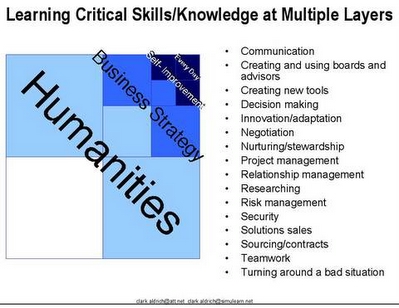
If anyone is interested, I read a bit from my new book at Second Life; the 13 minute downloadable MP3 is posted. It gave me a chance to present one of my favorite charts:


Posted by Hello

It suggests in order to understand "The Humanities" (the wisdom of the people who came before us), one thing you have to understand is business strategies. In order to understand business strategies, one thing you have to understand is personal improvement. And in order to understand personal improvement, one thing you have to look at is what you do everyday.

All of the most important skills/knowledge/wisdom cut across all these layers. Just focusing on one layer is almost always distorting. Most importantly, viewing content as just linear is crippling.

Accepting this view, one might see a unification
  • between academics and business,
  • between what we know and what we do, and
  • between understanding the past and impacting the future.

Sunday, June 5

Living by Eating

How many times have you or someone you know do something over and over again, yet learn nothing from it? If you are like me, then at least a few times.

On the other hand, Elliot Massie once said something to the effect that if you hand a salesperson a crumpled and smudged fax that explains how to increase her sales and thus increase her commissions, then more than likely, she will learn how to increase her sales. So did she learn by doing? If you call reading "doing" something, then she "learned by doing." If I turn an idea or thought over in my head (reflect) and learn something new, am I'm doing something or am I'm doing nothing?

In the July 23, 2004 edition of Science Journal, it was reported that information is obtained by two means; 1) trial-and-error tactics and 2) watching others. So if we watch someone do something and gain information from this act, did we learn by doing?

So when we say we "learn by doing," what exactly do we mean? Is it the same thing as saying that we "live by eating?" Or does it mean something more specific?

Saturday, June 4

Aldrich Axioms of Resistance to Change in Formal Learning Programs

  1. There is a difference between supporters of learning and supporters of e-learning.
  2. Every new formal learning technology/approach is judged against a standard that older formal learning technology/approach would fail.
  3. It is easier to criticize more/precise content than less/vague content.
  4. There is no e-learning that is so cheap that people will not complain about the price; there is no e-learning so brief that people will not complain about the time it takes to consume it.
  5. If a formal learning program has six new features and one traditional feature, people will evaluate the program on how the one traditional feature compares to existing programs; Any thing wrong with any part of a program invalidates the entire program.
  6. There is no right way of spelling e-Learning.

Thursday, May 26

See you in Second Life Tonight

I will be speaking at the Second Life Future Salon tonight. If you don't know about what I am talking, you owe it to yourself to at least check it out by clicking here.

Wednesday, May 25

Full Spectrum Warrior debate

Some people are criticizing the US Army's involvement with the computer game Full Spectrum Warrior. Although I was not involved in any way in the project other than doing a case study for LBD, I take the attacks very personally as attacks on necessary innovation.

The US military had always been good at building accurate simulations around pieces of equipment. The goal of FSW was to develop two new capabilities:
  • Using simulations to train softer skills
  • Add "game elements" to a simulation to increase voluntary participation.
Both were accomplished in spades. The commercial success of FSW both proved the second point, and also probably served as a great advertisement for the US Military. Further, FSW can be deployed using a $150 off the shelf Xbox, instead of $10 million dedicated hardware (which took some negotiating, as Microsoft loses money with each Xbox sold).

Game elements will always be controversial. Simulations by themselves are really boring. An accurate military simulation would have a soldier standing around, with no action, for days, weeks, or months, before something "happened." Just cutting right to the action is a game element.

Game elements are controversial even when they surround the simulation elements, because they consume resources, but more so when they selectively subvert the accuracy of the simulation, such as making bigger things happen sooner than real life.

Traditionalists will far too quickly damn an entire program for not getting the mix of simulation, game, and pedagogical elements right the first time (the only acceptable sin for them is too much pedagogy). I, for one, support the people willing to take risks.

Tuesday, May 24

Simulations, Microcosms, Apprenticeships, and Skunk Works

I wrote a book called Learning By Doing, all about the use of computer simulations in formal learning programs. But in many ways, it should have been called "Learning By Doing Part I."

Other, critical "learning by doing" techniques includes Microcosms, Apprenticeships, and Skunk Works.

Microcosms are small, controlled, comparable, but "real" worlds or projects, such as growing a garden, planning a party, running a meeting, baking a cake.

Apprenticeships are learning from someone with more experience, often in exchange for performing some menial task.

Skunk Works are teams that are trying something that has never been done before, with the goal of getting real feedback from the marketplace or enterprise.

The role of technology in all of these can be transformational, suggesting projects or"matching people up" at the beginning, giving real-time workflow centric advice during, and then tracking results afterwards.

Monday, May 23

Why I hate speaking to groups of twenty

For years, I have had a pretty significant fear of public speaking. Thankfully, through blood, sweat, and tears, I have been moderately successful at resolving that. For the last several years, I have had the honor and, yes, pleasure of speaking with groups ranging from two people to many thousand.

Here is a curious observation from that.
  • I like speaking with three people, because I can customize my material to the very specific needs of the individuals.
  • When I speak to hundreds or thousands, the audience seems pretty happy (with the exception of Stephen Downes!) if I can give some useful information and perspectives, and keep them relatively entertained and motivated to go deeper. There is also a lot of energy to tap and play back.

But fifteen to twenty people in an audience is always very, very hard. It is small enough so that people feel that the presentation should be highly customized (like a one:three experience), yet there are always many groups who want to take the conversation in very different directions (high level, low level a, low level b, etc).

I will continue to play with techniques, but for now, twenty is a very lonely number.

Sunday, May 22

The way formal learning ought to be

I was up in St. John's, Newfoundland at the end of last week. There is a lot to love about that part of the world, including the people, the architecture, and the rugged beauty of the land.

What I did not expect to find, however, was a state of the art simulator. But at The Center for Marine Simulation, they have one of the best in in the world. It is for training people who will run a ship, including the captain.

The crew works in an accurate replication of a bridge.

This bridge is about 25 feet wide and about 9 feet deep. This entire bridge rests on a six motion base.

Huge screens show dynamically rendered computer graphics in a complete, 360 ring seen through all of the windows of the bridge.

When you are in the simulation, you feel the rocking of the wave, the impact of the wind, even the chop when you put the boat in reverse. I found myself quickly pacing from one end of the bridge to the other to get a visual fix on an object to reinforce what my radar was showing me.

The formal learning also, of course, includes comprehensive instruction on the front end and debriefs (or after action reviews) on the back end.

One of my mantras has been, the organizations that care the most about training use simulations. You can tell people who built this center really care.

Saturday, May 21

Aligning Training Processes, Tools, and Metrics

I don't know why, but I have been getting a tremendous amount of interest recently in a concept I first put forth a few years ago called Learning Accord.

It suggests that you can rank many aspects of a Formal Learning Program (FLP) from tactical to strategic, including:

  • Type of learning material;
  • Types of results needed; and
  • Processes used.

With this organization, you can accurately predict how well a program will work. The most successful FLP's have a great deal of accord between the material, results, and processes, and the least successful have significant discord. So if you are planning any FLP, I would strongly suggest an early meeting between buyer, builder, and deployer around the issue of accord.

If you are interested in learning more about the idea, use the link above (Learning Accord) or check out the appendix in Learning By Doing. After that, feel free to email me and I can send you a ppt of the charts, including an academic version that has not been published anywhere.

Monday, May 16

CSTD Fredericton

Well after finally getting my wireless to work I am able to upload some blogging from the Canadian Society for Training and Development (CSTD) conference in Fredericton (links in this post are to my summaries).

Clark Aldrich led off with a talk called Simulations, Computer Games and Pedagogy. It took a long time to get to the point, so he really didn't get inot a lot of detail.

Then, in one of the breakout sessions, Darlene Burt and Darren McKinnon of the Canadian Imperial Bank of Commerce did a really nice session on the development and deployment of a personalized learning system for customer center staff, New Communication and Information Technologies Emerging in the Workplace. Good, comprehensive presentation that was well organized and didn't skimp on detail.

Good things about the conference so far: good mix of people, and not the same crowd I see at academic conferences. Talked with many people thus far. One good talk. Some interesting displays.

Bad things so far: the Delta Hotel here is declining in quality (room wasn't restocked, no milk for coffee in room service, convenience store closed). No signs at the conference and no rooms listed in the conference schedule - as a result, I missed this afternoon's session, as there were no sessions scheduled for the one room (the lecture theatre) I thought there would be.

Saturday, May 14

One Version of the Future

Per Mindy B's request, here's my version of our future.

I can elaborate a little now. As to a longer focus on workflow learning, we have several members of the LCB Blog Squad who are very involved in such efforts. I'll encourage them to post some of their thoughts. Jay Cross and Tony O'Driscoll laid out a more detailed vision of workflow learning in the February Training.

From a very high overview, I think we'll see changes in what learning interventions are and changes in what the Learning and Development function does.

Supervisors at all levels will be held responsible for the development of their employees. My growth strategy (versus developmental plan) will be focused on building my strengths and will be a matter of public knowledge so my colleagues will be able to help me meet my personal goals while we work together. Employees will be given opportunities to learn whenever, however they need.

Let's say I'm a marketing director with budget responsibility for my department. A week from today there's a meeting to launch the budgeting process for next year's budget. When I logged onto my work portal this morning my tablet PC reminded me of the meeting with to do's from my supervisor's memo. It also has organized last year's budget, my budgeting notes, a guide from finance on corporate budget strategy for this year - with my bosses reactions and directions included.

My system also gives a list of requested initiatives from my notes for meetings with my business partners, industry benchmarking numbers for similar initiatives and a reminder that I never took the training for the forecasting component of our new financial software - with a link to the online training. Outlook has even identified that my staff can meet with me at 3PM on Monday and is holding the time on everyone’s calendars waiting for my approval. Finally, I have my comments regarding budget processes for each of my direct reports culled from our reviews over the past year, L&D’s suggestions for materials to share with each, and coaching tips for me.

To guide the development of interventions that anticipate employee needs, we learning professionals will have to become proficient in systems thinking, business processes, change management and strategic planning. We'll get so close to our business partner that we'll become one of them. Needs analysis will truly be about what is needed and what the best solution(s) is – not the best training solution. Assessment will become focused on helping employees develop self-awareness of what they need to know to execute on their business objectives and pave the way for where they want their careers headed.

You asked who the vendors will be. Some will be the vendors you know today - SumTotal, GeoLearning, SAS, Oracle, etc. But don't be surprised if you're learning business process tools from Hyperion or Verity, synchronous meeting tools from Interwise or Skype, team/community enablement tools from UberGroups or Google and data mining and content management tools from Documentum or Fatwire.

So what do you think Mindy? Are you prepared for the change?

Thursday, May 12

Just Showing up

On my long-term and short-term projects, I am around motivated and talented people.

But a theme has come up when talking to colleagues. A lot of people these days, according to a lot of good sources, are just "showing up. "

They are just showing up to meetings, unprepared.
They are showing up to league basketball games without having done much practice.
They write reports and letters without doing much research.
I have seen sales calls when both sides knew nothing about the other.

If the theme is just "showing up," however, the expectations seem to vary.

Some people still expect to be great. Some people think we will revel in their wondefulness, unprepared as they are.

Others just want to get by. The years of incredible rewards for incredible efforts are over, they think. Why push?

Both have implications for formal learning. But first, let's test the premise. Are people seeing this in their own workplace?

Sunday, May 8

The reality of knowledge work

I installed a wireless home network this weekend, and it was a lot harder than I thought it should have been (three XP computers and a TiVo with new Linksys wireless stuff). I spent over an hour going online, Googling user groups, until I got what I needed to configure everything. The experience was similar to when I got a wide screen television, and had to change not just the user settings, but the accessed-only-by-secret-code factory settings.

The fussy, brittle, politically correct, theorist side of me was indignant at both activities. What about 'Customer satisfaction,' seamless integration,' 'quality assurance,' 'user interface,' blah blah blah?

And yet the rest of me was realizing how old I must sound. "I can't believe I have to go get gasoline for this new-fangled automobile. Why Bessie just needed some grass." Or even, 'why does the hardware store sell me these grass seeds that will need to be mowed once a week?'

So I spent an hour doing knowledge work. Big deal. What was I belly-aching about? Networking software and televisions might get easier over time, but what comes next will require just as much adapting.

It is easy to theorize about learning in the future. It is just a bit harder when it takes up a Saturday afternoon.

On being 85% right...

I remember the first time I was aware of reading a professionally published book and finding a typo. It was a Stephen King novel and I was at summer camp. I found the misspelled word, and even though I knew it was wrong, I reread it again and again, and finally looked it up in a dictionary just to confirm what I already knew.

Today, I almost wish that more words in some of the things I read were misspelled. It would remind me that the author is imperfect, and I should take his or her thoughts in the appropriate light.

This reasoning made me reflect upon some of my own rules for writing.

Rule 1: When describing about the uknown future, shoot for 85% accuracy. Aiming for higher than that makes you boring, and lower than that makes you just another industry hack.

Rule 2: When describing about the present or inevitable future, be specific enough so that it is obvious when you are wrong. This can be embarrassing in the short term, but what learning isn't?

Rule 3: Let people know if you are describing the first or the second.

Globalization depends on an informed and educated citizenry.

When talking and writing about simulations, one fun technique is to take a famous quote and change it just a bit. Here are some:

I made a perfect simulation about growing a company. The only problem is that it takes twenty-five years to play.
—With apologies to Steven Wright

An inexperienced learner is thrown by frustration, but a good learner uses it.
—With apologies to the late actor Carroll O’Conner

High production values that restrict immersion I wouldn’t give a fig for. High production values that open up immersion I would give my career for.
—With apologies to Oliver Wendell Holmes

The genre is the content.
—With apologies to Marshall McLuhan

Globalization depends on an informed and educated citizenry.
—With apologies to Thomas Jefferson

Teach someone a computer game; and you have engaged him for today. Teach someone a computer game genre and you have engaged him for a lifetime.
—With apologies to the old Chinese proverb

Wednesday, May 4

See you in New York tonight!

I hope to see some of you at ASTD's famed New York chapter for a presentation and book signing tonight.

Here's the link:

http://www.astdny.org/events.asp


Clark

Saturday, April 30

Cheating or just smart?

There was another story in the paper today about kids using technology to cheat while taking tests. I think the set up was scanning some test questions in real time and getting the responses IMed back to them while they were still at the desk.

The headline, "Cheating or just smart?" was mine not theirs. It is reminiscent of a headline I read about a year ago when some teacher seduced some high school boys, and the caption read, "victims or just lucky?"

Tuesday, April 26

How not to talk about simulations

This has happened to me more times than I can count. A bunch of people are in a room, invited for a two day meeting to talk about simulations. The moderator starts out by asking the group why they are interested in simulations.

One says, "Oh, I love simulations. I lead role-plays all of the time in my sales class, and they work really well."

Then someone says, "That's right. I build online certification programs, and simulations are critical."

Another says, "I agree. I love simulations. My kids play computer games all of the time. They are great."

Another says, "Simulations are the best. When I was in law school, we did moot courts, and they were very powerful."

The next person says, "Sure. I have spent decades modeling simulations using all sorts of tools like Stella, and they are great."

Then someone adds, "Absolutely. Simulations are necessary because learning needs to be made a lot more fun."

Another says, "Absolutely. I was a pilot, and we lived in the flight simulator."

"That's right," someone agrees. "The simulations are the most used part of our e-learning library."

Another says, "Oh, I love simulations. I was in the military and we practiced everything a hundred times."

Then someone says, "I work in IT, and we rigorously simulate every new architecture before we implement it."

At this point, I know the conversation is doomed. We have, in five minutes, dug ourselves into an intellectual hole that will take at least a day and a half to dig ourselves out of before we can actually move forward.

Monday, April 25

Questions about eLearning and Public Education

LCB received an email from John R. Wallace who is new to the elearning world and seeking advice on resources on the web regarding public education and elearning. Here are his questions. I'm sure the Learning Circuits Blog community can overwhelm him with good ideas!

....Which brings me to you. I have found the entries at
"The Learning Circuits Blog" to be very interesting,
serving as excellent stepping stones in my recent, much
more focused exploration of e-learning. I hope you might
be able to offer some advice...

Why am I having such a hard time finding articles or
information about e-learning as it might be applied in
public education?

Where are the discussions, the forums, and the people who
are involved?

Are large publishing houses the only real source of
investment in K-12 multimedia content (thus obviating the
growth of ADL-type communities in the field of public
education)?

Have I just been Googling the wrong two dozen search terms?

Also, what area(s) of e-learning do YOU see as having the
greatest potential in contributing to public education?...

Nested Feedback: Designing Learning Experiences for Generations for Gamers

One of the interesting parts of creating educational simulations is the role of nested feedback. At any given point, a learner should be getting feedback on short, medium, and long-term actions, all simultaneously.

This thinking is very foreign to traditional instructional designers, but very familiar to anyone who builds or uses computer games.

I like to think of feedback at intervals of Turn 1, Turn 3, and Turn 9. Turn 1 feedback happens after every turn. Turn 3 feedback reflects on the execution of simple strategies and ability to build capacity; we see the results of multiple tactics. Turn 9 gets to the biggest ideas of success or failure.

Here is a breakdown, focusing on specifics.

Turn 1 Feedback is around:
*Do I understand my options at any given moment?
*Can I map an action that I want to do/ would do in real life to the screen/ virtual world?
*Do I know if I did something really wrong (not always possible)?
*Do I know if I did something really right (not always possible)?

Turn 1 Feedback meets these learning objectives:
+Use of simple process
+Understanding options/tactics

Turn 1 Feedback Uses:
- Voices
- Graphics

Turn 3 Feedback is around (depending on the learning objectives/content/genre):
*Can I influence/ optimize one (primary systems) variable?
*Do I know if I am on the right track?
*Do I know if I have blown any chance of success?
*Do I know where I am losing ground/ need to triage?
*Do I know if I am doing something rather wrong?
*Do I know if I am doing something rather right?
*Do I know what my long-term goal is?
*How does what I do maximize some part of the system?
*How do I traverse some part of the map?
*How do I build some part?
*How do I get some critical competency/ tool?
*How do I control some territory,?
*How do I build some important personal relationships
*Given my strategy, am I executing against it?

Turn 3 Feedback meets these learning objectives:
+How actions impact a System
+Executing complicated process

Turn 3 Feedback Uses:
- Triggers at milestones reached
- Onscreen graphs and maps

Turn 9 Feedback is around (depending on the learning objectives/content/genre):
*Did I win?
*Can I optimize/ influence many (primary systems) variables
*Did I build what I wanted to build?
*Did I get to where I wanted to go?
*What does victory actually look like?
*Do I understand the trade-offs in my victory?

Turn 9 Feedback meets these learning objectives:
+Understanding Systems
+Use of Time
+Execution of Complex Strategy

Turn 9 Feedback uses:
- After action reviews
- Complex charts and graphs
- Multiple analyses of plays
- Advice for future plays
- Scores
- Consequences of actions taken

When learners first engage the sim, they are focused on Turn 1 Feedback. But after a few iterations, either replaying or continuing on to advanced levels, the learners increasingly focus on Turn 9 Feedback.

One necessity of building these nested feedback cycles is that we have to spend a lot more time thinking about failure than thinking about success. Our increasing challenge is how to help learners recognize, and then avoid, failure. This also gets to a concept of level design, again familiar to gamers and foreign to traditional instructional designers.

The bad news is that this is obviously a lot of work. The good news is that it produces formal learning experiences that teach much more, in much less time, in a format that meets the needs of the next generation of learners.

Friday, April 22

The Interface is the Content

One of the big "ahas" of the next generation of elearning designers is that the interface is a significant piece of the content, not just a conduit to the content. We are learning that the interface should line up to the real life activity at some level, high or low, to enable transferability of content.

Computer games designers get this, in that they think about the interface and the complexity of interaction, although they also mislead us, in that they don't care about transferability of skills to the real world; they also rely quite a bit on established genres (first person shooters, real-time strategies).

Not realizing the learning opportunity of the interface, as is the case with traditional designers and learners used to traditional models, has a feedback loop of problems.

If the learner does not realize that the interface is part of the learning, they think the time spent learning the interface is wasted time, which they resent.

Because traditional designers think of the web, with ease of navigation, as a model of a good interface, they design content that is very difficult to transfer.

We are getting over this. But it is slow.

Thursday, April 21

Learning By Doing out tomorrow

Starting tomorrow, a little rock that is my second book will be tossed into the water of our collective understanding. How big the ripples cast is hard to say.

And yet, I can't help but be excited. I am excited because I do think we are in an inflection point when it comes to education. Probably the most true statement from the book comes from its introduction:

"At least a handful of people reading this book will, through their work, define the future of learning, just as absolutely as Shakespeare defined drama, Eastman defined photography, the Beatles defined modern music, Ford defined automobiles, Hitchcock defined modern cinema, and Beethoven defined, well, Beethoven... Productivity and the corresponding standards of living can be raised to the next level. The work of a few people will echo through the ages, changing the very wealth of nations."

To any potential readers, don't worry. Only the introduction and the conclusion have this much hype.

Yet I believe every word.

Sunday, April 17

Training Pays Off

CDW does not just let new telephone reps loose, first they must complete a six and half week training course. And their training continues with a six-month Academy and then a Master's Curriculum. While the stock market has gone down over the last five years, CDW's stock price is up fifty percent.

This is because they, like others, see training as an investment rather than an operating expense. Laurie Bassi, one-time professor of economics at Georgetown University and former vice president of ASTD says that organizations that make large investments in people do much better than others. She further says that the education and training variable is the most significant predictor of an organization's success as compared to price-to-earning ratios, price-to-book statistics, and measures of risk and volatility.

Bassi puts her theories to the test -- her and a fellow partner launched an investment firm that buys stocks in companies, such as CDW, that invest heavily in employee training. It has returned 24 percent a year over the past two years, topping the S&P by four percentage points.

In the Human Equation, Jeffery Pfeffer writes, "Virtually all descriptions of high performance management practices emphasize training" (p.85). Yet, on the very next page he writes that in times of economic stringency, many U.S. organizations reduce training to make profit goals.

Training works, yet it remains at the bottom of the pole in many an organization. But my guess is that it will not remain this way for long. The baby-boomers are starting to retire. There may be quite a few people out of work now, but when the pool of workers slowly starts to dry-up, then it is going to make the labor shortages of the late 90s look like a small bump in the road. How do we best prepare for it?

Cheers,
Donald Clark

For more on Bassi, see:
Carnahan, Ira (2005). Forbes. "Blame the Accountants". April 25, 2005, p. 48.

Delahoussaye, M & Ellis, K. & Bolch, M. (2002). Training Magazine. "Measuring Corporate Smarts." August 2002, pp. 20-35.

The instructor is egoistic. And now the learner is too.

It has often been said that the web allows us to better understand and tailor experiences to ourselves. Online dating services let us take detailed personality profiles to better reveal our hidden selves. We love ourselves, and can't get enough about us. Web citizens are encouraged to be egoistic (and sometimes even egotistic). Even educational simulations are all about us. It is better to be the President than to read about someone else being the President.

Training and educational programs have always been themselves egoistic. "We know something that you should know," they tell us. This is even more true of programs with certification, and even more so with degrees. This is often a good deal, by the way. I graduated from Brown University. People, at early job interviews, didn't have to trust me - they could just trust my alma mater.

This clash of ego vs. ego explains a lot of the angst in not just e-learning and online education, but all formal education. The instructor/course says, "I have the answer." And the student either says or wants to say "Great. I have a different answer."

But ultimately the synergy of the two forces should lead to better experiences for all. Here's an example. When helping clients with rebuilding new employee orientation programs, I start the day with the new employees talking about what seems not great about their new organization. After all, the new people were hired for a reason, and this might be the last chance to get some free, unbiased consulting.

Clark

Canary in the Coal Mine Part II: Promotions out of Training

I had a friend who suggested that training groups were career dead-ends. The cases of professionals for whom success at a high level in a training unit led to a position at an even higher level in the organization outside of training were few and far between.

If that is true, that is very frightening indeed. But if that is a false perception, it is also dangerous. Can readers comment on this, either agreeing or disagreeing with the premise, ideally with specifics as data points?

Friday, April 15

Oh, Canada

I sometimes feel that other countries are so much more progressive in terms of pushing elearning's potential than here in the States. Canda, the UK, Australia, New Z., all seem to outstrip us, or at least see things that us Yanks miss but really need to know. (Israel had been one of the places until about four years ago... I wonder what distracted them....)

That is one reason I am so excited to be speaking at the CSTD's 2005 Learning Innovation Symposium. I really look forward to seeing some innovation! If you haven't been to a conference outside of the US, Fredericton, New Brunswick is a perfect place to start.


Of course, it is also the official Candian launch of Learning By Doing, so you can get your very own autographed copy while you are there.

If you do go, please say hello (Of the three pictures, I'm the one at the top!).

Clark

Customer Loyalty for Learners? How weird!

I love the stream of consciousness effect imparted by linking from one blog to another. It reminds me of the best part of the best classroom discussions; making new connections. Let me try to recreate a recent experience in a way that you can share.

One minute I'm reading the Furrygoat experience (found because long ago I used his PocketFeed PocketPC RSS reader), the next minute I'm linked to Kathy Sierra (from the Head First books) for a discussion of thank you's for customer loyalty. Evidently she has a thing for trendy eyeglasses, to which I can not relate, having recently turned 40 and only acquired my first pair. However, her local eyeglass store could relate and she was duly rewarded.

I started thinking about how people will wear university hats, t-shirts, sweaters, cheer for teams... long after the learning experience. Will we ever see this for Capella and University of Phoenix or Thompson NETg? What about the elearning in our own organization?

Why? Why not! How can we 'brand' e-learning and bond with our learners, like say Notre Dame? I've never been tempted to paint say a Macromedia logo on my niece's face, but maybe that's just me.

Does anyone contribute to an alumni fund because of one teacher or experience? It is clearly a branded, larger experience. music fades in, playing Beach Boys "Wouldn't it be nice". Is there some way to instill this into our elearning even if our elearning comes from a variety of sources and covers all sorts of content? Top-notch universities accomplish it with a wide range of content and various sub-contractors they call professors.

That's a long enough post for a first timer. I hope you take the time to surf Kathy's blog and read entries like, "Most classroom learning sucks" or "Getting past the brain's crap filter." Sometimes it is nice to think about elearning while you're not really reading about it.

Wednesday, April 13

Look Mom, I said 'sex' in a post!

In light of the recent discussion about gaming technologies and learning (see Where I Disagree with George Lukas and Two Fascinating Books) it was coincidence to run across James Paul Gee's article, Learning by Design: good video games as learning machines, in the lastest edition of E-Learning, a year-old, online peer-reviewed journal.

Gee posits good video games build their success on the backs of good principles of learning. He says, "Under the right conditions, learning, like sex, is biologically motivating and pleasurable for humans (and other primates)."

He outlines 13 principles, describes how video games exploit them, examples, and then how education can apply the same principles. He groups the 13 principles in three broad categories:

Empowered Learners: Co-design, Customize, Identity, Manipulation and Distributed Knowledge

Problem Solving: Well-ordered Problems, Pleasantly Frustrating, Cycles of Expertise, Information 'On Demand' and 'Just in Time', Fish Tanks, Sandboxes, Skills as Strategies

Understanding: System Thinking, Meaning as Action Image

Gee finishes by pointing out that while we think of learning as work, good games show us that deep learning can be fun. He leaves it to instructional designers to guide and scaffold learning through the lessons being taught to us by video games.

Friday, April 8

Training is not important, learning is (and so on)...

Training is not important, learning is.
Learning is not important, doing the right thing is.
Doing the right thing is not important, having measured results is.
Having measured results is not important, having a positive ROI is.
Having a positive ROI is not important, meeting the needs of the budget holder is.
Meeting the needs of the budget holder is not important, increasing your next quarters’ funding is.
Increasing next quarters’ funding is not important, having revenue next quarter is.
Having revenue next quarter is not important, having profit next quarter is.
Having profit next quarter is not important, having the right people is.
Having the right people is not important, having the right experiences are.
Having the right experience are not important, having the right training is.

Clark Aldrich

In Praise of IT Conversations

I think my best "discovery" of the last six months has been the web site IT Conversations. This is a web site that provides FREE downloads of hundreds of cutting edge IT speeches by the best in the industry.

I am one who loves a good speech. It goes deeper than a magazine article, and is more current than a book. It also has passion and personality.

But I am not as fond of the ten speeches in a row format of a typical conference. In fact, I have a hard time sitting through just one.

Rather, I love to listen to speeches while driving, even working around the grounds. I can put several on my PDA, and it reloads automatically when I synchronize after I delete the last one.

We all use ourselves as test subjects, practicing learning. Here is one of the best ways around.

Clark

What are topics about which a Learning Professional should be uniquely proficient?

I would greatly value all of your input. What are topics about which a Learning Professional should be UNIQUELY PROFICIENT (i.e. you know more than anyone else in your organization), and VERY PROFICIENT (i.e. critical knoweldge to do your job)?

Here are some thoughts to get the ball rolling:


UNIQUELY PROFICIENT
Virtual classrooms
LMSs/Training Portal
LCMS
Simulations
Workflow Learning?
EPSS?
Training Evaluation (Kirkpatrick levels?)
Skills Management?
Organizational Strategic Skill Gaps (OSSGs)
Needs Analysis

VERY PROFICIENT
Enterprise Strategy
Business Unit Strategy
Project Management
Technology Trends
Application Interface Design?
Schedule of Application Deployments

NICE TO HAVE'S?

BLEEDING EDGE?

Thursday, April 7

Learning vs. Training

The cliche is that training is not important, learning is.

OK.

And consequently there is one school of thought that suggests we look at the richest possible learning environments, and then replicate them. For me, that is skunk works, microcosms, new responsibility, access to Internet, Massively Multiplayer Role-Playing Games, etc.

But here's the thing. There is a big difference between learning a lot broadly and learning a given objective really well. Said differently, the focus on, given a learning objective (say, project management), what is the best way of making that happen, is different than saying, given employee A, how do we make sure she is in a rich learning environment.

I am not saying both are not really important. But I am saying that the Training community has at most a two percent ability to directly influence general rich learning environment, and an eighty percent ability/responsibility to accomplish the successful deployment of specific (and hopefully business critical) learning objectives.

If training has fallen as a word, so be it. But if predictably deploying critical skills is no longer our responsibility, than it will soon be someone elses.

Monday, April 4

ROI and Productivity: Industrial Age Metrics

We have two holy grails in this industry, ROI and Productivity.

ROI and Productivity (ROIP) are great for talking about manufacturing widgets. They are even great for talking about call centers. But value creation? Leadership? Relationship management? Innovation?

Would you use such metrics for an acquisition? How about a hire of a key corporate officer? Would you make a career switch to improve your personal ROI or productivity? Would you use ROIP to make the case to develop a web portal for your enterprise? How about ROIP for picking out what to have for lunch?

With these as goals, we are rushing headlong into the 1950's. I distrust generic metrics anyway. But these seem to especially trap us in the wrong decade.

Books: The new white bread?

White bread is wonderful. Our parents and their parents swore by it as key to our diet. It is part of our culture, depicted in oil paintings, discussed in epic poetry. Preparing bread is a cultural milestone from our own Paleolithic history. Just mentioning a great baguette, brioche, or even peasant bread makes my mouth water. It is the base of our current prescribed food pyramid.

And yet we are learning that it might not be the perfect food. The process of preparing white flour might take out much of what was good in it. The results is something that tricks our body into thinking it is getting nourishment, while spiking and upsetting parts of our own internal chemical balance.

White bread is still a fabulous treat, and it fits nicely into a healthy diet. But to go overboard with it results in bloat rather than health.

That brings me to books. We are very proud of books. Many have a religious zeal about them, especially those old enough to remember when they were very scarce. We all have books that transformed us, that helped make us who we are today. There is no better way of transferring someone else’s internal monologue than a good book. They teach us empathy and respect. We also get facts, allowing us to make more informed decisions.

And yet, as we try to take what we have read and apply it to real situations in an attempt to get a desired result, we are starting to have our own Atkins “aha’s.” We become increasingly aware of what they don’t contain, as much as what they do contain. We love the buzz of a good book, like a good vacation, but hate the transition back to our world.

And, we start to look at computer games and simulations, not as whole wheat bread necessarily, but something with elements that we know we need.

Enough. I am off to read the morning paper and get a bagel.

Friday, April 1

Where I disagree with George Lucas

No, this is not about Phantom Menace, Clones, or Revenge of the Sith.

I greatly appreciate how much George Lucas advocates educational simulations. But when he talks about the “immaculate reality,” the attention to the detail and cohesiveness of the simulated environment, the fear that a discordant factor will break the illusion and the learning, I have to disagree.

There are at least four key reasons:

Adding pedagogical details: Whether an onscreen graph or chart, or forced "advice" from a computer colleague, or even a screen telling you "congratulations," the adding of pedagogical elements on top of the simulation is critical to minimizing frusteration. Maybe these elements can be phased out over successive missions, but if they are not there, the students suffer.

Breaking reality delibrately: Whether training a pilot on a flight simulator, or learning to drive, there are great reasons for breaking reality. An instructor might take out three out of the four engines without warning, to see how the pilot reacts. Or, after successfully following the rules and completing a difficult assignment in a driving simulator, the player might be rewarded with a bonus section where gravity is only one tenth as strong for his or her car.

A focus on certain elements: One reason for a simulation is to narrow down the complexity of the system and the complexity of possible options. If someone wants a perfect simulation of a lemonade stand, I suggest they just go outside and open up a lemonade stand. If they want a perfect project management simulation, they should actually plan a party.

We are imperfect: No computer can yet perfectly create reality. Every new generation of technology shows us how incomplete the last generation was. That can't hold us back. The learning experience should be measured in how much better than previous approaches, not closeness to perfection. On top of that, once we can create a perfect simulation in any given situation, we should just automate the process to behave perfectly and get the human out of the loop.

We have to get better. We have to always be more accurate. We can get more complex. But to create this expectation, and to give traditionalists such a weapon, is more unforgivable than Jar Jar.

Thursday, March 31

My next book, Learning By Doing

My second book, Learning By Doing, will be out on April 22. It is a comprehensive look at educational simulations. My entire first book, Simulations and the Future of Learning, fits neatly between chapters 19 and 20.

I have a copy on my desk, printed out on three hole punch paper, based on the last draft. I find myself thumbing through it a couple of times a day.

Don't tell anyone, but I have found a few grammer flaws. I also described a knot as Gideon, instead of Gordian (I hate when I do that).

But one of the biggest tests for any book in our world is how much does it practice what it preaches? Does it role model, or just lecture? How engaging and interactive can/should one make such a book?

I am satisfied with how funny it is. The line that I was most sure would be edited out (but that made it) is: "Virtual reality systems can now superimpose computer images onto real-time video goggles. Now soldiers, not just Alzheimer patients, can see snipers where there are none."

(By the way, I want to use this blog to officially say that my father-in-law who lives next door suffered from dimentia with his Parkinsons, so while it is still a shockingly cruel line, at least I know personally of what I speak.)

The humor corresponds to the game elements I suggest as a consideration for educational content. Each one is a risk, but the greatest risk is not to include any at all.

The interactive part might be the toughest test. I am satisfied when I was able to exemplify something described in a page or chapter by interacting with the reader.

For example, when talking about Thiagi's open style questions:

"He might give you a piece of a story or scenario, and then ask what
comes before it and what comes after. For example, consider this:

Then e-learning took off. It changed the world. Attracting all of the
best and brightest talent, it became the fastest growing industry of
the 21st century.


Thiagi might ask you:
• What came before this to make it happen?
• What came after it as a result that made it matter?"


Or when, after describing one type of early simulation model called branching stories, I asked:

"Which of the following is true for you?
• I have a strongly favorable impression of branching stories.
• I have a mixed impression of branching stories.
• I have a very negative impression of branching stories.

If you have an opinion about branching stories, it often reflects how appropriately they were used. By the way, if you were frustrated because the options were not exactly what you wanted, welcome to the user side of any branching interfaces."

Learning By Doing is more interactive than most books. But ultimately it is not as interactive as I wish it were, or that I hope (paper-based) books will be in the future.

We are in a changing world. It is hard not to feel honored to have a role in it, to feel excited about the possibilities, and yet frusterated that things don't happen more quickly, even when we are the ones holding ourselves back.

The Canary in the Training Coal Mine

There is the old cliche that train companies should have realized they were in the transportation business and invented and embraced airplanes. This always seemed a bit dim to me. There was just not that much value-add they could have, well, added.

I bring this up because I think a lot about the training business. I don't mean the vendors, but the internal training group. What is the best model for them? For any group, what is their "brand," and what is their core competency? How can they grow that? To the degree that they have investment dollars, where should they be taking risks?

There is a trendiness in which the training industry seems to get sucked up. Every new technology captures our imagination. "Training should be more like TiVo, or cell phones, or web pages, or iPods, or Segways..."

Yet the canary in our coalmine is training people in management skills. Most organizations, if they are honest, are terrible at training at a higher level than entry level. There are a few exceptions, of course, but not many. The implications of this are staggering. One is that the people at the top of an organization don't look at training very fondly. The training group was not a key ingredient in the assent. Training is for someone else, not me. Another implication is that most managers are horribly trained. That impacts stock price and, frankly, our GDP.

I am not saying that we should stick to an early twentieth century notion of training as a teacher boring conscripted students. Quite the opposite. But I am saying that our mission, our reason for being, if it is not enabling higher-level skills is enabling low-level skills. And that seems like a lost opportunity.

Thursday, March 17

Informal Learning, Blogs, and Corporations

One of the prime rules of blogging has to be that good information can come from just about any source. While going through my email, I decided to click on what was obviously an unsolicited newsletter from a vendor. The concept of an enterprise wiki sucked me in. I'm not sold on that idea.

But what did make me want to blog was ideas raised in another article in the newsletter entitled Three Rules for Sharing Informal Knowledge. The author suggests that the three defining qualities of information found in blogs (which IMHO would have been the better title for the article) are:

  1. Immediacy
  2. Interactivity
  3. Informality

He then goes on to say:

When companies start to take seriously the idea that something written in an informal tone can be just as valuable as something that has been copy edited and when they start to get comfortable with the self-correcting effect that comes when knowledge workers share information they will be amazed how much more powerful their information resources will be.

I think he hits on a couple of concepts that are barriers to adoption by most organizations. First, corporate control of information. There have been several recent articles companies trying to control blogs/bloggers (Apple suing bloggers for releasing information on Tiger or the Delta flight attendant fired for blogging about her travels.) I'm not going to weigh in on right or wrong, but leave it at I don't think many companies, particularly their legal departments are ready to relinquish control of information.

A second barrier i think is more problematic - listening. Most organizations, corporations especially, are focused on honing their message down to laser beam accuracy to have greatest impact on their target market. Talk to anyone in marketing or sales and they'll tell you about the effort that goes into getting the message right for a relatively small group of consumers. Building a mindset that then turns to it employees and welcomes unfettered dissent just isn't going to happen overnight. If at all.

The self-correcting effect that the author refers to is true, but takes time. Lots of time, in some cases. I haven't seen too many books on corporate strategy recently that have been advocating a "slow down, relax, you've got plenty of time" approach.

All this said, I still agree that any company who can overcome these barriers and successfully tap into the wealth of information available to it in informal channels will clobber its competitors. Agree? Disagree? Speak up! Hit the comment button below.

PS - To read great commentary on the latest ruling in Apple v. Doe (and blogging at it's best) check out morons.org.

Saturday, March 12

O Collaboration - Where Art Thou?

For those that know me (all three of them) know that I am pretty passionate about the power of the Internet being its ability to connect people to people, not people to content. I was reading an entry called Learning Conversation from Jay Cross' blog and was provoked enough to start writing a comment. A really long comment. So long in fact I thought I would post it here instead and get other people's reactions rather than have it buried there as a comment.
[yes, I believe that the comment format in blogs hinder more than help collaboration. Why, for example, can't blogs by default show comments to the right of the original post, in parallel, or even better have the option of the comment appearing as a footnote numbered so that you can precisly situate your comment relative to that section in the orignal post]

To get the context of what I am writing about play the archive of Jay's event before reading further.

I believe that for any effective learning event (events come together to form a continuous learning experience) a structure of before/during/after applies. For example during university my most effective classes were the ones that we prepared for ahead of time by reading the materials and then came to class ready to discuss. The same principles still apply online because they apply to effective learning, regardless of the delivery medium. One learning event flows into another one; the After phase of one event ends up being the transition to the Before phase of the next event and so it goes on to create the learning experience.
(as an aside I was recently talking to a generic courseware provider and expressing amazement that they were still in business given that no one has ever wanted a generic course but a solution to a specifc problem and he replied that they may be a dinosaur but that dinosaurs survived for thousands of years and it took a meteor hit to wipe them out - good point!)

To me Real Time Collaboration (RTC) solutions like Macromedia Breeze, Centra, WebEx, Elluminate etc replicate oh so many of the problems we face in the traditional face-to-face model. Yet on the other hand I don't want an unscripted, wandering presentation format. I want, I need, structure - just not the structure of the traditional classroom where it was so rigid that you felt that you were a captive unable to do anything let alone contribute in a meaningful way (i.e. sit and listen).
If you don't engage me then I'll vote with my web browser and go elsewhere. You need to keep me involved - the most effective way is to set my expectations before, during and after the event. I don't want just the agenda, tell me what the framework is going to be but keep it flexible. But remember, as a host, you are my guide and I trust you to be the ring master to keep us together as we explore the framework.

Let me give some quick general examples of what I mean by Before/During/After:
(1) Before - offer links of your related articles and blogs entries. If you really want to engage me I need to know the context of who you are (at least as expressed through your writings). You're the expert - you tell me what I should have passing knowledge of in order for me to understand you (context).
- Why ask me to email topic suggestions? Why can't I go to some place and post them out in the open for all to see. At least that way I can see other people's questions which may provoke questions from me. Email is so one way and runs counter to effective collaboration. Post a summary of the accepted questions ahead of time
(as some questions you can roll into one question) so that I too have time to think about my own responses. Lets start the conversation before the event!

(2) During - it's online so of course all of us are going to be multitasking while attending. If you are PowerPointing us to death than at least show one web link at the top of each slide that allows us to dive in deeper on that particular slide topic (I'm going to be multi-tasking so you might as well try to give me some things to do).
- Give me profiles of my follow viewers so that when I participate in the chat room I know more about the person I am chatting with.
It may be shocking to some but I don't care about videoconferencing. I will take a static picture of Jay over watching a video stream any time. I will get enough of the nuances from the audio, the video doesn't add much, if anything it is a distraction. The power is in what you are saying, not in what you look like (this is the fundamental principle of the Internet).

(3) After - so now the online event is over but in reality the learning is still continuing. This is where RTC really needs to be improved because I basically feel that in today's world when the RTC event is over then it all fades to black . Sure creative sparks may fly during the event and a good conversation was had by all but (and this may be just me) I need to time to think about what was said before being able to really articulate my thoughts and contribute. Give me a place to go to afterwards.
- And in the archive why can't I fill out the survey that was presented to the live viewers? You sure would get a lot more responses!
Macromedia - stop asking for my mailing address when I go to view the archive. If I want you to have it I give it so make it voluntary. And forget about getting my phone number, I don't even know you do, so here it is: 555-555-5555. It is an annoying barrier to what I came there to do - watch the archive. You already have what I consider to be my most precious piece of information - my email address.


For effective collaboration you need to synchronize not only the tools and people but also the processes.
(1) tools - the thing I hate most about Real Time Collaboration events is the lack of pre and post follow-up using other collaboration technologies. As Jay suggested at least link a blog to the archived event so I have a place to give my feedback and thoughts on the topic. Feedback keeps the underlying event alive and frankly the value of such an event increases over time as the comments will keep the topic fresh and current.

(2) people - most of your visitors will come from those viewing the archive version, often outnumbering the live viewers 100:1 (and more as a function of time). Keep that in mind when doing your live web cast.
- Don't just give me your email address at the end; give me a way to interact with other viewers because I know they are at least interested in the same topic. Even if I attended the live event why can't I keep up to date with the comments being added to the archive. Discussion group software has the ability to notify me by email of new postings, why can't the event archive do this?
And by the way, don't allow anoymous comments. If you have something to say then put your name to it (even better if it is a validated name or email address). This isn't AOL, this is a place for learning.

(3) processes - we need better ways of engaging people before, during and after an event. Like Jay said the Breeze technology technically worked fine but event was not as effective as it could have been. I felt that during Jay's event that there were two things going on - Jay and the guys talking and the interactions going on in the chat room. Sometimes the two worlds connected but not often. I wanted more crossovers to occur.

Real Time Collaboration works best when it acts as a springboard to something else and is viewed as one aspect of an entire learning experience. I'm sorry but no single RTC event by itself is going to change my life. The best events make me think about the topic so that I will continue to explore that area so that over time my habits will change. Until RTC vendors get this, that they are part of something bigger, then real time events will continue to leave the viewer turned off (pun intended).

So this is my rambling rant -
What do YOU think about my comments? Yea or Nay?
What do you think can be done to improve real time collaboration?
Click on the "comments" link below.

"Informalization" of everything

Citizen journalism is an interesting concept that continues to gain attention. Sites are beginning to provide resources to assist these journalists in improving the quality of their writing and reporting. As with any societal change, the visible is only an indication of a foundational shift. "Informalization" seems to be a growing trend - podcasting, music, journalism, etc. What is driving the move from institutional to personal (i.e. the "rise of the individual")? And what does it say to those of us in education and training fields?

I think traditional institutions have been slow to respond to the speed at which information is flowing. Newspapers report news 12 hours after it happened. Bloggers often report it first-hand and within minutes. Personal control has caused a fair bit of stress to the music, movie, and now media industries. There are certainly downsides to this trend (authenticity, responsibility, accountability of the "new journalist" as examples). For the purpose of this post, however, I'd like to look past those downsides and focus on what the trend of informalization means to learners.

Learning is under similar pressure. I'm concerned that higher education and corporate training will fail to understand the fundamental shift in individual control in highlighting personal learning needs...and meeting those needs in an informal manner. Education doesn't need to look far to see the danger of failing to acknowledge changing needs of its end users (note journalism in particular). In a rapidly evolving information climate, firm structure is a handicap. Fluidity, adaptability, and responsiveness are survival traits. What has to happen for training/education to meet the needs of today's changing learner?

Wednesday, March 9

Open Source LMSs

I am just curious what people have found in terms of open-source LMSs. Are there any good ones?

Tuesday, March 8

Flash

In the old days, web purists ranted against Flash. It was proprietary. It wasn't web-like.

How do people feel now? I'm thinking more of posting on the open web than in a controlled in-house environment.

I'd like to replace Abode pdf white papers with a new design I'm calling a "brief." Briefs are created in FlashPaper. Take a look.

Is the fact that Macromedia owns Flash a hang-up?

Friday, March 4

Alignment (or Big Brother II)

Dave,
This is actually a comment on your earlier posting, but I couldn't resist adding the picture, so I've posted here.

It appears to me that the Big Brother ideal (see all, know all, control all) functions, in the eyes of many, as a driver of progress. It incites people with money to invest in technology because they know other wealthy control freaks have the budgets to buy and the will to extend their control. The phenomenon is as obvious in the technology industries as it is in contemporary politics.

The fearsome side of Big Brother is made to look more attractive and consistent with traditional ideals when its purveyors emphasize the advantages to the individual (retain all, access all). IBM calls it "just for me" (one step beyond "just in time"), but behind it there's the implicit notion of alignment, which might send chills up some people's spines.


As we attempt to build the pillars of the yet to be constructed collaborative culture that awaits us, I suggest that “coaching” , as you suggest, is a better place to start but that “mentoring” would be an even better place to finish.

What’s the difference between the two? Simple: spontaneity!